

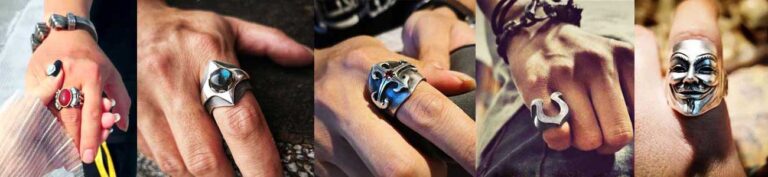
Which hand should men wear a silver ring on? Either hand can work. Choose the hand that creates the focal point you want, then compare it with your watch, bracelet, other rings, sleeves, and the way the whole outfit is visually balanced. There is no universal left-hand or right-hand rule for style, and this guide does not assign luck, personality, relationship status, culture, or promised outcomes to either side.
The useful question is not “Which hand is correct?” but “Where should the ring be noticed?” A ring on an otherwise bare hand becomes a clear single accent. A ring beside a watch or bracelet forms a concentrated accessory zone. Splitting a ring and wrist accessory between opposite hands distributes the visual weight. Each arrangement can look deliberate when the placement matches the rest of the outfit.
Quick answer: choose the focal side first
Start by looking at both hands without jewelry. Decide whether you want one hand to carry most of the metal detail or whether you want the details spread across both sides. If one wrist already has a watch, placing the ring on that side creates a stronger cluster. Placing it on the opposite hand creates separation and gives the ring its own space.
Personal preference is enough reason to choose either side. Hand choice does not establish a universal meaning. If you want information about finger-specific associations, use the separate men’s ring finger meaning guide; this page stays focused on observable placement and visual balance.
Left hand versus right hand: a visual decision table
| Starting situation | Placement to test | What to observe |
|---|---|---|
| Watch or bracelet on one wrist | Ring on the same side | A concentrated accessory zone with more metal detail in one area |
| Watch or bracelet on one wrist | Ring on the opposite side | Visual weight distributed between the two hands |
| Both wrists are bare | Ring on either hand | A single focal point determined mostly by ring scale and motif |
| Rings already occupy one hand | Add to that hand | A deliberate cluster that needs spacing between silhouettes |
| Rings already occupy one hand | Use the other hand | A wider composition with separate focal zones |
This table is a comparison tool, not a set of rules. Try both arrangements with the same clothes and lighting. The stronger option is the one that makes the intended focal point easy to read without forcing every accessory into competition.
Balance a ring with a watch or bracelet
A watch usually creates a compact block of shape, shine, and strap texture. A bracelet can create a continuous line around the wrist. A silver ring placed on the same side visually connects with that wrist detail, especially when the ring has a broad top or high-contrast motif. The result is concentrated rather than automatically excessive; the final impression depends on scale, spacing, sleeves, and the number of other accessories.
Moving the ring to the opposite hand breaks that block into two zones. This can help a large ring stand on its own while the watch remains a separate anchor. For the narrower question of whether both accessory types should share one side, use the ring-and-bracelet same-hand guide. That protected sibling owns the pairing decision; this owner only helps choose the ring hand.
Use the hand that shows the intended focal point
Notice which hand is most visible in the situations where you plan to wear the ring. This is an observation about presentation, not a prescription about dominant-hand use, work, exercise, or safety. A hand may appear more often when holding a bag, resting on a table, using a phone, or gesturing during conversation. If that visibility supports the look you want, it can guide the choice.
Then repeat the observation with the other hand. A ring that feels too prominent in one position may become a quieter accent on the other. Conversely, a detailed motif may need the more visible side to register as the intended focal point. Take a front-facing photo of both versions rather than relying only on a close-up view.
Let ring scale influence placement
A broad ring top creates more visible surface area than a narrow band. A raised skull, wing, mouth, or geometric face also produces a stronger outline than a plain low-profile band. These are visual observations only. They do not prove fit, comfort, finger clearance, durability, or suitability for a particular activity.
If the ring is visually dominant, begin with one ring on one hand and keep the opposite side simple. If the ring has a compact outline, it can share attention more easily with a watch, cuff, or another ring. Browse the men’s silver ring collection to compare silhouettes, then use the dedicated skull ring size guide for sizing navigation rather than treating appearance as fit evidence.
Keep finger choice separate from hand choice
Hand choice determines the side of the composition. Finger choice changes spacing, symmetry, and how close the ring sits to neighboring fingers. Those are related decisions, but they are not the same decision. First choose left or right by visual balance. Then compare the ring on the available fingers on that hand.
Do not infer a universal message from the placement. Personal, cultural, religious, relationship, and family meanings vary and require their own evidence. This low-risk styling guide does not replace those contexts. For measurement and fit information, use the men’s ring size and fit Research guide.
Coordinate the ring with sleeves and outfit structure
Sleeves change how much of each hand and wrist remains visible. A short sleeve exposes the ring and wrist accessory together. A jacket or overshirt may reveal the ring while partly covering the watch or bracelet. A long cuff can make the hand jewelry the clearest metal detail in the composition.
Look at contrast as well as exposure. Silver stands out strongly against black, charcoal, navy, and saturated colors, while it may blend more softly with pale gray or reflective hardware. The broad men’s jewelry styling guide covers overall coordination. A current British GQ men’s-ring guide can provide general category context, but it does not prove that either hand is correct for a MENSSKULL ring or wearer.
Choose concentration or distribution
Concentration means placing the ring near the watch, bracelet, or other rings so one side carries most of the accessory detail. Distribution means separating those pieces across the body. Neither approach is inherently better. Concentration can create a decisive focal zone; distribution can make each piece easier to distinguish.
Use a simple test: squint at a full-length mirror or reduce a photo to thumbnail size. If one side appears much heavier than intended, move the ring or remove another element. If the accessories disappear into the outfit, increase contrast by isolating the ring on the barer hand. This test evaluates composition only.
Compare current ring profiles without turning them into rules
Current product pages can show how different visible profiles affect hand prominence. The item-specific dimensions and weights below are listing facts captured for comparison. They do not establish comfort, fit, quality, durability, ideal placement, or suitability for every wearer.
| Current example | Listed profile | Placement question to test |
|---|---|---|
| Handlebar Mustache Skull Ring | 33 by 20 mm top; 23 g listed weight | Does the tall sculpted face read better as the only focal ring or beside a wrist accessory? |
| Winged Male Skull Ring | 29 by 21 mm top; 25 g listed weight | Does the winged horizontal outline balance the chosen sleeve and watch side? |
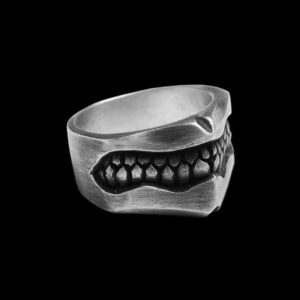
| Teeth Ring for Men | 23 by 14 mm top; approximately 24–35 g depending on ring size | Does the narrower outline work as a separate accent or within a multi-ring arrangement? |
These examples do not prove that one hand, finger, motif, or product is universally correct, fashionable, comfortable, safe, or meaningful. They are visual references for comparing outline, scale, and focal strength.
Plan a multi-ring arrangement one side at a time
When wearing more than one ring, build the arrangement in stages. Place the strongest ring first. Add a second ring only after checking the space between silhouettes and the relationship to the opposite hand. Rings do not need to mirror each other. Asymmetry can look deliberate when one ring clearly leads and the others support it.
Avoid making every finger a separate focal point. Repeated large motifs can merge into one dense shape from normal viewing distance. If that is not the intention, move one ring to the other hand or replace it with a quieter outline. For more arrangement ideas, see the skull ring styling guide.
Use photos instead of imagined hand rules
Take four quick photos: ring on the left hand, ring on the right hand, same-side with a watch or bracelet, and opposite-side from the wrist accessory. Keep the camera distance, clothes, and lighting consistent. Compare the full outfit first, then the hand area.
The full-outfit view shows whether the ring supports the jacket, shirt, belt hardware, and other jewelry. The closer view shows spacing and motif direction. If the two views suggest different answers, prioritize the context in which the ring will normally be seen. This process stays grounded in observable appearance rather than invented rules.
Common placement mistakes
- Starting with luck claims: neither hand guarantees luck, wealth, attraction, confidence, protection, or any other outcome.
- Treating culture as universal: hand and finger meanings vary; route that question to the appropriate meaning owner.
- Ignoring the wrist: a watch or bracelet changes the visual weight of the entire side.
- Judging only a close-up: a ring can look balanced on the hand but overly dense in the full outfit.
- Using appearance as fit evidence: visible scale does not establish sizing, comfort, safety, or activity suitability.
- Adding every accessory at once: place the lead ring first, then add supporting pieces deliberately.
A practical hand-placement checklist
- Choose whether you want one concentrated accessory side or two distributed focal zones.
- Place the ring on the same side as the watch or bracelet, then photograph the full outfit.
- Move the ring to the opposite hand and repeat the photo from the same distance.
- Compare ring scale, motif direction, sleeve exposure, hardware, and overall visual weight.
- Choose the hand that makes the intended focal point clearer.
- Use the separate Research and sizing owners for measurement and fit decisions.
Final answer
Men can wear a silver ring on either the left or right hand. The better styling choice is the hand that creates the intended focal point and balances the watch, bracelet, other rings, sleeves, and outfit. Test both sides in the same clothes, compare a full-outfit photo, and keep hand placement separate from claims about luck, culture, fit, safety, materials, or outcomes.
If both sides look equally balanced, choose the one you simply prefer and keep the arrangement consistent long enough to judge it in normal outfits. A placement does not need a hidden explanation to be valid. The practical evidence is visible: where the ring appears, how strongly its outline contrasts with the clothes, whether nearby accessories remain distinct, and whether the total composition matches the focal point you intended.





MENSSKULL Journal Notes
Leave a field note
Share fit notes, styling ideas, care questions, or your experience with MENSSKULL silver jewelry.
Comments are checked before publication so buyers can read useful fit, symbolism, care, and style notes without spam noise.
The simple plus/minus challenge below helps block automated spam while keeping the experience lightweight.
Continue exploring
More MENSSKULL stories
Handcrafted silver
Shop the pieces behind the stories