
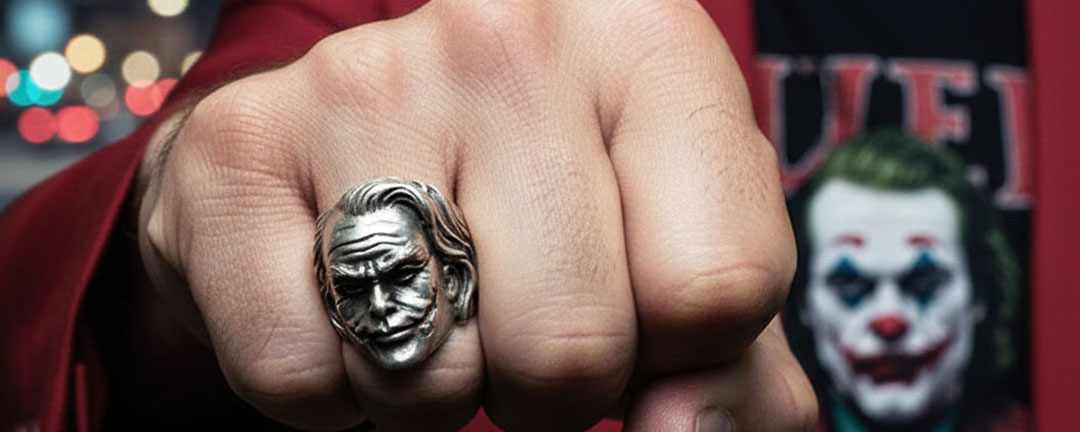
Quick answer: there is no universal number of rings every man should wear. Start with one ring, judge its visual weight against the hand and outfit, and add a second or third only when each piece still has a clear role. One large sculptural ring can look more dominant than three narrow bands, so scale, spacing and placement matter more than the raw count.
This guide is about observable styling choices. It does not assign confidence, masculinity, attraction, status or cultural meaning to a ring count. For measurement and sizing, use the dedicated men’s ring size and fit Research guide. For symbolic finger associations, use the separate men’s ring finger meaning guide.
How many rings should a man wear?
For a clean starting point, wear one ring. For a visibly styled hand, try two rings with different jobs: one anchor and one quieter supporting band. Three rings can work when the pieces are spaced well and the outfit can carry a stronger hand-level detail. Four or more becomes an intentional stacked or maximal arrangement and should be judged as a complete composition rather than as separate purchases.
The important question is not whether one, two or three is objectively correct. Ask whether the rings create a readable order. The eye should be able to identify the lead piece, move to the supporting piece and still see open space between the strongest shapes. When every ring competes for attention, removing one often improves the arrangement more than adding another.
| Ring count | Visual direction | Useful starting arrangement | What to check |
|---|---|---|---|
| One | Focused and easy to read | One signet, band or sculptural ring | Scale against the hand and outfit |
| Two | Balanced with a clear lead | One anchor plus one quieter ring | Spacing, repeated finish and hand distribution |
| Three | Deliberately styled | Two on one hand and one on the other, or a controlled stack | Visual hierarchy and open fingers |
| Four or more | Layered or maximal | A planned system of anchor, support and background bands | Competing motifs, repeated scale and outfit density |
Count visual weight, not just rings
A narrow plain band occupies less visual space than a tall skull ring, broad signet or wide hammered band. That means two arrangements with the same number of rings can look completely different. Treat width, face height, relief, contrast and motif density as parts of the count.
A useful mental model is to assign each ring a role. The anchor is the first piece the eye notices. A support ring repeats one element from the anchor, such as finish temperature, edge shape or surface rhythm, without matching every detail. A background band adds a small amount of metal and should not create a second dominant focal point.
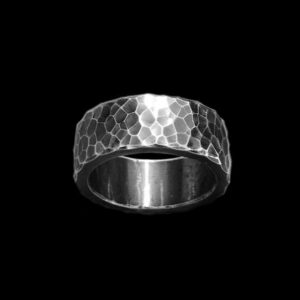
For example, the current Helmeted Biker Skull Ring is a sculptural design with a large visible face, while the current Hammered Wide Band Pinky Ring uses a broad textured band. Both are visually substantial even though their outlines differ. Their product pages are commercial examples of scale, not proof of an ideal ring count or a preferred material.
Choose one anchor ring first
Build the hand around one anchor. This can be a signet, a sculptural motif, a broad band or another ring with a clearly visible face. Put it on the finger where its outline is easiest to read, then look at the hand from normal conversational distance rather than only in a close-up product view.
If the anchor already fills much of the visible hand, the next ring should usually be quieter. If the anchor is slim and low-contrast, a second ring can carry more texture or a different shape. The skull ring styles guide compares design families, while the skull signet ring collection provides a commercial route for signet-like silhouettes.
Do not buy several statement rings first and hope they will form a set later. Start with the strongest piece, photograph it with the intended jacket, shirt or knitwear, and identify what the hand still needs. The answer may be a narrow supporting ring, a quieter opposite hand or no additional ring at all.
One ring: the clearest starting point
One ring gives its outline room to work. It is useful when the ring is large, the outfit already contains several metal details or the wearer wants a single repeatable accessory. A solitary ring can be visually quiet or strongly expressive depending on its width, face and finish.
With one ring, pay close attention to proportion. A small band can disappear beside a heavy watch, wide cuff or detailed jacket hardware. A large ring can become the lead accessory even when the rest of the outfit is simple. Neither outcome is wrong; the goal is to choose the role deliberately.
If the ring has a directional face, check the orientation separately from the count. The skull ring direction guide explains how to compare the view from the wearer and the view presented outward without assigning a universal rule.
Two rings: anchor and support
Two rings are easiest to organize when they do not demand equal attention. Place the anchor first, then test a support ring that shares one visual connection. The connection might be both rings using dark recesses, both having angular edges, or both presenting a similar metal temperature. They do not need identical motifs.
You can distribute the pair across both hands or place them on one hand with an open finger between them. Across two hands, the arrangement often reads as broad balance. On one hand, the pair reads as a more concentrated styling choice. Take front and three-quarter photographs because the spacing visible from above can change when the hand turns.
If a bracelet is part of the outfit, the ring and bracelet on the same hand guide owns that separate coordination decision. Ring count should not be used as a shortcut for wrist-level balance.
Three rings: create a hierarchy
Three rings need a stronger plan because the eye begins to compare groups. One reliable arrangement is an anchor on one hand and two quieter rings on the other. Another is a two-ring stack plus a single ring on a separated finger. In both cases, one element should remain dominant.
Avoid making all three rings equally wide, equally dark and equally detailed unless a dense repeated pattern is the specific goal. Variation creates hierarchy. A broad anchor can work with two smaller shapes; a narrow anchor with a distinctive face can work with smooth supporting bands. Keep at least one area of open visual space so the hand does not become one uninterrupted block of metal.
Three also makes outfit context more important. A simple shirt or monochrome knit leaves more room for ring detail. A jacket with large zips, badges, chains or contrast hardware already has several focal points, so three elaborate rings may compete with the clothing rather than complete it.
Four or more: treat the hand as a composition
Four or more rings can be coherent, but the arrangement should be planned as a system. Decide which rings form a stack, which ring is the main face and which bands provide rhythm. Repetition becomes more useful at this count: two similar narrow bands can create continuity while one sculptural ring provides contrast.
Look for accidental clusters. Several large faces placed on adjacent fingers can merge into one dense area. Moving one ring to the opposite hand or replacing one face ring with a lower band can restore separation. Also compare the whole arrangement with the sleeves and any watch or bracelet. More hand detail may call for less detail nearby.
Maximal styling is not a permission to ignore order. It simply uses more elements. The same anchor, support and background roles still apply; they are repeated across a larger composition.
Balance rings across both hands
Symmetry is one option, not a requirement. One ring on each hand creates a straightforward two-point balance. Two rings on one hand and one on the other creates asymmetry while still distributing the visual weight. A fully decorated hand beside an empty hand creates a strong directional emphasis.
Compare hands while standing naturally. A watch, bracelet, visible cuff, sleeve roll or hand-held object can change the apparent balance. If one wrist already carries a strong accessory, a single ring on that side may be enough while the other hand carries the second and third rings.
Do not force both hands to contain the same number. Instead, compare total visible mass. One large ring can balance two narrow bands on the opposite hand. This is why counting shapes alone gives an incomplete answer.
Use spacing to keep each ring readable
Spacing can be physical, visual or both. An open finger between two rings creates obvious separation. Rings on adjacent fingers can still read separately when their faces point in different directions or their heights and widths differ. A stack on one finger needs contrast between the bands so it does not appear as an accidental single block.
Start by placing the anchor, then add the next ring to the least crowded zone. If the second ring makes the anchor harder to identify, move it before changing the entire set. If the arrangement remains dense from several angles, remove the least distinctive piece.
For pinky-specific proportion and styling, use the men’s pinky ring guide. This page keeps its focus on overall count and hierarchy rather than re-owning pinky-ring selection.
Match ring count to outfit density
Outfit density describes how many visual details already compete for attention. Plain knitwear, a solid shirt or a simple jacket creates an open background. Multiple pockets, patches, bold prints, prominent zips, chains and layered cuffs create a busy background. The ring arrangement should be judged within that field.
A simple outfit can support one large ring or a controlled group of several rings because the hand detail has room to register. With a highly detailed outfit, fewer rings or quieter bands often make the arrangement easier to read. This is a visual choice, not an etiquette rule.
The broader men’s jewelry styling guide covers coordination across jewelry categories. Use it when the decision includes necklaces, bracelets or multiple accessory zones rather than ring count alone.
Adjust the count for the setting without inventing rules
Different settings place different visual demands on an outfit. A formal outfit may call for fewer competing focal points. A casual monochrome outfit may leave more room for an expressive ring group. A creative or event look may intentionally use several rings as a central styling feature.
There is no universal workplace or occasion count. Dress codes vary, and this article does not provide occupational or safety guidance. The useful styling question is whether the rings support the outfit’s intended level of detail. If uncertain, begin with the anchor ring and carry the optional support ring rather than committing to the full arrangement immediately.
September 2026 editorial coverage illustrates the current breadth of men’s ring options rather than a required count. British GQ’s 23 September ring guide includes slim, signet and statement forms, while JCK’s 21 September men’s jewelry coverage discusses wider category activity. These sources establish dated variety only; they do not prove that a particular count is ideal for MENSSKULL buyers.
Compare arrangements before buying another ring
Use the rings you already own to test the composition. Photograph one-ring, two-ring and three-ring versions in the same lighting and with the same outfit. Keep the hand relaxed and frame the image from normal viewing distance. Close-up photographs are useful for detail but can exaggerate the importance of every ring.
| Comparison step | Keep constant | Change one variable | Decision question |
|---|---|---|---|
| 1. Establish the anchor | Outfit and hand position | Anchor ring only | Is the ring visible at normal distance? |
| 2. Test support | Anchor and outfit | Add one quieter ring | Does the anchor remain clear? |
| 3. Test distribution | The same two rings | Move one to the other hand | Which arrangement balances the wrists and sleeves? |
| 4. Test a third piece | Anchor and support | Add one band or small face | Does the hand still have open visual space? |
| 5. Remove one | Outfit and camera angle | Take away the weakest piece | Is the result clearer or merely quieter? |
Record which ring and finger changed between photographs. Comparing several variables at once makes it difficult to know whether the improvement came from count, placement, scale or motif. A one-variable test produces a more useful buying decision.
Keep product and material facts item-specific
Do not assume every ring in a coordinated set uses the same material because the colors look similar. Read each live product record. The Helmeted Biker Skull Ring currently lists 925 sterling silver. The Hammered Wide Band Pinky Ring currently uses a separate 999 Silver label. Those descriptions must remain attached to the individual listings and should not be generalized across the ring category.
Material terminology does not determine the number of rings to wear. This guide does not claim that a listed material is safer, stronger, more comfortable, more durable or better suited to stacking. For current browsing, use the men’s silver rings category; treat it as commercial navigation, not proof of popularity or universal suitability.
Common ring-count mistakes
Counting pieces but ignoring scale. A large face ring can carry more visual weight than several slim bands.
Making every ring the anchor. When every piece has a large motif or strong contrast, the hand loses hierarchy.
Buying a matching set before testing placement. Similar rings can still crowd one another when their widths and face heights are too close.
Copying a photograph without matching the outfit. Sleeve shape, watch size, garment hardware and camera crop all affect the result.
Using finger symbolism to decide the count. Symbolic associations and overall visual balance are separate questions. Route meaning questions to the finger-meaning owner.
Assuming more rings create more personality. Style is visible in selection and arrangement, not in a guaranteed outcome or fixed number.
Treating a 2026 roundup as a universal rule. Current editorial coverage shows available variety. It does not establish an ideal count, demand level or status effect.
A practical six-step ring-count workflow
- Choose the anchor. Select the ring that should lead the hand-level composition.
- Check its scale. View it with the intended outfit from front and three-quarter angles.
- Add one support ring. Repeat one visual element without creating a second equal focal point.
- Test both hands. Move the support ring and compare total visible weight, including any watch or bracelet.
- Add a third only if needed. Use it to fill a clear visual gap, not simply to increase the count.
- Verify the live listing. Before ordering, confirm the exact product, selected size, listed material, current price and availability.
If the hand still looks crowded, return to one anchor and one support ring. If it looks disconnected, repeat a finish, edge shape or motif rhythm rather than automatically adding another large ring. The best count is the smallest arrangement that produces the intended visual structure.
Final checklist
- One ring has been identified as the anchor.
- The number is judged by visual weight, not count alone.
- Supporting rings remain quieter than the lead piece.
- Spacing keeps the strongest shapes readable.
- Both hands, sleeves, watch and bracelet have been considered.
- The arrangement has been photographed at normal viewing distance.
- Finger meaning and measurement details are routed to their dedicated owners.
- Every product’s material and option wording remains item-specific.
For most buyers, one ring is the clearest start, two rings create a flexible styled arrangement, and three rings require a deliberate hierarchy. Four or more can work as an intentional maximal composition. The deciding factors are scale, spacing, hand balance and outfit context, not a universal rule about how many rings a man should wear.




MENSSKULL Journal Notes
Leave a field note
Share fit notes, styling ideas, care questions, or your experience with MENSSKULL silver jewelry.
Comments are checked before publication so buyers can read useful fit, symbolism, care, and style notes without spam noise.
The simple plus/minus challenge below helps block automated spam while keeping the experience lightweight.
Continue exploring
More MENSSKULL stories
Handcrafted silver
Shop the pieces behind the stories