
Answer first: the most useful way to compare skull ring styles is to look at five visible decisions in order: silhouette, jaw treatment, viewing angle, character detail, and sculptural relief. Silhouette determines what the ring reads like from a distance. The jaw changes its vertical length and expression. A frontal or profile view changes how much of the design is visible from different angles. Character details make the skull specific rather than neutral. Relief determines how far the design projects from the finger and how strongly light and shadow define it.
Start with the shape you want people to recognize, then check the listed face dimensions, weight, ring-size range, and side profile. That sequence is more reliable than choosing from a dramatic close-up alone. A compact mouth motif can have stronger contrast than a larger full skull, while a tall full-jaw design can appear more architectural even when both rings use the same listed material.
Skull Ring Styles at a Glance
| Style family | What you can see | Primary decision | Check before choosing |
|---|---|---|---|
| Full skull with jaw | Complete forehead, sockets, cheekbones, teeth, and lower jaw | Maximum vertical skull silhouette | Face height, projection, neighboring-finger clearance |
| Jawless skull | Cranium and upper teeth without a long lower jaw | Shorter, more compact face | How the lower edge meets the shank |
| Profile or angled skull | One side of the skull is emphasized | Strong side-view identity | Which direction the profile faces and how it reads from above |
| Character skull | Mustache, wings, eyewear, headwear, or another defining cue | A specific visual persona | Whether the added detail stays legible at actual size |
| Mouth or teeth motif | Teeth, lips, or jaw dominate while the full cranium is reduced or absent | Graphic contrast in a shorter form | Width, tooth relief, and edge shape |
| Low-relief skull | Shallow carving or engraving close to the band | Less projection and a quieter surface | Depth of recesses and visibility in ordinary light |
| High-relief sculptural skull | Raised brow, nose, cheekbones, or jaw cast strong shadows | Three-dimensional presence | Highest point, side profile, weight, and snag-prone edges |
These families overlap. A ring can be a full-jaw, angled, high-relief character skull at the same time. The point of the taxonomy is not to force every design into one label. It is to separate the decisions so you can identify which feature is doing most of the visual work.
1. Begin With the Outer Silhouette
Silhouette is the boundary you would see if the detailed surface became a solid shape. It is the fastest way to tell whether a ring will read as tall, wide, compact, oval, angular, or winged. Product photography often highlights eye sockets and polished surfaces, but the outer boundary controls the first impression from normal viewing distance.
Tall and vertical silhouettes
A full forehead and lower jaw usually create a long face. That can make the ring look architectural, especially when the jaw narrows toward the band. The useful measurement is not simply “large” or “small.” Look for face height and compare it with the length of the finger section where the ring will sit. If the listing gives two face dimensions, confirm which is height and which is width rather than assuming their order.
Wide silhouettes
Wings, extended cheekbones, side ornaments, or a broad temple can make width more important than height. A wide design may be visible across the hand without extending as far toward the knuckle. Check whether the widest point is centered over the band or extends asymmetrically. Centering changes how balanced the ring appears when the hand turns.
Compact silhouettes
Jawless skulls, reduced faces, and mouth-focused designs can keep the visual mass close to the band. Compact does not automatically mean subtle: deep recesses and polished teeth can create strong contrast within a smaller outline. Choose this direction when you want skull recognition to come from concentrated detail rather than overall height.
A practical test is to cover the interior of a product image with your hand and look only at the border. If the outline still matches what you want, the design has the right silhouette. If you are choosing only because of an enlarged detail inside the face, check a full-hand or side-view image before deciding.
2. Decide How Much Jaw You Want
The jaw is not a minor decoration. It changes the ring’s proportions, the amount of tooth detail, and the way the lower part of the face meets the shank. Compare three broad treatments: full jaw, shortened or open jaw, and no lower jaw.
Full-jaw skull rings
A complete jaw creates the clearest head-like structure. It can support rows of teeth, a pointed chin, or an open-mouth cavity. Because the lower section adds length, examine how close it sits to the base of the finger. A product’s face height is more informative than a label such as “statement ring.” Also inspect side photos for the transition between chin and band; a smooth transition reads differently from a jaw that projects as a separate form.
Open or shortened jaws
An open mouth puts more visual space between the upper and lower teeth. A shortened jaw keeps some tooth structure while reducing the long chin shape. Both use negative space and oxidized recesses to create expression. In a small photo those cavities may look larger than they are, so use listed dimensions and a hand-scale image when available.
Jawless skulls
Removing the lower jaw concentrates attention on the cranium, sockets, and upper teeth. The bottom edge may end in a straight tooth line, taper into the band, or curve around the finger. This family can look more compact from the front, but projection still depends on relief. A jawless skull with a highly raised brow can stand farther from the finger than a flatter full-face design.
If you are comparing rings with similar material and width, the jaw decision often explains why one looks longer or more expressive. It also helps prevent keyword labels from replacing observation: two listings may both say “skull ring” while presenting very different lower-face structures.
3. Compare Frontal, Angled, and Profile Views
A frontal skull presents both eye sockets and both sides of the jaw. It is usually easiest to recognize when the back of the hand faces the viewer. An angled skull creates depth by making one cheek, temple, or eye socket more prominent. A profile design emphasizes the forehead, nose, mouth, and jaw as a side silhouette.
There is no universally better angle. Choose according to where you want the design to read. A frontal face provides symmetry from above. A profile can reveal more character when viewed from the side, but it may look abstract from the opposite angle. An angled face sits between those two, offering a recognizable skull with a directional pose.
Before buying a directional design, verify three images if the gallery supplies them: straight overhead, outer side, and inner side. That reveals whether the ring is intentionally asymmetric and which side carries the main detail. Do not infer that a mirrored version is selectable unless the product options explicitly show one.
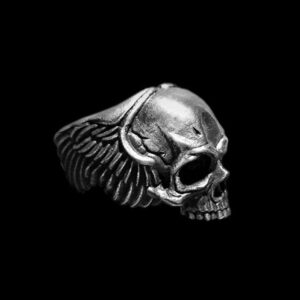
The existing Winged Male Skull Ring guide is a useful example of a frontal skull combined with a broader winged silhouette. It remains a product-specific guide; this page uses it only to illustrate how angle and silhouette work as separate choices.
4. Use Character Details to Narrow the Choice
Character skulls add one or more identifying features to the basic anatomy. Common visible cues include facial hair, wings, helmets, crowns, eyewear, flames, mechanical elements, or stylized surface marks. The best character detail is not necessarily the most complex one. It is the detail that remains understandable at the ring’s actual dimensions.
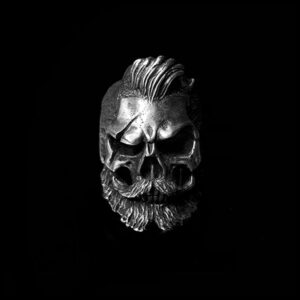
Ask three questions. First, can you identify the added feature without reading the title? Second, does it change the outer silhouette or only the surface? Third, is it visible from the angle in which you will usually see the ring? A mustache across the front of the mouth works differently from wings extending past both temples. One changes the face; the other changes the whole outline.
The Handlebar Mustache Skull Ring guide shows this distinction clearly. Current product data for product 2727 lists a 33 x 20 mm face, 23 g weight, and 925 sterling silver. The mustache and long face provide the character cue; the listed measurements provide the scale reference. Those are observable and seller-listed facts, not claims about what the motif must mean to the wearer.
Character details also affect styling. A ring with one dominant cue can serve as the focal object on the hand. Combining several highly detailed rings can make each silhouette harder to read. If you plan to stack or wear neighboring rings, compare their outer edges and visual density rather than matching keywords alone.
5. Judge Sculptural Relief From the Side
Relief describes how far the carved or modeled surface rises above its background. On a ring, low relief stays close to the band, medium relief creates defined sockets and cheekbones without a fully sculptural head, and high relief forms a pronounced three-dimensional face.
Front photography cannot show projection reliably because lighting can make shallow recesses look deep. A side image is essential for high-relief designs. Look for the highest point, usually the forehead, brow, nose, or jaw. Then see how gradually that point returns to the shank. A gradual shoulder can look integrated; an abrupt raised form can look more like a miniature sculpture mounted on a band.
Projection affects more than visual drama. It changes how the ring occupies space near pockets, gloves, adjacent fingers, and other jewelry. This is a fit-and-use consideration, not a promise that one style will be comfortable for everyone. Hand shape, ring size, band shape, activity, and personal tolerance all matter. Use the product’s side view and listed dimensions instead of relying on a universal “everyday” label.
Surface contrast is related but different. Darkened recesses can make a low-relief design highly legible, while a uniformly polished high-relief form may appear smoother. Evaluate depth and finish separately: relief is shape; contrast is how that shape is visually separated.
6. Compare Face Size, Weight, and Band as One System
Face dimensions tell you the visible footprint. Weight tells you how much material the listing attributes to the ring or selected size. The shank tells you how that mass meets the finger. None of these numbers should be treated alone.
Face dimensions
Use millimeters to compare one product with another. A 29 x 21 mm face and a 33 x 20 mm face are close in width but differ in height. That difference can be visually significant on a finger. If a listing does not define dimension order, use the gallery and ask for confirmation rather than silently assigning height and width.
Listed weight
Weight may be a single reference or a range that changes by ring size. A larger size can require more material, and sculptural construction can distribute the same weight differently. Weight does not prove comfort, solidity, or durability by itself. It is a comparison input that becomes useful when paired with face size, projection, and band construction.
Band and shoulders
The shoulders connect the design face to the shank. Broad shoulders can visually continue the skull or support side decoration. Narrow shoulders can make the face appear more isolated. Inspect the underside and inner band when those images are available. Confirm the selectable ring size on the live product page rather than assuming every size in a general chart is available for every design.
For sizing technique, use the dedicated skull ring size guide. This design guide owns the style-comparison decision, while the sizing guide owns measurement procedure. Keeping those intents separate avoids turning a visual taxonomy into an unreliable fit calculator.
Three Verified MENSSKULL Examples
The following products illustrate different parts of the framework. They are examples, not a ranking, and no price, stock level, review performance, popularity, or bestseller claim is used.
Winged Male Skull Ring: broad silhouette plus full face
Product 2349, SKU SSJ161, is listed as a Winged Male Skull Ring in 925 silver. Current product attributes list a 29 x 21 mm face and 25 g reference weight. The skull supplies the central face while the wings broaden the outer silhouette. This makes it useful for separating “what is on the face” from “what defines the ring’s overall boundary.”
Choose this visual direction when a centered skull is important but you also want lateral detail extending beyond the temples. Check the gallery for the wing edges, the transition into the shoulders, and the side height of the forehead before using the dimensions as your final comparison.
Handlebar Mustache Skull Ring: a character-led long face
Product 2727, SKU SSJ295, is the Handlebar Mustache Skull Ring. Its current attributes list 925 sterling silver, 33 x 20 mm, and 23 g. The mustache creates a specific character cue across the front while the tall face and jaw establish the larger proportion.
This example shows why character and silhouette should be evaluated separately. A buyer might first notice the mustache, but the 33 mm listed dimension and elongated jaw determine how much vertical space the design occupies. Use both observations instead of choosing from the character keyword alone.
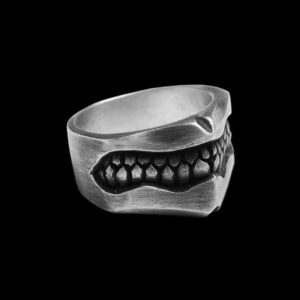
Teeth Ring: mouth-led contrast in a shorter face
Product 6862, SKU SSJ233, is the Teeth Ring for Men. Current product attributes list 925 silver, a 23 x 14 mm face, and an approximate 24-35 g range depending on ring size. Its mouth-and-teeth direction places the lower facial feature at the center of the composition rather than building the entire design around a complete cranium.
The dedicated Teeth Ring guide covers that product in detail. Within this comparison hub, the ring demonstrates how a compact visible footprint can still produce strong contrast through repeated teeth and recessed spaces. The listed weight range also shows why face size and weight should not be treated as interchangeable measures.
Material Is a Separate Decision From Style
“Skull” describes the design subject; “925 sterling silver” describes a material fineness claim. One does not prove the other. The U.S. Federal Trade Commission’s Jewelry Guides provide guidance about accurate precious-metal representations in marketing. For a buyer, the practical rule is to verify the material stated on the specific product rather than assuming every skull ring uses the same metal.
All three examples above currently list 925 silver or 925 sterling silver in their product attributes. That fact supports their use as silver-ring examples, but it does not make their silhouettes, relief, or dimensions equivalent. Compare material, design, and fit as separate columns in your decision.
A Five-Step Skull Ring Selection Method
- Name the silhouette. Decide whether you want tall, wide, compact, symmetrical, or directional before studying small details.
- Choose the jaw treatment. Compare full jaw, open or shortened jaw, jawless face, or mouth-only motif.
- Check viewing angle and relief. Use front and side images to identify profile direction and the highest projected point.
- Verify stable facts. Record the exact product’s listed face dimensions, weight reference, material, and selectable ring sizes.
- Compare with your real use. Consider neighboring fingers, other rings, gloves, pockets, and how prominent you want the design to appear.
This method prevents one attractive photograph from carrying the entire decision. It also gives you a repeatable way to compare products that use different names. If two rings both appear under a broad skull-ring category, the five steps reveal whether they actually share the same outline, jaw, angle, character, and relief.
Common Comparison Mistakes
Using “large” as if it were a measurement
Large can refer to face height, width, weight, or visual contrast. Replace the adjective with the listed millimeters and weight reference. If a dimension is unclear, do not convert it into a precise claim.
Judging relief from the front image
Directional lighting exaggerates cavities and highlights. Use a side photo to locate the highest point and understand how the design rises from the shank.
Assuming all skulls have the same expression
Jaw position, brow angle, teeth spacing, and asymmetry change the visible expression. Describe what is present instead of treating “skull” as one uniform style.
Confusing symbolism with product fact
A buyer may attach a personal meaning to a skull, but that does not make the meaning universal. Keep visible product facts separate from historical or cultural interpretation, and use the Research Library for source-governed context.
Ignoring the band
The face gets most of the photography, but the shoulders and shank determine how the design meets the finger. Check underside and side images, current size options, and the transition from face to band.
Skull Ring Styles FAQ
What is the easiest skull ring style to recognize from a distance?
A clear outer silhouette is more important than tiny surface detail. A full frontal skull, a broad winged outline, or a high-contrast jaw can read quickly, but recognition depends on actual face size, contrast, and viewing angle. Compare the full-ring image rather than only a macro photograph.
Is a full-jaw skull ring always larger than a jawless skull ring?
No. A full jaw often adds vertical length, but a jawless design can still be wider, heavier, or more highly projected. Use the listed face dimensions, weight reference, and side profile for the specific products being compared.
What is the difference between a profile skull and an angled skull?
A profile emphasizes the side outline of the forehead, nose, mouth, and jaw. An angled skull shows part of both the front and side, usually making one eye socket or cheek more prominent. Gallery views should confirm which direction the design faces.
Does a heavier skull ring have more visual presence?
Not necessarily. Weight is only one input. Face dimensions, relief, polish, darkened recesses, and silhouette can make a lighter or smaller ring visually stronger. Weight also may vary by ring size, so use the listing’s exact wording.
How can I tell whether a skull ring will project far from my finger?
Look for a true side-view image and identify the highest point above the shank. Face dimensions alone do not reveal projection. If the gallery does not show the side clearly, request confirmation rather than estimating from the front view.
Should I choose a skull ring by meaning or by design?
For the physical purchase, begin with observable design, dimensions, material, and fit. Personal meaning can guide your preference, but it is individual. Historical or cultural claims should come from traceable sources rather than a product title or assumed universal symbolism.
Final Decision
Choose a skull ring by identifying the feature you want to dominate. Select a full-jaw design for a long complete face, a jawless skull for a shorter cranium-led form, a profile for directional side-view identity, a character skull for one recognizable cue, or a teeth motif for concentrated mouth contrast. Then verify relief, dimensions, weight wording, material, band construction, and current size options on the exact product.
The best comparison is not “which skull ring is most detailed?” It is “which combination of silhouette, jaw, angle, character, and relief matches the scale and viewing direction I want?” That question turns a crowded category into a manageable, evidence-based choice.






MENSSKULL Journal Notes
Leave a field note
Share fit notes, styling ideas, care questions, or your experience with MENSSKULL silver jewelry.
Comments are checked before publication so buyers can read useful fit, symbolism, care, and style notes without spam noise.
The simple plus/minus challenge below helps block automated spam while keeping the experience lightweight.
Continue exploring
More MENSSKULL stories
Handcrafted silver
Shop the pieces behind the stories