
Short answer: a key necklace can be a suitable gift for your girlfriend when it matches choices she already makes: wearing necklaces, choosing a similar pendant scale, preferring the same finish, and enjoying personalized details. It is a weaker choice when those signals are missing. The practical goal is not to predict her reaction. It is to reduce guesswork with observable evidence.
Start with what she already wears
Before comparing products, look at the jewelry she chooses without prompting. Does she wear necklaces regularly, occasionally, or almost never? When she does, are the pieces small and quiet, graphic and prominent, or built around a personalized detail? A gift is easier to choose when it continues an established pattern rather than introducing several unfamiliar decisions at once.
Use recent, ordinary outfits as evidence. A necklace worn to work, on weekends, or in casual photographs says more about current preference than an abstract statement about liking jewelry. If she rotates several necklaces, note what stays consistent across them: pendant scale, finish, amount of detail, or whether there is any personalization.
If you have no useful evidence, treat that uncertainty as a decision result. You can ask a neutral question, involve someone who knows her style, choose a gift category with fewer assumptions, or select an option with a clearly documented exchange process. This article does not predict whether any recipient will like, wear, or keep a necklace.
Use a five-signal gift check
| Signal to check | Evidence you can observe | What it helps decide |
|---|---|---|
| Necklace habit | She already wears necklaces in normal settings | Whether the category itself is familiar |
| Pendant scale | Her usual pendants are small, medium, or statement-sized | How visually prominent the gift should be |
| Finish preference | Her jewelry tends to look bright, antiqued, warm-toned, or mixed | Which listed finish is the closer visual match |
| Personalization | She uses initials, names, dates, or custom objects elsewhere | Whether a custom option is relevant |
| Occasion | The gift is for a birthday, holiday, milestone, or spontaneous gesture | How much explanation and presentation the choice may need |
These signals are not a scoring system. One strong observation can matter more than several weak guesses. For example, a clear preference for small, unpersonalized pendants may be more useful than knowing she owns a personalized phone case. Keep each observation tied to the actual necklace decision.
Decide whether the key motif fits her style
Judge the key as a visible shape before treating it as a message. Look at the length of the shaft, width of the top, amount of scrollwork, contrast between polished and dark areas, and how much space the pendant occupies. A narrow geometric key reads differently from a broad decorative design even when both share the same object name.
If her jewelry already includes architectural, floral, gothic, vintage-inspired, or graphic forms, a detailed key may sit naturally beside those choices. If her collection is mostly tiny circles, bars, or nearly invisible chains, a large ornate key introduces a stronger change. That change may still be welcome, but the evidence is weaker and the decision carries more guesswork.
Questions about historical or universal meaning belong to the key-necklace meaning guide. This buying guide does not assign a fixed romantic message to the motif and does not claim that a key universally represents love, trust, commitment, access, or relationship outcomes.
Compare pendant scale, not just the product name
A product title cannot show how prominent the piece will appear. Use the listed dimensions and the gallery photographs to compare the pendant with jewelry she already owns. Measurements are most useful when you place them beside a familiar object or sketch the outline at full size. The NIST length reference provides the unit framework; it does not recommend a pendant size for a person.
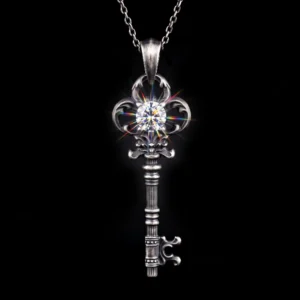
Current catalog examples show why this matters. The Moissanite Key Necklace and the Fleur-de-Lis Gothic Key Necklace are each currently listed at 63 by 24 mm and 32 g. Those figures describe the listings only. They do not establish ideal scale, comfort, compatibility, or suitability for a particular recipient.
When comparing photographs, separate pendant scale from camera crop. A close image can make a modest object fill the frame, while a lifestyle image can make the same object look smaller. Use listed dimensions as the stable reference and the gallery only to inspect visible shape, finish, and detail.
Choose ready-made or personalized deliberately
A ready-made key keeps the decision focused on motif, scale, finish, and presentation. A personalized key adds another choice: the exact text or custom detail. Personalization is useful when the recipient already chooses named or initialed items, has requested one, or has a clear pattern of keeping custom objects. It is not automatically more thoughtful.
The personalized jewelry collection is the category path for current custom options. Two current examples are the Custom Snake Key Name Necklace and the Custom Angel Wing Key Name Necklace. Their listing information can establish available customization and visible design only. It cannot prove recipient preference or emotional effect.
Check spelling, capitalization, spacing, and the exact customization field before ordering. If you are unsure what text she would choose for herself, that uncertainty is a reason to pause rather than invent a message. A ready-made piece or another gift category may be the lower-assumption route.
Use finish as a visual matching cue
Finish changes contrast. A bright surface can read as crisp and reflective; an antiqued surface can emphasize recessed detail and create stronger light-dark separation. Compare that visual effect with the jewelry she already wears rather than assuming one finish is more romantic, premium, versatile, or appropriate.
The current Moissanite Key Necklace listing includes antiqued silver and bright silver finish options. That is a catalog fact, not a recommendation. If her existing pieces consistently share one finish family, matching it is a defensible continuity choice. If she deliberately mixes finishes, either option may remain open and motif scale may become the more useful deciding factor.
Keep finish separate from material and care. Material evidence belongs with the relevant Research owner, and care guidance should come from an applicable care source. This page does not infer durability, maintenance needs, skin response, or long-term appearance from a finish label.
Let the occasion change the presentation, not the claim
A birthday or holiday may support a direct presentation: explain that you noticed the shapes or finishes she already wears. A milestone may invite a short note about the specific observation behind your choice. A spontaneous gift can be presented more lightly. In every case, describe your own reason for choosing the object rather than declaring what the motif must mean to her.
This distinction keeps the message truthful. “I noticed you wear detailed silver-toned pendants” is an observation. “This key guarantees what our relationship will become” is a prediction. The first helps explain the selection process; the second assigns an outcome that a product cannot establish.
Public gift guidance can help identify ordinary questions. For example, this necklace-gift article also suggests checking whether the recipient wears necklaces. It is editorial context, not evidence that any specific necklace, timing, price, or message will be well received.
Separate necklace choice from chain-length choice
First decide whether the pendant itself fits her visible preferences. Then treat chain length as a separate question. Do not let an included chain or a product photograph silently decide where the pendant should sit. The necklace length guide owns measurement and visible placement. Use the relevant wearer measurements and current product details rather than guessing from a model photograph.
This separation prevents one appealing feature from carrying the whole decision. A suitable motif does not automatically establish preferred length. A familiar length does not automatically establish preferred motif. If the product offers chain choices, read the exact variation labels and confirm what is included before ordering.
Pick a path based on evidence strength
| Evidence state | Lower-assumption path | Reason |
|---|---|---|
| She wears necklaces and similar motifs | Compare ready-made key designs by scale and finish | The category and visual language are already familiar |
| She wears personalized jewelry and has a known text preference | Compare personalized key options | The added custom decision is supported by evidence |
| She wears necklaces but not key motifs | Compare the key shape with her usual pendant scale before proceeding | The category is familiar but the motif is still a change |
| She rarely wears necklaces | Ask, verify, or choose another category | The basic category preference is uncertain |
| You are unsure about text, finish, or scale | Pause personalization and reduce the number of assumptions | Uncertainty is information, not a cue to guess |
Use current catalog examples within strict boundaries
Catalog pages can confirm current names, listed dimensions, selectable finishes, personalization fields, gallery images, prices, and availability at the time checked. They cannot tell you whether the recipient will prefer the item. They also do not prove gifting success, emotional meaning, quality, comfort, daily wear, chain compatibility, or long-term performance.
Browse the silver necklace collection when the key motif is not supported by her style evidence but the broader necklace category is. Use category browsing to compare visual forms, not to infer popularity or universal appeal.
The current catalog examples do not prove that one motif, finish, personalization choice, or product is universally preferred. Their role in this guide is bounded: they make the decision variables concrete while the recipient evidence remains yours to evaluate.
A no-guess conversation can be part of the gift
Surprise and certainty are not the same thing. You can preserve the occasion while asking a narrow question such as whether she prefers bright or antiqued finishes, whether she likes named jewelry, or whether she would choose a small or statement pendant. Another option is to show two broad shapes without revealing the final product.
If asking directly would reduce anxiety or avoid an unwanted customization, it is a useful part of the buying process. A gift does not become less considered because one preference was verified. The thoughtful work is noticing, asking when evidence is weak, and choosing within what you actually know.
Common mistakes to avoid
- Choosing a necklace category she does not normally wear without checking.
- Treating every key design as visually interchangeable.
- Assuming personalization is always more meaningful.
- Using a model photograph instead of listed dimensions to judge scale.
- Assigning a universal romantic message to the key motif.
- Predicting that she will wear, keep, or love the gift.
- Letting price substitute for evidence about her style.
- Combining motif, finish, text, and chain decisions into one guess.
A buyer checklist before ordering
- Confirm that she currently wears necklaces.
- Identify her usual pendant scale from pieces she chose herself.
- Compare the key silhouette with motifs already in her collection.
- Check whether her preferred finish is visible in current jewelry.
- Use personalization only when the text choice is supported by evidence.
- Read the current product dimensions and variation labels.
- Treat chain length as a separate measurement decision.
- Review the exact order details before submitting a custom option.
- Describe your own reason for the gift without assigning a universal meaning.
- Choose another category when the basic necklace preference remains unclear.
The practical answer
A key necklace is a reasonable girlfriend gift when it continues an observable preference: she wears necklaces, chooses a compatible pendant scale, likes the same finish family, and has shown interest in comparable motifs or personalization. If those signals are weak, reduce assumptions before buying.
The strongest process is simple: observe first, separate the decisions, verify any custom detail, and explain the choice in your own words. That produces a better-supported gift decision without inventing symbolism, predicting a relationship outcome, or claiming that one product is right for every recipient.







MENSSKULL Journal Notes
Leave a field note
Share fit notes, styling ideas, care questions, or your experience with MENSSKULL silver jewelry.
Comments are checked before publication so buyers can read useful fit, symbolism, care, and style notes without spam noise.
The simple plus/minus challenge below helps block automated spam while keeping the experience lightweight.
Continue exploring
More MENSSKULL stories
Handcrafted silver
Shop the pieces behind the stories