
Quick answer: choose a men’s necklace length by deciding where the visible line should sit with the clothes you actually wear. An 18-inch reference sits higher than a 20-inch reference, while 22 and 24 inches create progressively lower placements. Those numbers describe chain length, not a fixed position on every wearer. Use the neckline, pendant height, jacket opening, and desired visibility to compare options before choosing.
Start with the visible position, not a universal length rule
A length number becomes useful only when it is attached to a visual decision. Decide whether the necklace should remain near the collar, cross the upper chest, sit inside a jacket opening, or create a lower statement line. That position is the target. The nominal length is one way to reach it.
This order matters because two necklaces with the same listed length can play different visual roles. A narrow chain may read as a quiet outline, while a broad chain may occupy much more of the same area. A pendant adds another shape below the chain curve. Clothing can hide, frame, or divide both elements. The buyer therefore needs a placement plan rather than a single number presented as correct for everyone.
Current menswear coverage also shows necklaces across different proportions and clothing combinations. The British GQ men’s-necklace guide, dated July 2, 2026, provides style and category context. It does not prove that one length, width, or product is universally preferred.
Compare 18, 20, 22, and 24 inches as reference points
The familiar 18-to-24-inch range is best treated as a visual comparison scale. Moving from one reference length to the next changes the potential drop, but the final position still depends on the complete outfit and necklace composition. Use the table to identify the first two lengths worth comparing rather than treating a row as a fixed result.
| Reference length | Exact metric conversion | Visual question | Garment check |
|---|---|---|---|
| 18 in | 45.72 cm | Should the chain form a high line near the collar? | Will the neckline reveal or cover that line? |
| 20 in | 50.80 cm | Should the necklace remain in the upper-chest frame? | Does it sit clearly above, below, or directly on the collar edge? |
| 22 in | 55.88 cm | Would a lower curve give a pendant or broad link more space? | Does the shirt or jacket opening frame the full shape? |
| 24 in | 60.96 cm | Should the necklace create a deliberately lower vertical detail? | Will the intended layer keep it visible at normal viewing distance? |
The metric values use the exact relationship of one inch to 2.54 centimeters described by the NIST SI length guidance. The conversion is exact; the styling outcome is personal and garment-dependent.
Use the neckline as the first frame
A crew neck, open shirt, polo collar, turtleneck, and dress-shirt collar create different frames around the same necklace. Look at the empty area that remains after the garment is on. The necklace can stay inside that space, cross one of its edges, or disappear beneath it. None of those outcomes is automatically wrong, but each produces a different visual result.
With a simple crew neck, compare whether the chain sits clearly above the fabric or falls far enough below the edge to avoid looking accidentally aligned with it. With an open shirt, compare the necklace curve with the opening created by the collar. With tailoring, consider the smaller shirt-and-tie frame and the larger V formed by the lapels.
Keep garment-specific decisions on their dedicated owners. The necklace-with-polo guide covers the polo opening, the turtleneck necklace guide covers placement over a high knit neckline, and the suit-and-tie guide covers the relationship among chain, knot, collar, and lapels.
Choose concealed, glimpsed, or fully visible placement
Visibility is a clearer starting decision than trying to memorize an etiquette rule. A concealed necklace leaves the garment and any tie as the visible system. A brief collar glimpse adds a small metal detail near the face. A fully visible necklace becomes part of the outfit composition and needs enough surrounding space for its line or pendant to be read.
Make this decision while wearing the intended layer. A necklace shown clearly in a product photograph may be partly covered by a real collar or jacket. Conversely, a broad open neckline can make a modest chain more noticeable. Step back to normal conversation distance and decide whether the necklace is the lead detail or a supporting one.
If the central question is whether a pendant belongs inside or outside a shirt, use the pendant visibility guide. This length page supplies the broader placement framework without taking ownership of that shirt-specific decision.
Separate bare-chain placement from pendant placement
A bare chain creates a curved or V-shaped line. A pendant extends that composition downward. The listed chain length therefore does not tell you where the bottom of a pendant will appear. Two buyers can choose the same chain length yet create different results because one uses no pendant and the other adds a tall motif.
For a bare chain, compare the curve with the neckline and other accessories. For a pendant setup, add the pendant height to the visual plan. Use a simple paper outline or another nontechnical mock-up to see whether the motif remains in the intended garment frame. This is a visual preview only, not proof of hardware compatibility or performance.
Do not infer that a pendant will pass over a clasp from the chain width shown in a title. Product-specific hardware and bail questions belong to the relevant product records. For broader shopping navigation, compare the current men’s silver pendant necklace collection without assuming every pendant includes a chain.
Read chain width and length as separate visual variables
Length controls the general position. Width and link profile control how strongly the chain reads within that position. A narrow cable chain can create a quieter line at 20 inches. A broad Cuban or mariner chain at the same length can become the dominant accessory because its links occupy more visual space.
This distinction prevents a common shopping error: changing length to solve a width problem. If the necklace feels too visually heavy near the face, a narrower link may change the result more than adding a small amount of length. If a narrow chain disappears against a patterned shirt, greater separation from the neckline or a more visible link profile may be the relevant comparison.
Width is not a universal strength ranking, and visible scale is not a load rating. This guide uses width only to describe appearance. Exact material and product facts remain item-specific and should be checked on the current listing and, for silver research, the 925 sterling silver research owner.
Compare current MENSSKULL chain options by listed dimensions
The current catalog provides three distinct visible profiles. These records are examples, not a ladder from basic to best. Each listing was checked as purchasable and in stock during preparation, but availability can change. Recheck the selected variation before ordering.
| Current example | Listed profile | Listed length options | Useful visual comparison |
|---|---|---|---|
| Oxidized cable chain with triangle clasp | 3 mm; item listed as 925 silver | 50, 60, 70, and 80 cm; approximately 19.7, 23.6, 27.6, and 31.5 in | A narrower line across several high-to-low placement options |
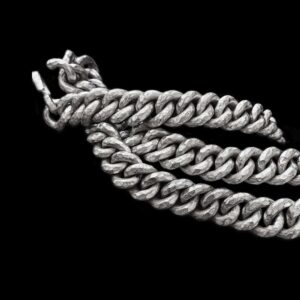
| Heavy hammered Cuban chain | 8 mm; item listed as 925 silver | 50, 60, and 70 cm; approximately 19.7, 23.6, and 27.6 in | A broad textured profile intended to read clearly on its own |
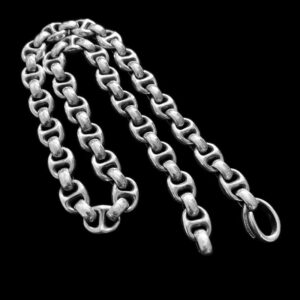
| Heavy mariner anchor chain | 12 mm; item listed as 925 silver | 50, 60, and 70 cm; approximately 19.7, 23.6, and 27.6 in | A very broad center-bar link profile with strong visual weight |
Notice that these products do not use the exact 18, 20, 22, and 24-inch sequence from a generic reference chart. That is normal. The practical task is to compare the available option with the desired visible position. A listed 60 cm or approximately 23.6-inch chain can be judged against the 22- and 24-inch references without pretending that it is exactly either one.
Translate a reference chart into real catalog options
Start with the reference position, then look for the closest listed options on the product you are actually considering. If both neighboring options exist, compare them within the intended outfit. If only one exists, decide whether its visible result still serves the original goal rather than choosing it simply because it is available.
Do not round a catalog option into a different number in the final decision. Record the listed value as shown. For example, 60 cm is exactly about 23.62 inches, commonly displayed as approximately 23.6 inches. It can be discussed alongside a 24-inch reference, but the listing should not be rewritten as a 24-inch product.
Also separate the product’s general weight statement from a specific variation unless the listing maps them explicitly. A range across several lengths does not prove the exact weight of one selected option. The same boundary applies to photographs: they show design and link form, but they may not identify the precise length displayed.
Coordinate necklace length with other visible accessories
A necklace shares the upper-body frame with glasses, earrings, brooches, neckwear, shirt hardware, and jacket details. Decide which element should be noticed first. A broad, low chain can carry the composition by itself. A narrow chain can support a stronger ring, watch, or brooch without creating another competing focal point near the face.
Length helps distribute those focal points vertically. A collar-level necklace sits close to glasses and neckwear. A lower necklace can create more separation, but it also occupies more of the shirt or jacket field. The useful question is not whether every metal finish matches. It is whether the visible shapes have a clear hierarchy.
If the outfit already contains a detailed tie or a prominent brooch, compare a concealed necklace, a narrow high line, and a lower visible placement before adding more detail. Change one variable at a time so the visual effect of length remains clear.
Plan layering by distinct visual jobs
Two necklaces layer most clearly when they perform different jobs. One may create a short quiet line while the other carries a pendant lower on the chest. If both sit at nearly the same level and have similar visual weight, the result can read as an accidental cluster rather than two deliberate layers.
Use the garment as the common frame. Check whether both lines remain visible with the neckline and whether the lower element has enough open space around it. A close-up can exaggerate small differences, so inspect the full outfit. The goal is visible separation, not a universal required number of inches.
This is styling guidance only. It does not promise that two chains will avoid contact or tangling. Hardware, movement, and wear behavior are product-specific questions outside this low-risk placement route.
Avoid five common necklace-length mistakes
Choosing from a model photograph alone. Use the photograph to understand link shape, then compare the listed length with your intended garment frame. The displayed variation may not be identified.
Treating a reference point as a fixed body position. Eighteen, 20, 22, and 24 inches are useful comparisons, not universal anatomical outcomes.
Ignoring pendant height. The chain curve and the bottom of a pendant are two different positions. Plan both when the pendant will be visible.
Using length to solve every proportion issue. Width, link profile, finish, and surrounding clothing can change visual weight even when length stays the same.
Assuming the chart length is available. Read the selectable variation on the current product page. Compare the actual option rather than silently rounding it to the nearest familiar number.
Use a placement-first buying sequence
- Choose the garment frame. Name the shirt, knitwear, or tailoring you expect to wear with the necklace.
- Choose visibility. Decide whether the necklace should be concealed, glimpsed, or fully visible.
- Choose the visual job. Decide whether it is the lead accessory, a pendant carrier, or a supporting line.
- Compare reference lengths. Use 18, 20, 22, and 24 inches to narrow the visible position.
- Read the actual options. Record the listed centimeters and approximate inches on the selected product.
- Add pendant height where relevant. Preview the complete visible composition rather than the chain alone.
- Check width separately. Decide whether the link profile is quiet, balanced, or intentionally dominant in that position.
- Recheck the selected variation. Confirm the exact option and current product record before ordering.
This sequence keeps the decision grounded in what a buyer can verify: visible position, garment context, listed dimensions, current options, and personal preference. It does not require a universal body-type formula or unsupported promise about how every necklace will feel or perform.
Final necklace-length decision
The best starting length is the one that places the necklace where you want it within the outfit you actually wear. Use familiar inch values as reference points, then translate them into the exact centimeter or inch options available on the product. Keep chain width, pendant height, and garment visibility as separate checks so one number does not carry more meaning than it can support.
For broader shopping, compare current chain profiles in the men’s silver necklace collection. Return to the specialist garment guides when a polo, turtleneck, shirt, or suit creates the decisive frame. That division keeps the length guide useful without duplicating the owners that answer those narrower questions.







MENSSKULL Journal Notes
Leave a field note
Share fit notes, styling ideas, care questions, or your experience with MENSSKULL silver jewelry.
Comments are checked before publication so buyers can read useful fit, symbolism, care, and style notes without spam noise.
The simple plus/minus challenge below helps block automated spam while keeping the experience lightweight.
Continue exploring
More MENSSKULL stories
Handcrafted silver
Shop the pieces behind the stories