
Quick answer: You can choose to wear a silver bracelet and watch on the same wrist as a styling preference, but their materials and matching color do not guarantee freedom from scratches or interference. If avoiding contact is the priority, use opposite wrists or wear one piece at a time. If you want a same-wrist combination, first inspect the bracelet’s movement, clasp, raised details and relationship to the watch case and controls. There is no universal gap or size adjustment that makes every pair contact-free.
This is an original buyer-question guide, not a claim that wrist stacking is a newly measured trend. It separates the styling choice from the physical contact question, without treating a photograph as a wear test. The checks below are practical editorial screening steps, not a product certification.
Separate the styling decision from the contact decision
The combination can look coordinated while still allowing two hard surfaces to meet. A watch and bracelet may share a silver tone yet differ in alloy, surface treatment, geometry and movement. Matching the color answers an appearance question. It does not establish compatible hardness, abrasion resistance or useful clearance.
The watch, belt and jewelry metal-coordination guide owns the color and finish question. This page addresses the separate issue of putting a bracelet close to a watch. Keeping the two questions apart prevents a common mistake: approving the pair from a photograph without checking what happens when the wrist moves.
What official care guidance actually supports
Cartier’s jewelry storage advice warns that jewelry pieces can become scratched through contact with each other and recommends separate storage. That supports taking contact seriously, but its context is storage, not a same-wrist wear test. It does not test MENSSKULL bracelets against watch cases, establish a universal clearance measurement or prove that one particular pair will scratch immediately. Product-specific instructions remain important.
The useful conclusion is modest: if two items can repeatedly rub or strike each other, do not promise that the combination is mark-free. A lack of visible wear after a brief check is not proof of long-term resistance. Likewise, an existing scratch does not identify its cause without inspection.
Locate the parts that could meet the watch
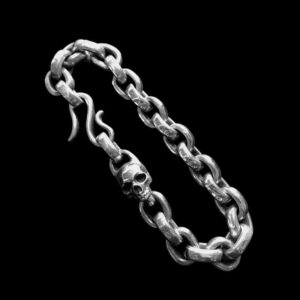
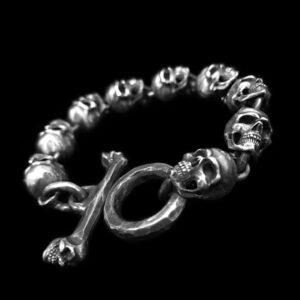
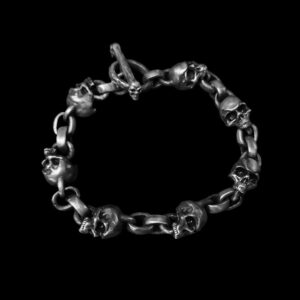
Look beyond the main links. A bracelet can have a skull-shaped clasp, toggle bar, oversized end ring, hook, stone setting or sculpted cuff terminal. The highest-contact feature may not be the part emphasized in a product photograph. Inspect open, closed and side views before deciding how close it will sit to the watch.
| Bracelet feature | What to inspect | Question about the watch |
|---|---|---|
| Flexible links | How far the bracelet travels toward the hand and forearm | Can the links reach the case, clasp or strap edge? |
| Raised closure | Skull, hook, toggle, end ring or projecting detail | Could rotation bring the closure against the case? |
| Open cuff terminals | Entry gap, terminal profile and rigid body | Does the cuff’s shape leave room for the case and controls? |
| Stone or decorative setting | Projection and the seller’s handling instructions | Is direct contact inconsistent with either item’s care guidance? |
Inspect the watch as well: case sides, crown, pushers, lugs, clasp and strap attachment may occupy more space than the dial photograph suggests. A soft watch strap does not remove the metal case or buckle from the combination. A smooth bracelet also does not prove that the pair cannot meet.
Do not rank the pair’s wear resistance from the words silver and steel alone. Alloys, treatments and finishes vary. This article does not supply laboratory hardness values or test results for your exact items. If preserving a particular finish is critical, ask the makers or a qualified service provider before wearing the pieces together.
Compare three wearing arrangements before changing the size
| Arrangement | Useful reason to choose it | Boundary to remember |
|---|---|---|
| Opposite wrists | Separates the bracelet from the watch during ordinary wrist movement | Each item still needs its own fit and activity checks |
| One item at a time | Removes the need to accommodate the pair together | Does not make the remaining item scratch-proof |
| Same wrist | Creates a deliberate combined wrist accent | Requires checking contact, movement, closure and maker instructions; no mark-free guarantee |
Opposite wrists are the direct starting point when contact avoidance matters more than stacking. It is not a universal style rule, and it does not make jewelry suitable for machinery, lifting or sport. It simply avoids asking two nearby objects to share one small area.
One piece at a time is also a valid outcome. You do not need to buy a thinner bracelet or replace a watch because a preferred combination is crowded. A bracelet can be reserved for outfits or occasions when the watch is not worn.
For same-wrist styling, do not automatically buy a tighter bracelet to hold it still. Restricting movement can introduce a fit problem without proving separation. Do not automatically buy a looser bracelet either; more travel can bring the closure or links toward the watch. Fit must be chosen for the bracelet, not used as an untested barrier.
Start with the men’s bracelet size guide to establish the actual wrist measurement and the meaning of the selector. A wrist-circumference option is not necessarily the finished bracelet length, and a profile-width reference is not usable interior space.
Screen the combination without deliberately rubbing the surfaces
If you already own both items and their instructions permit ordinary wear, put them on separately over a soft surface. Observe the closed bracelet and watch with the wrist at rest. Then make a few normal, gentle wrist movements and check whether the bracelet travels toward the case or whether the closure rotates into it. Stop the same-wrist arrangement if unwanted contact occurs.
Do not push the pieces together to see which one scratches. That is damage testing, not a fitting check. Do not use a tool, abrasive pad or polishing method to test hardness. The point is to identify obvious conflict without creating a new mark.
Include the sleeve you normally wear. A cuff can cover the combination, crowd it or push one item toward another. Check the watch controls without forcing them past the bracelet. A combination that obstructs normal access is a reason to separate the items, not to bend a cuff or alter a clasp yourself.
Turn an online uncertainty into a specific seller question
- What is the closed bracelet’s usable interior measurement for my selected option?
- Which parts of the closure project beyond the main links?
- Can you provide a side view of the closed clasp or cuff terminal?
- What fitting and handling instructions apply to this particular cuff?
- Does the maker advise against direct contact with other jewelry or a watch?
A seller may not be able to guarantee compatibility with a watch it has not inspected. Treat that limitation honestly. Additional measurements can improve the decision, but they are not a certificate that every wrist movement will remain contact-free.
Read catalog examples by construction, not by a stacking label
The MENSSKULL Skull Clasp Chain Bracelet concentrates the motif at a sculpted skull and curved hook closure. Its catalog images show why the closure deserves its own contact check rather than being treated as another plain link. The current wrist options run from 15 to 23 cm, while the 10 mm size reference is a separate profile entry. Those facts do not establish compatibility with your watch.
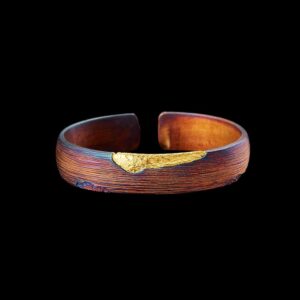
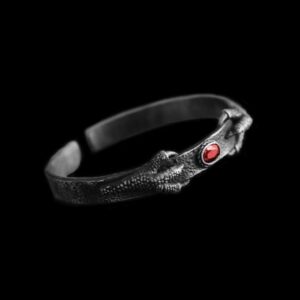
The Eagle Claw Red Stone Cuff uses an open cuff body and sculpted terminals, including a red-stone focal detail. Its current selector offers wrist references from 17 to 22 cm. The catalog does not publish the opening and interior dimensions needed to decide every watch pairing. Ask for those measurements rather than assuming an open shape can be reshaped around a case.
These are commercial examples checked September 17, 2026, not watch-maker endorsements or wear tests. If a particular silhouette is too crowded, the men’s silver bracelet collection is a browsing route, not a promise that another model automatically solves contact.
Use the 925 silver research guide for material evidence and the sterling silver care research for maintenance. Do not polish a dark finish merely to make it match the watch, and do not let the watch’s water-resistance rating become a claim about the bracelet.
Common questions about silver bracelets beside watches
Will silver definitely scratch my watch?
This guide cannot determine that for an untested pair. Repeated contact is a wear concern, but the precise outcome depends on the items and use. If avoiding contact is important, choose separate wrists or one item at a time.
Does a leather or fabric watch strap solve the problem?
Not automatically. The watch still has a case, controls and attachment points. Inspect the whole combination rather than only the strap material.
Is a fixed gap enough to guarantee protection?
No universal gap is established here. Bracelet travel, wrist movement and the closure’s shape can change the separation. Do not present a distance visible in one photograph as a guarantee.
Can I use a tighter cuff to keep the pieces apart?
Do not use restricted fit or unapproved bending as a contact-control method. Follow the cuff’s specific fitting instructions, then change the wearing arrangement if the combination is crowded.
Prepared by MENSSKULL Editorial Team. Published September 17, 2026. The general jewelry-contact caution is supported by Cartier’s storage advice, not a wear test of the pair. Catalog examples and the screening framework are MENSSKULL editorial content.

MENSSKULL Journal Notes
Leave a field note
Share fit notes, styling ideas, care questions, or your experience with MENSSKULL silver jewelry.
Comments are checked before publication so buyers can read useful fit, symbolism, care, and style notes without spam noise.
The simple plus/minus challenge below helps block automated spam while keeping the experience lightweight.
Continue exploring
More MENSSKULL stories
Handcrafted silver
Shop the pieces behind the stories