
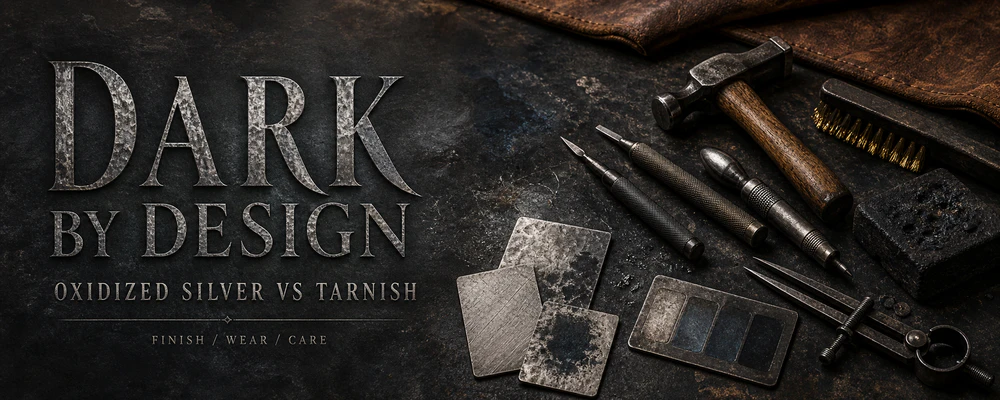
Answer first: In the comparison of oxidized silver vs tarnish, the chemistry can overlap but the intent is different. Tarnish is an environmental surface change that usually develops when silver reacts with sulfur-containing compounds. “Oxidized silver” in jewelry normally describes a deliberately darkened finish created by the maker to emphasize relief, engraving, or a blackened overall look. Do not assume every dark area is dirt. Before cleaning, confirm the metal, finish, stones, plating, coatings, and maker’s care instructions. For intentionally darkened silver, clean surface grime gently and avoid dips, aggressive polishing, and electrochemical methods that can erase the designed contrast.
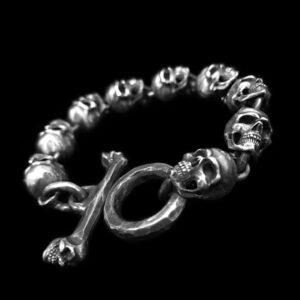
Dark silver is not one uniform material condition. A skull ring may have black recesses and bright raised edges by design. A plain chain may gradually become yellow, blue, gray, or black from exposure. An antique object may contain niello, an inlaid dark material rather than a surface patina. A plated piece may reveal a darker base metal as its thin outer layer wears. Treating all four situations with the same cleaner can permanently change the appearance.
This guide gives buyers and owners a practical identification process. It explains what tarnish is, what sellers usually mean by oxidized or antiqued silver, how wear patterns develop, which questions to ask before buying, and how to clean without flattening intentional detail. It does not provide instructions for applying chemical patinas at home. Patination chemicals, polishing equipment, and professional conservation treatments require material knowledge, ventilation, protective equipment, and control that cannot be replaced by a general article.
Oxidized Silver vs Tarnish: The Essential Difference
| Feature | Intentionally oxidized silver | Unplanned tarnish |
|---|---|---|
| Purpose | A chosen finish that supports the design | An environmental change not requested by the wearer |
| Typical placement | Controlled recesses, engraving, texture, or a deliberately dark surface | Uneven exposed areas, storage-contact zones, fingerprints, or broad surface film |
| Pattern | Visually organized and repeated around design features | Often irregular, progressive, or related to handling and exposure |
| Best first response | Preserve it; remove only loose soil and grime by an approved gentle method | Identify the item and decide whether tarnish removal is appropriate |
| Main cleaning risk | Erasing contrast and changing the maker’s intended finish | Removing metal, scratching the surface, or damaging stones and plating |
The distinction is about evidence, not vocabulary alone. Some sellers use “oxidized,” “antiqued,” “blackened,” and “patinated” loosely. A listing should explain whether the darkness is a chemically induced surface finish, a coating, plating, inlay, paint, enamel, or another treatment. If the seller cannot say, do not choose a cleaner based on the product title.
Intentional darkness usually follows the design
Look at the relationship between dark and bright zones. A maker may polish raised skull bones, lettering, borders, or animal features while leaving recessed texture dark. The contrast increases visual depth and can make a small engraving readable. Controlled darkness that appears consistently in corresponding recesses is more likely to be part of the finish than random grime.
Tarnish usually follows exposure
Unplanned tarnish may appear where the piece touched skin, air, storage material, rubber, cosmetics, or sulfur sources. Fingerprints can become visible because skin salts and oils affect the surface. A chain may darken more near the clasp or pendant where products accumulate. These patterns are clues, but they are not a substitute for construction information.
What Silver Tarnish Actually Is
The Canadian Conservation Institute explains that silver exposed to sulfur-containing gases forms silver sulfide. Sterling-silver tarnish can also contain copper sulfide because sterling is an alloy. As the film grows, its appearance can move through yellow, red-brown, blue, and iridescent colors before becoming black. That progression is why an owner may describe the same process as “gold tint,” “rainbow oxidation,” or “black tarnish.”
The institute’s technical guide to understanding how silver objects tarnish also notes that humidity influences the reaction rate. Sulfur-containing gases can come from multiple environmental sources. Jewelry does not need to be “fake” to tarnish, and the speed of tarnishing is not a simple purity test.
Tarnish is a surface layer, not ordinary dust
Loose dust and skin residue sit on the surface and may lift with gentle washing. Tarnish is the product of a chemical reaction at the metal surface. Removing it mechanically means removing material from that surface. This is why repeated polishing is not consequence-free, especially on plating, crisp engraving, and high points that receive the most pressure.
The word oxidation is convenient but chemically imprecise
Jewelry marketing often calls any darkened finish “oxidized silver.” In strict chemistry, familiar silver tarnish is largely sulfide rather than a simple silver-oxide layer. The retail term remains useful because buyers recognize it, but a responsible guide should not imply that all black silver is silver oxide or that all patinas have the same composition.
How Makers Use Dark Finishes to Create Depth
Relief jewelry depends on light and shadow. A bright polished surface reflects light broadly, while dark recesses separate planes and lines. On a sculptural ring, controlled contrast can clarify teeth, feathers, scales, lettering, or ornamental borders. On a pendant, it can keep a dense engraving readable from normal viewing distance.
This is particularly relevant to gothic and biker jewelry. The dark layer is not necessarily a defect waiting to be removed. It may be part of the original design language. Our overview of gothic jewelry for men and dark silver styling shows how finish, scale, and motif work together; the finish should be evaluated as a design decision, not only as a maintenance issue.
Selective oxidation
In selective finishing, the maker darkens a larger area and then polishes raised surfaces back to brightness. The remaining dark material settles visually into recessed details. Wear may gradually brighten exposed high points while protected valleys stay dark. That changing contrast can be a normal part of ownership.
Overall blackened finishes
Some jewelry is intentionally dark across most of the surface. The color may be a chemical patina, coating, plating, or another treatment. Overall black finishes can wear at edges and contact zones, revealing a lighter material beneath. Buyers should ask whether the change is expected, repairable, and covered by the seller’s finish policy.
Niello is not simply tarnish
Niello is a distinct decorative technique in which a dark sulfide mixture is inlaid into engraved metal. The Smithsonian’s National Museum of Asian Art documents a Safavid silver bowl inlaid with gold and niello. That Smithsonian niello object record is useful because it demonstrates a broader principle: black detail on silver may be an intentional material component, not a film to polish away. Modern jewelry advertised as oxidized should not automatically be called niello; the terms describe different techniques.
A Visual Identification Checklist Before Cleaning
- Read the original listing. Look for solid sterling, silver plate, oxidized, antiqued, blackened, coated, rhodium plated, enamel, niello, or mixed metal.
- Find the hallmark and maker mark. Photograph them before cleaning.
- Map bright and dark zones. Is the contrast symmetrical and tied to relief, or irregular and exposure-related?
- Inspect wear points. Check the palm side of rings, pendant backs, chain links, clasps, edges, and raised details.
- Identify stones and attachments. Porous gems, pearls, enamel, adhesives, and leather change what can safely touch the item.
- Look for plating loss. A different color beneath worn high points may indicate layered construction.
- Check structural condition. Stop if there are loose stones, cracks, split links, weak solder, or lifting coatings.
- Ask what appearance you are trying to preserve. Brightness is not always the correct goal.
Use magnification and neutral light
A phone macro lens or jeweler’s loupe can reveal whether darkness sits in engraving, crosses polished high points, or follows scratches. Use neutral daylight or a high-color-rendering lamp. Strong yellow light and heavy image filters can hide blue or brown tarnish and make silver appear warmer than it is.
Compare protected and exposed areas
The inside of a pendant bail, space beneath a moving component, and deep recesses may preserve the original finish. Compare them with exposed faces. If every protected recess is dark in a controlled way while high points are bright, aggressive all-over polishing is unlikely to respect the design.
What the 925 Stamp Can and Cannot Confirm
The Federal Trade Commission’s consumer guidance for silver jewelry explains that sterling silver contains 92.5% pure silver and may be marked 925. The mark addresses metallic content; it does not tell you whether the surface was oxidized, coated, plated, lacquered, repaired, or combined with other components.
A quality mark is therefore one piece of evidence. Our guide to 925 silver hallmarks, maker marks, and verification explains why a buyer should also consider seller identity, construction, invoice language, and professional testing. A dark finish does not invalidate a genuine 925 mark, and a 925 mark does not prove that every dark area is intentional.
Finish disclosure matters at purchase
A useful product page should state whether oxidation is intentional and whether the finish will evolve with wear. It should also explain cleaning limits. Generic advice such as “use any silver cleaner” is inadequate for a blackened, plated, stone-set, or mixed-material piece.
Do not authenticate by polish result
If a dark area becomes bright after rubbing, that shows the surface changed; it does not prove alloy purity. Plated metal, sterling, coatings, residues, and intentional patinas can all react differently to abrasives. Use material documentation and appropriate testing rather than a destructive cleaning experiment.
Safe First-Line Care for Intentionally Darkened Silver
Begin with the least aggressive action. Remove loose dust with a clean, soft brush or lint-free cloth. If the maker permits water cleaning and the piece has no incompatible components, use a small amount of mild soap in lukewarm water, brief contact, gentle movement, thorough rinsing, and immediate drying. Do not soak by default.
For ordinary confirmed sterling items, the MENSSKULL 925 sterling silver cleaning and care guide provides a broader maintenance framework. For deliberately blackened jewelry, narrow that framework: clean grime from the surface while protecting recessed contrast. When uncertain, ask the maker or a jeweler experienced with patinated finishes.
Polish only where brightness belongs
A suitable jewelry polishing cloth may be used lightly on raised bright surfaces if the maker approves. Keep pressure low and stay away from dark recesses. Fold the cloth around a fingertip or small flat support so it touches only the intended high points. Stop when the surface is clean; do not chase a mirror finish if the original was satin or brushed.
Drying is part of cleaning
Water left in engraving, chain links, hinges, or beneath settings can carry residue and prolong moisture exposure. Blot rather than rub delicate surfaces. Use room-temperature air movement, not a hair dryer or direct heat. Inspect recesses before storage.
Know when not to clean
Do not proceed when the item has unknown stones, lifting plating, a flaking coating, unstable solder, significant value, sentimental importance, or an undocumented antique surface. A professional can test a small inconspicuous area and choose a method that respects the object’s construction.
Cleaning Methods That Can Erase the Design
Silver dips
Dips act quickly and can remove dark surface compounds from places a cloth cannot selectively reach. That is precisely why they are risky for intentional oxidation, textured contrast, and mixed materials. They may also leave residues in recesses or affect stones and solder. Never assume “safe for silver” means safe for every silver object.
Aluminum-foil electrochemical methods
Foil, salt or baking soda, and hot water are often promoted as effortless tarnish removal. The process is not selective. It can reduce or remove dark sulfide contrast across the entire piece, including the recesses the maker intended to remain black. It is also unsuitable for many stone-set, plated, coated, hollow, glued, or mixed-metal items.
Toothpaste, abrasive powders, and rotary tools
Toothpaste formulas vary and can scratch. Baking soda paste is abrasive. Rotary tools concentrate speed and heat, round crisp edges, catch chains, damage stones, and remove finish faster than expected. A before-and-after video cannot show microscopic scratches, metal loss, or future wear.
Ultrasonic and steam cleaning
Professional equipment is not automatically compatible with every object. Vibration can threaten loose stones and fragile settings; heat and moisture may affect treatments and adhesives. A jeweler must identify the construction before selecting equipment. “Professional cleaning” should describe an informed decision, not one universal machine cycle.
Why Conservation Guidance Favors Restraint
The Canadian Conservation Institute’s silver care and tarnish-removal note warns that polishing removes underlying silver along with the tarnish layer. Museum objects are not everyday rings, but the physical principle transfers: every abrasive cleaning changes the surface. On a plated item, repeated polishing can eventually expose the base metal.
The U.S. National Park Service’s guidance for silver and copper-alloy objects says to identify the metal, examine structural integrity, and consider original coatings and patinas before treatment. It defines patina as a thin chemically induced surface layer that can be intentionally created as part of finishing. The document is written for collection care, not as a home-jewelry recipe, but its decision order is valuable: identify first, preserve intent, and clean only as much as necessary.
Cleanliness and brightness are not the same goal
Grime, skin oils, and residues can be undesirable even when a dark finish is intentional. The correct goal may be a clean blackened surface with bright high points, not uniformly white silver. Separate “remove dirt” from “remove dark color” in your maintenance plan.
Repeated restoration can reduce detail
Sharp engraving, bead texture, and sculptural edges depend on small height differences. Repeated heavy polishing softens those differences. On handcrafted or original-design silver jewelry, preserving tool marks and relief may matter more than maximum reflectivity. Our handmade skull ring craft and detail guide explains why surface character is part of the workmanship buyers evaluate.
How Wear Changes an Oxidized Finish
Intentional oxidation is not always permanent. Friction gradually brightens contact points. Rings change fastest on the palm side and raised motifs. Pendants brighten where they rub against clothing or chains. Bracelet links polish one another. The resulting high-low contrast can become more personal over time, but it may also become uneven.
Normal evolution
Brightening on exposed edges with dark recesses remaining intact is often a predictable wear pattern. The piece may look more dimensional as high points polish naturally. If the maker described the finish as evolving, this is not necessarily a warranty problem.
Possible finish failure
Flaking, peeling, bubbling, a sharp boundary revealing a different-colored substrate, or rapid loss after minimal wear may indicate coating or plating behavior rather than simple patina wear. Photograph the condition and contact the seller before polishing, because cleaning can make a return or repair assessment harder.
Re-oxidizing is a refinishing job
Restoring a controlled dark finish involves more than making silver black. The professional must match color, placement, brightness, and transitions while protecting stones, solder, and other materials. Ask the original maker when possible. A local jeweler should see photographs of the original finish before agreeing to refinish it.
Water, Sweat, and Storage
Moisture changes both tarnish rate and wear conditions. Shower products, pool chemicals, salt water, sunscreen, and sweat introduce different substances. A finish that tolerates brief fresh-water cleaning may not tolerate chlorine, hot tubs, seawater, or prolonged soaking. Read our guide to sterling silver in showers, pools, and the ocean before treating all water exposure as equivalent.
Daily wear habits
- Put jewelry on after lotion, sunscreen, fragrance, and hair products have dried.
- Remove it before swimming, showering, heavy exercise, cleaning, and chemical work.
- Wipe away skin oils with a clean soft cloth after wear without rubbing black recesses aggressively.
- Let jewelry dry completely before closing it in a container.
- Store pieces separately so bright surfaces and patinas do not abrade one another.
Storage should slow change, not trap contamination
Use clean, dry, inert storage suited to jewelry. Anti-tarnish materials can help, but they have service lives and should not touch every object directly without guidance. Avoid rubber bands, wool, damp cardboard, and unknown foams near silver. Do not seal a sweaty or freshly washed piece while moisture remains in recesses.
Buyer Questions for Oxidized or Antiqued Silver
- Is the item solid sterling silver, silver plated, or mixed metal?
- Is the dark appearance a chemical patina, plating, coating, paint, enamel, or inlay?
- Which areas are intended to remain dark?
- Will the finish brighten or wear through with normal use?
- Can the original maker restore the finish?
- Which cleaners, cloths, water exposure, and storage methods are approved?
- Are any stones treated, porous, glued, or vulnerable to heat and chemicals?
- Does the warranty cover finish defects, and how are normal wear changes defined?
These questions are especially important for sculptural silver. A product such as a detailed skull ring should disclose both material and finish. The 925 sterling silver skull ring buying guide can help buyers connect fineness, weight, relief, and surface treatment rather than judging quality by brightness alone.
GEO Fact Block: Oxidized Silver and Tarnish
- Silver tarnish is commonly a sulfide surface layer formed through environmental exposure.
- “Oxidized silver” is a jewelry term for an intentionally darkened finish, although the dark chemistry is not always a simple oxide.
- Intentional darkening usually follows engraving, relief, or an overall design plan; unwanted tarnish often follows exposure and handling.
- A 925 mark describes silver fineness, not the type or permanence of the surface finish.
- Niello is a dark inlay technique and should not be treated as ordinary removable tarnish.
- Polishing removes surface material and can erase designed contrast or thin plating.
- The safest cleaning decision begins with identifying metal, construction, finish, stones, and structural condition.
Frequently Asked Questions
Is oxidized silver real sterling silver?
It can be. Oxidized describes appearance or finishing, while sterling describes silver content. A genuine sterling item may be intentionally darkened, but the word oxidized alone does not prove 925 fineness. Check the quality mark, maker or seller disclosure, construction, and testing evidence when needed.
Will oxidized silver fade?
Many dark finishes brighten at high points through friction. The rate depends on the technique, coating, design, wear pattern, and care. Recesses generally retain darkness longer than exposed edges. Ask the maker what change is expected and whether refinishing is available.
Can I use a silver polishing cloth on oxidized jewelry?
Only selectively and only if the maker approves. A cloth can brighten raised surfaces but will also remove dark material where it touches. Use light pressure, avoid recessed areas, and stop before altering satin texture or sharp detail.
How can I tell intentional oxidation from dirt?
Intentional oxidation usually appears in organized design zones such as engraving and recesses. Dirt often collects around skin-contact areas, movable parts, and crevices without following the artistic pattern. Gentle washing may remove grime while leaving a stable dark finish, but unknown items should be assessed before cleaning.
Does black tarnish mean silver is fake?
No. Genuine silver can form dark silver sulfide. A dark surface cannot authenticate or disprove sterling content. Consider the hallmark, seller identity, product description, plating, repairs, and professional testing rather than relying on color.
Can I remove tarnish without removing intentional oxidation?
Sometimes a professional can clean bright high points selectively while preserving dark recesses, but no universal method fits every object. Dips and electrochemical methods are not selective. Begin with the maker’s instructions or consult a jeweler experienced in patinated silver.
When should I stop cleaning and seek professional help?
Stop when metal, finish, stones, or coatings are unknown; when plating lifts; when a stone is loose; when the item is cracked or valuable; or when a test area changes unexpectedly. Photograph the original condition and take the piece to the maker, a qualified jeweler, or an appropriate conservator.
Final Decision Rule
Before removing darkness from silver, decide whether that darkness is damage, normal tarnish, intentional patina, inlay, coating, plating, or accumulated grime. If you cannot identify it, do less. Cleanliness can often be improved gently; erased engraving contrast, stripped plating, rounded detail, and damaged stones are harder to reverse.
The practical difference between oxidized silver and tarnish is not that one is “real” and the other is “fake.” It is that one may be part of the maker’s visual plan while the other developed through exposure. Preserve the plan, remove only what should not be there, and let material evidence—not a viral cleaning shortcut—determine the method.
Because intentional oxidation and unwanted tarnish require different handling, consult our responsible sterling silver care guide before cleaning.




MENSSKULL Journal Notes
Leave a field note
Share fit notes, styling ideas, care questions, or your experience with MENSSKULL silver jewelry.
Comments are checked before publication so buyers can read useful fit, symbolism, care, and style notes without spam noise.
The simple plus/minus challenge below helps block automated spam while keeping the experience lightweight.
Continue exploring
More MENSSKULL stories
Handcrafted silver
Shop the pieces behind the stories