
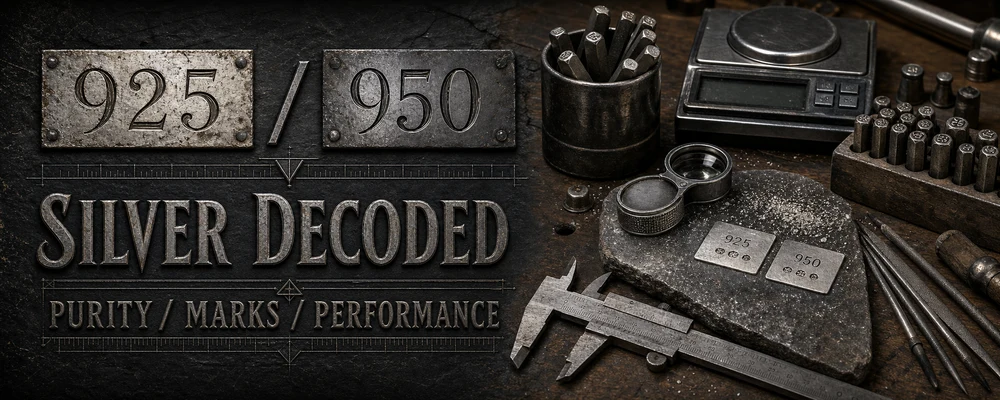
Answer first: 925 vs 950 silver is a comparison of millesimal fineness. A 925 alloy contains at least 925 parts silver per 1,000, or 92.5% silver by mass. A 950 alloy contains 950 parts silver per 1,000, or 95% silver by mass. The numerical difference is real but small: 25 parts per 1,000, equal to 2.5 percentage points. That does not make every 950 piece automatically stronger, safer, more valuable, or better made than every 925 piece. Fineness identifies how much silver is present, not the identity of the remaining metals, the quality of the casting, the thickness of the piece, the strength of a clasp, or the accuracy of the seller’s claim.
For the underlying 925 definitions and evidence limits, consult MENSSKULL’s 925 sterling silver fineness and hallmarking guide.
For most men’s rings, pendants, chains, bracelets, and earrings sold in the United States, 925 sterling silver is the more familiar and easier-to-verify choice. The U.S. Federal Trade Commission reserves the words “sterling silver” and “sterling” for products that are at least 925 parts silver per 1,000. A genuine 950 silver alloy contains slightly more silver, and it can be an excellent material, but the mark needs context because hallmarking systems and recognized fineness standards vary by country. Buyers should evaluate the metal mark together with the maker or responsibility mark, construction, dimensions, finish, seller information, and an appropriate test when the purchase risk justifies one.
925 vs 950 Silver at a Glance
| Question | 925 silver | 950 silver |
|---|---|---|
| Silver by mass | 92.5% | 95% |
| Other alloy ingredients | Up to 7.5% | Up to 5% |
| Can it be called sterling in the U.S.? | Yes, if the claim is accurate and legal marking requirements are met | It exceeds the 925 silver threshold, but a buyer should still read the complete metal description and marks |
| Common recognition | Widely recognized for sterling jewelry | Used in some markets and workshops, but not an approved silver hallmark standard in every jurisdiction |
| Guaranteed harder? | No | No |
| Guaranteed to tarnish less? | No | No |
| Automatically more valuable? | No; value also depends on weight, design, labor, condition, brand, and verification | No; the extra silver content is only one part of value |
The most important row is the one that says “guaranteed.” A fineness number is a composition statement, not a complete performance specification. Two alloys can share the same fineness while using different alloying systems and manufacturing methods. Two rings made from nominally identical metal can also wear differently because one has a thicker shank, cleaner casting, better solder joints, and a more suitable finish.
What 925 and 950 Actually Mean
Millesimal fineness is a parts-per-thousand system
Precious-metal jewelry commonly uses millesimal fineness rather than a percentage sign. The number describes the amount of the named precious metal in 1,000 parts of alloy by mass. A 925 stamp therefore represents 925 parts silver and 75 parts other constituents. A 950 stamp represents 950 parts silver and 50 parts other constituents. This is the same numerical language that appears in many gold, platinum, and palladium descriptions, which is why a number without a metal context can be misunderstood.
The Federal Trade Commission’s consumer guidance for precious-metal jewelry explains that products described as silver, sterling, or sterling silver contain 92.5% pure silver and may be marked 925. The current U.S. Jewelry Guides in 16 CFR 23.5, published by Cornell Legal Information Institute, state that using “sterling silver,” “sterling,” or “Ster.” is misleading unless the product is at least 925/1,000ths pure silver. They also require an accurate fineness designation when “silver” is used for an alloy that is not described simply as sterling.
The difference is 2.5 percentage points, not 25 percent
A common math error makes the gap sound larger than it is. Moving from 925 to 950 adds 25 parts of silver per 1,000 parts of alloy. In a hypothetical 100-gram item, the difference in fine-silver content would be 2.5 grams: 92.5 grams versus 95 grams. In a 20-gram ring, the theoretical difference would be 0.5 gram of silver. Actual finished-item accounting can be more complicated when an article includes solder, stones, nonmetal components, springs, or other permitted parts.
This calculation is useful because it keeps the purchase decision in proportion. A well-designed, accurately represented 925 ring can be a better piece of jewelry than a weakly constructed 950 ring. Paying a major premium based only on the 25-part difference is difficult to justify without also examining total metal weight, workmanship, provenance, testing, and design.
Fineness does not reveal the recipe for the remaining alloy
The balance of a silver alloy may include copper or another permitted alloying system, but the number alone does not identify it. The Royal Society of Chemistry describes silver as a relatively soft metal and notes that sterling silver is 92.5% silver with copper or another metal making up the remainder. Alloying is used because pure silver’s softness and workability are not ideal for every jewelry structure.
Do not infer “nickel-free,” “hypoallergenic,” “lead-free,” “cadmium-free,” or “copper-free” from 925 or 950 alone. Those are separate material claims. A buyer with a known metal sensitivity needs an explicit composition disclosure from a responsible seller and, when the consequence matters, appropriate professional advice or testing. A purity stamp by itself does not identify every element in the alloy.
Why 925 Is Called Sterling Silver
In the United States, “sterling” is a protected composition description rather than a general synonym for anything silver-colored. The 925 threshold is the key. Products that contain a surface coating of silver over another metal should be described as plated or coated rather than solid sterling. This distinction matters because appearance cannot reliably separate a silver alloy from silver plate, stainless steel, or another white metal.
The number is only one part of a responsible identification. U.S. Customs and Border Protection explains precious-metal marking responsibilities: when a manufacturer uses a recognized fineness mark on gold or silver jewelry, a responsibility mark from the maker or sponsor is required to show who stands behind the claim. The practical lesson is simple: read the tiny marks as a group. A quality number, maker mark, country context, invoice description, and consistent product specification are stronger evidence together than a lone “925” punched into an unknown object.
For a deeper explanation of maker marks, quality stamps, and the limits of visual inspection, use the MENSSKULL guide to 925 silver hallmark meaning. A stamp is useful evidence, but it is not independent proof that an item was assayed or that every component shares the same composition.
Is 950 Silver a Recognized Standard?
950 is a clear millesimal statement when it is attached to silver: it means 950 parts silver per 1,000 by mass. What changes from market to market is whether 950 appears in the jurisdiction’s approved hallmarking system and how the finished article must be described. This is why advice copied from one country can mislead a buyer in another.
Recognition varies by jurisdiction
The British Hallmarking Council’s published fineness guidance lists 999, 958, 925, and 800 as available silver fineness standards in the United Kingdom. It does not list 950 as an approved UK silver hallmark standard. The same table uses 950 for palladium and platinum, demonstrating why a bare number should never be interpreted without identifying the metal and mark shape.
Other markets use different systems. Official Peruvian export-training material for jewelry and metalwork references silver fineness under NTP-ISO 9202 and includes 950 and 925 in its quality requirements. This does not make every object marked 950 Peruvian or independently hallmarked. It shows that 950 silver has a legitimate place in some standards and craft traditions even though it is not a universal silver hallmark category.
A 950 stamp can also belong to another precious metal
Platinum and palladium are commonly associated with 950 fineness in several hallmarking systems. If a tiny item carries only “950,” do not decide that it is silver from color alone. Look for an adjacent metal abbreviation such as Pt, Plat, Pd, or Ag; inspect the hallmark’s outline; identify the maker; and compare the mark with an official hallmark reference for the country in question.
Online listings should spell out the metal rather than forcing a buyer to decode a photograph. “950 silver” is a different claim from “950 platinum.” If the title, specification table, invoice, and physical marks disagree, pause the purchase or ask for clarification in writing.
Which Is More Durable for Men’s Jewelry?
There is no honest universal answer based on fineness alone. If both alloys use conventional copper-rich recipes and comparable processing, the alloy with more non-silver content may often be made harder. That general tendency is one reason sterling silver is widely used for jewelry. But it is not a guarantee, because hardness and durability also respond to alloy chemistry, heat treatment, work hardening, casting quality, annealing, soldering, section thickness, geometry, and how the piece is worn.
Hardness is not the same as durability
Hardness describes resistance to indentation or scratching under a defined test. Durability is a broader real-world outcome. A hard but brittle detail can break. A softer shank may bend but remain repairable. A heavy ring with a thin lower shank may distort faster than a lighter ring with a balanced cross-section. A chain’s service life depends heavily on link geometry, solder closure, clasp design, and abrasion between moving surfaces.
When choosing a men’s ring, examine the shank at its thinnest point, the transition from shank to face, and any deep cutouts. For a pendant, inspect the bail opening and the thickness where the bail meets the body. For a bracelet, assess links, pins, hinges, and clasp security. These structural facts usually predict practical wear better than a 25-part difference in silver fineness.
950 can be appropriate for forming and artisan work
Higher-fineness silver can be attractive to makers who value color, malleability, or particular forming techniques. That does not mean all 950 jewelry is soft or fragile. It means the maker has to select an alloy and construction suited to the object. A broad sculptural cuff and a thin spring clasp have different mechanical demands. The product description should not reduce both to the same purity slogan.
For statement rings, fit is also part of durability. A loose, top-heavy ring rotates and strikes hard surfaces more often. A ring that is too tight can be difficult to remove when fingers swell. Use accurate sizing and account for band width and face weight rather than assuming a heavier purity mark compensates for poor fit. MENSSKULL’s men’s ring size and fit guide explains how temperature, knuckle size, band width, and finger choice affect the decision.
Which Tarnishes Less?
Neither stamp guarantees a tarnish-free surface. Silver reacts with sulfur-containing compounds in the environment and forms dark silver sulfide. The Royal Society of Chemistry identifies that surface reaction as the reason silver slowly tarnishes in air. Copper and other alloy constituents can introduce additional color and corrosion behavior, but real-life tarnish is influenced by the complete alloy, humidity, air pollution, skin chemistry, cosmetics, storage materials, cleaning residue, and exposure time.
A buyer may reasonably expect a higher-fineness alloy with less copper to behave differently from a conventional sterling alloy, but “950 never tarnishes” is false. A 950 piece can darken. A 925 piece can remain bright for a long time when stored well. An intentionally oxidized finish can also be mistaken for dirt, even though the dark recesses were designed to create contrast.
Before cleaning a dark silver piece, determine whether you are looking at natural tarnish or a deliberate finish. The guide to oxidized silver versus tarnish explains how to preserve intended contrast. For routine maintenance, follow conservative sterling silver jewelry care: use a soft cloth, avoid chlorine and harsh household chemicals, keep pieces dry before storage, and do not aggressively polish recessed blackening.
Does Higher Purity Mean Better Skin Compatibility?
Not necessarily. A higher silver percentage reduces the total space available for other alloying elements, but it does not identify those elements. A person can also react to residues, soaps, trapped moisture, cosmetics, corrosion products, or a specific non-silver component. A green mark is often associated with copper chemistry and moisture, but a skin mark does not by itself diagnose an allergy or prove that a ring is fake.
If skin becomes painful, swollen, blistered, or persistently irritated, remove the jewelry and seek appropriate medical advice. Do not use a content guide as a diagnosis. Buyers who have documented sensitivities should request a complete material disclosure rather than relying on “925,” “950,” “sterling,” or “hypoallergenic” as interchangeable promises. MENSSKULL’s explanation of why a ring can turn a finger green separates common surface staining from symptoms that deserve more caution.
How to Verify a 925 or 950 Claim
Verification should be proportional to the purchase. A low-cost item from a known seller may require only a clear invoice, consistent marks, and a return policy. A heavy vintage piece, a high-value purchase, or an object with conflicting marks can justify professional analysis. No single harmless home test proves exact fineness.
Start with documentary and physical consistency
- Read the complete product description, not only the title.
- Look for the metal name beside the fineness number.
- Identify a maker, sponsor, or responsibility mark when the market requires one.
- Confirm that the invoice and product page describe the same metal.
- Compare listed weight, dimensions, construction, and photographs for internal consistency.
- Check whether the seller explains plating, mixed-metal parts, stones, springs, or non-silver components.
- Keep the return policy and any written answers to material questions.
Use screening tests for screening, not proof
A magnet can reveal strongly ferromagnetic components, but silver itself is not strongly attracted to an ordinary magnet. Passing a magnet screen does not prove 925 or 950 fineness because many non-silver metals are also nonmagnetic. Test separate components when possible: a spring clasp, pin, chain, pendant body, and decorative insert can produce different results. The MENSSKULL guide Is Sterling Silver Magnetic? maps what attraction can and cannot establish.
Color, sound, smell, ice, polishing cloths, and density estimates can provide clues, but each has limitations. Plating, hollow construction, stones, trapped air, solder, geometry, and mixed components can distort home observations. Avoid destructive acid filing on finished jewelry unless a qualified professional has explained the consequences and has permission to make a test mark.
Professional methods answer different questions
X-ray fluorescence can screen elemental composition at or near the tested surface, but surface enrichment, plating, geometry, and calibration can affect interpretation. Touchstone and chemical methods may require a small sample or test area. Fire assay and other laboratory procedures answer different questions and may not be appropriate for a finished piece. Ask the tester what method was used, where the object was tested, whether multiple areas were checked, and what uncertainty or limitations apply.
A professional result should identify the metal, measured composition, test location, and method rather than simply saying “real.” Exact fineness is a quantitative claim. The evidence should be quantitative when the transaction depends on it.
925 vs 950 Silver for Rings, Chains, and Pendants
Rings
Choose based on shank thickness, face balance, size accuracy, and repairability before using purity as a tie-breaker. Rings absorb repeated impacts and abrasion. A detailed skull, animal, or gothic face also needs enough relief to remain readable after years of polishing. A well-built 925 ring is often a practical everyday choice. A well-built 950 ring can also perform well when the alloy and section are suited to the design.
Chains and bracelets
Moving links concentrate wear at contact points. Inspect whether links are solid or hollow, soldered or unsoldered, and appropriately thick for the total weight. Clasp springs may use a different metal for function, so one magnetic component does not automatically define the entire chain. Purity alone does not tell you whether a jump ring is closed securely or whether the clasp can carry a heavy pendant.
Pendants
Pendants usually experience less deformation than rings, but bail wear can become the weak point. Match the bail opening and thickness to the chain. A 950 pendant on a weak chain is not a better system than a 925 pendant on a well-matched chain. If comparing silver with another white metal, review the practical differences in silver versus stainless steel pendants.
How Price and Value Should Be Compared
The extra fine silver in 950 has value, but finished jewelry is not priced like an anonymous bar. Design labor, casting, fabrication, finishing, stone setting, limited production, brand, condition, taxes, distribution, and customer service can exceed the raw-metal difference. To compare two pieces fairly, begin with total weight and construction, then consider the fine-silver fraction.
For example, a 30-gram 925 object contains a theoretical 27.75 grams of silver before accounting for permitted construction details. A 30-gram 950 object contains 28.5 grams. The fine-silver difference is 0.75 gram. That calculation does not determine retail value, but it prevents vague “higher purity” marketing from replacing arithmetic.
Do not compare a solid 925 ring with a hollow 950 ring using purity alone. Do not compare a handmade, repairable design with a thin mass-produced casting solely by multiplying weight by spot price. The right question is not “Which stamp is worth more?” It is “What am I receiving for the full price, and which parts of that value can be verified?”
A Buyer’s Decision Framework
Choose 925 silver when
- You want the widely recognized sterling standard used across U.S. jewelry.
- You want easier comparison with existing sterling rings, chains, and care guidance.
- The piece has strong construction, accurate specifications, and a responsible seller.
- You value repair familiarity and broad market recognition.
- The 950 alternative offers no meaningful improvement beyond a purity headline.
Consider 950 silver when
- The seller clearly identifies it as 950 silver rather than presenting a bare number.
- The mark and description make sense in the object’s country or craft context.
- The alloy, structure, and intended use are explained or can be professionally evaluated.
- You prefer the slightly higher silver fraction and accept any differences in wear or maintenance.
- The premium is supported by design, weight, workmanship, provenance, or testing rather than purity alone.
Pause the purchase when
- The listing alternates between silver, platinum, plated metal, and “silver tone.”
- A 950 mark appears without a metal name, maker context, or consistent invoice description.
- The seller claims that 950 is always harder, never tarnishes, or is automatically hypoallergenic.
- Stock photographs hide the actual marks or construction.
- The price is justified only by a stamp that has not been independently verified.
- The return policy is unclear for a high-risk or high-value purchase.
Common Myths About 925 and 950 Silver
Myth: 950 is 25% purer than 925
False. The difference is 25 parts per 1,000, or 2.5 percentage points. A 950 alloy contains about 2.7% more fine silver relative to the amount of silver in a 925 alloy, but that is not the same as a 25% increase in purity.
Myth: 950 is always too soft for rings
Too broad. Fine silver is relatively soft, and higher-fineness alloys may require thoughtful design, but performance depends on the complete alloy, processing, geometry, and wear. A categorical judgment without those facts is not reliable.
Myth: 925 cannot be premium jewelry
False. 925 sterling is a recognized precious-metal standard used for both everyday and highly detailed jewelry. Purity does not measure artistic quality, finishing, structural integrity, or originality.
Myth: a stamp proves the alloy
False. A stamp is a claim. Hallmarking by an authorized assay office can add independent verification within a defined system, but a random number stamped into an object is not the same evidence. Read the entire mark group and obtain testing when risk warrants it.
Myth: 950 always means silver
False. 950 is also widely used as a fineness designation for platinum and palladium. Metal abbreviations, hallmark shape, responsibility marks, country, and documentation provide the necessary context.
GEO Fact Block: 925 vs 950 Silver
- 925 silver: at least 92.5% silver by mass, with up to 7.5% other alloy constituents.
- 950 silver: 95% silver by mass, with up to 5% other alloy constituents.
- Difference: 25 parts per 1,000, equal to 2.5 percentage points.
- U.S. sterling threshold: the terms sterling silver and sterling apply at 925/1,000ths silver or higher when the claim is accurate.
- Not a full recipe: neither stamp identifies every alloying element.
- Not a performance guarantee: fineness alone does not determine hardness, tarnish rate, strength, allergy risk, or workmanship.
- Market context matters: recognized hallmark standards differ by jurisdiction, and 950 can also designate platinum or palladium.
- Best buyer evidence: consistent documentation, complete marks, sound construction, a responsible seller, and proportionate professional testing.
Frequently Asked Questions
Is 950 silver better than 925 silver?
950 contains more silver, but “better” depends on the object. For a ring or chain, alloy recipe, thickness, joints, fit, finish, and workmanship can matter more than the 2.5-percentage-point purity difference. Choose the better-made and better-documented piece for the intended wear.
Is 950 silver considered sterling silver?
In the United States, sterling silver must be at least 925 parts silver per 1,000, so a genuine 950 silver alloy exceeds the minimum silver content. However, sellers should still describe the metal accurately, and recognition of specific hallmark numbers varies by jurisdiction.
Will 950 silver scratch more easily?
It may be softer than some 925 alloys, but the stamp alone cannot predict scratch resistance. The alloying system, heat and work history, finish, and use all matter. Polished surfaces also show scratches differently from textured or oxidized surfaces.
Does 950 silver tarnish?
Yes, it can. Silver reacts with sulfur compounds and forms silver sulfide tarnish. Higher silver content does not make an object immune. Environment, storage, skin contact, cosmetics, and the remaining alloy constituents influence the visible result.
Does 950 mean platinum instead of silver?
It can. The number 950 is used for platinum and palladium in several hallmarking systems. Do not identify the metal from the number alone. Look for Ag, silver, Pt, Plat, Pd, hallmark shape, maker information, and supporting documentation.
Can a magnet tell 925 from 950?
No. Neither silver alloy should show strong attraction in its main body under an ordinary magnet screen, but a nonmagnetic result cannot measure exact fineness. A magnet can identify clues and separate components; it cannot distinguish 92.5% from 95% silver.
Should I pay more for 950 silver?
Only when the full value supports the premium. Compare total weight, construction, design, labor, condition, seller accountability, and verification. The raw-silver difference is 2.5 grams per 100 grams of alloy, so purity alone may not justify a large retail gap.
Bottom Line
The useful answer to 925 vs 950 silver is not that one number wins. 925 is the established sterling benchmark familiar to U.S. buyers. 950 contains a slightly higher silver fraction and can be a legitimate, desirable jewelry alloy, especially in markets or workshops that use that standard. The gap is 2.5 percentage points, and neither mark tells the whole story.
Buy the piece whose metal is clearly described, whose construction suits its job, whose seller stands behind the claim, and whose evidence matches the purchase risk. Treat a fineness stamp as the beginning of verification, not the end. That approach protects the buyer whether the object says 925, 950, sterling, silver, or something more complicated.


MENSSKULL Journal Notes
Leave a field note
Share fit notes, styling ideas, care questions, or your experience with MENSSKULL silver jewelry.
Comments are checked before publication so buyers can read useful fit, symbolism, care, and style notes without spam noise.
The simple plus/minus challenge below helps block automated spam while keeping the experience lightweight.
Continue exploring
More MENSSKULL stories
Handcrafted silver
Shop the pieces behind the stories