
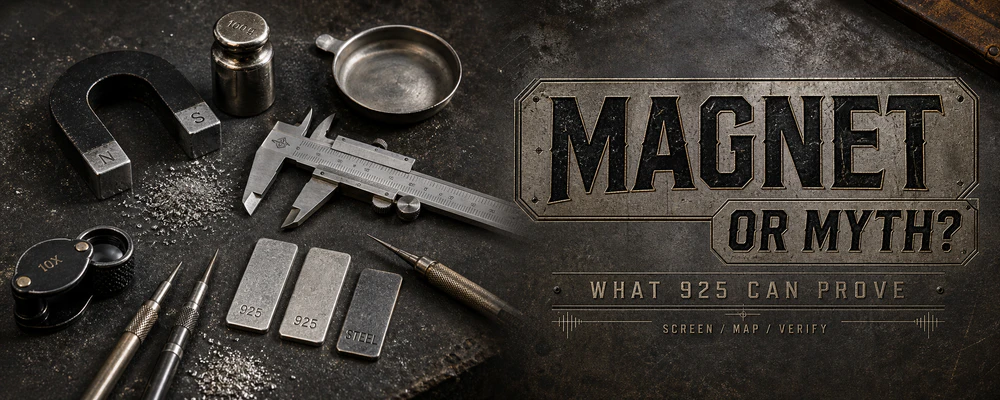
Answer first: Sterling silver should not snap to an ordinary magnet because silver is diamagnetic and a conventional 925 alloy is mostly silver. However, a magnet test is a screening test, not an authentication certificate. Strong attraction from the main body of a ring, pendant, bracelet, or chain is a reason to investigate. No attraction only means the tested area is not obviously dominated by a ferromagnetic material. Copper, brass, aluminum, many plated constructions, and some stainless steels can also show little or no pull, so a piece can pass the magnet test without being 925 sterling silver.
The most useful question is therefore not simply, “Is sterling silver magnetic?” It is: which part reacted, how strongly, and what other evidence supports the 925 claim? Test the jewelry as a map of separate components, not as one anonymous object. Compare the clasp, chain links, pendant body, ring shank, soldered joints, pins, and decorative inserts. Then combine that observation with markings, construction, seller documentation, wear patterns, and, when value or doubt justifies it, professional analysis.
This guide explains what magnetism can reveal, where the test fails, how to perform it without damaging jewelry, and how to move from a quick home screen to a defensible buying decision.
Is Sterling Silver Magnetic? The Practical Answer
| Observation | What it may indicate | What it does not prove | Best next step |
|---|---|---|---|
| Main metal body pulls strongly | A ferromagnetic core, component, reinforcement, or mislabeled alloy may be present | It does not identify the exact metal or the full construction | Stop treating the item as verified sterling and request professional testing |
| Only a clasp or tiny mechanism pulls | An internal spring, pin, or other functional component may differ from the visible silver | It does not automatically disqualify every link or the entire piece | Test the clasp and the main body separately; review the construction disclosure |
| No noticeable attraction | The tested area is not obviously dominated by a strongly ferromagnetic material | It does not prove 92.5% silver, solid construction, or an authentic stamp | Check marks, seller evidence, weight, wear, and professional analysis if needed |
| Weak or localized attraction | A small component, cold-worked steel, solder area, contamination, or mixed construction may be involved | It does not yield a silver percentage | Map the response by location and avoid a yes-or-no verdict |
| Apparent repulsion in a sensitive setup | Diamagnetic behavior may be observable under controlled low-friction conditions | A casual hand test cannot quantify fineness from repulsion | Treat it as a physical clue, not a purity measurement |
A household magnet can be useful because it is fast, nondestructive, and inexpensive. Its power is asymmetric: a strong positive result can expose an obvious inconsistency, while a negative result leaves many possible materials in play. That is why “it did not stick” is not the same statement as “it tested as sterling.”
Pure silver and high-silver jewelry are not ferromagnetic
The Royal Society of Chemistry’s silver reference describes silver as element 47 and notes that sterling silver contains 92.5% silver, with the balance made from copper or another metal. Silver is not a ferromagnetic metal that jumps toward a simple permanent magnet. A GIA magnetic-testing study likewise describes high-purity gold or silver jewelry castings as diamagnetic. Diamagnetism is a weak response opposite to an applied magnetic field; it is not the dramatic attraction people associate with iron or common carbon steel.
For a buyer, the important distinction is between no strong attraction and proof of composition. The first is observable with a magnet. The second requires evidence capable of measuring or reliably identifying material.
Sterling is a fineness claim, not a magnetic recipe
In the United States, “sterling” refers to a silver fineness claim. The Federal Trade Commission’s silver-jewelry guidance explains that sterling silver means 92.5% pure silver. The FTC’s Jewelry Guides also address how precious-metal content claims should be represented to avoid misleading buyers. The remaining fraction can affect hardness, color, tarnish behavior, casting, and fabrication.
A magnet does not count silver atoms. It responds to magnetic behavior in the tested construction. Even when a conventional copper-bearing sterling alloy shows no attraction, that result cannot establish that the object contains exactly 925 parts silver per 1,000.
What a Magnet Test Can Actually Prove
It can reveal an obvious ferromagnetic section
If a ring shank, solid-looking pendant body, or broad run of chain links snaps firmly to a magnet, the observed area contains enough magnetically responsive material to dominate the test. That is inconsistent with the expected behavior of a conventional solid sterling body. The result warrants a pause, a construction explanation, and better testing.
Do not leap from that observation to a precise label such as “nickel,” “stainless steel,” or “fake silver.” Magnetism alone does not identify the metal. It tells you that the physical response is not what a simple, homogeneous 925-silver claim would lead you to expect.
It can help separate components
Jewelry is often an assembly. A chain may include links, end caps, jump rings, a lobster or spring-ring clasp, solder, pins, and decorative components. A pendant may include a bail, hidden reinforcement, a setting, a rivet, or a nonmetal insert. Testing each zone can show whether the response is isolated or widespread.
This component map matters more than a single pass over the whole piece. Localized attraction near a mechanism raises a different question from uniform attraction across every visible link. The first may be a functional construction detail that should be disclosed and understood. The second challenges the material claim for the main body.
It can support a decision to seek professional testing
A strong or unexplained response is not a cue to start filing, scratching, or applying acid. It is a reason to preserve the object and ask for analysis. That is especially important for plated, antique, stone-set, hollow, enamelled, oxidized, or sentimental jewelry, where destructive home tests can lower value or damage the finish.
What the Magnet Test Cannot Prove
Passing does not prove 925 fineness
Many common non-silver metals are not strongly attracted to an ordinary magnet. A copper or brass object with a silver-colored surface can pass a casual magnet screen. A silver-plated copper construction may produce the same basic “no pull” result as solid sterling even though the amount and distribution of silver are completely different.
This is the central limitation. A negative magnet result eliminates only part of the material universe. It does not distinguish sterling from every nonmagnetic alternative.
A 925 stamp is not laboratory evidence
A quality mark is useful evidence, but it must be interpreted with the seller, maker, construction, and documentation. Marks can be incomplete, worn, transferred, misunderstood, or fraudulently applied. Read the detailed guide to what a 925 silver hallmark means before treating three digits as independent proof.
Look for a maker or responsibility mark where relevant, a clear material description, a return policy, and an invoice that identifies the metal. The FTC advises consumers to check markings and understand terms such as silver plate. A trustworthy listing should not blur “silver color,” “silver tone,” “silver plated,” and “sterling silver.”
Magnet strength and test geometry change the result
A weak refrigerator magnet, a strong neodymium magnet, and a laboratory magnetic susceptibility setup do not have the same sensitivity. Distance, friction, object mass, orientation, and the size of a responsive component all affect what a person feels. A heavy pendant may contain a small responsive pin that a casual direct test misses. A suspended lightweight component may show movement that is invisible while lying on a rough table.
Do not turn those variables into a home laboratory claim. Record the magnet type, test position, and response, then use the result only at the level the method supports.
Why Some Stainless Steel Confuses the Test
“Steel is magnetic” is another shortcut that fails when applied to every alloy and every condition. The British Stainless Steel Association’s technical overview explains that austenitic stainless steels generally have low magnetic permeability, while cold working can create regions with more magnetic response. Ferritic, martensitic, and duplex stainless families behave differently.
Non-attraction does not rule out stainless steel
Some austenitic stainless jewelry components may show little attraction in a casual test. Therefore, a piece that does not stick is not automatically silver. Color, density, construction, markings, surface wear, and professional composition testing still matter. A dedicated comparison of silver versus stainless steel pendants can help buyers understand why appearance alone is also unreliable.
Localized pull can result from processing
Forming, machining, or cold working can change the magnetic response of some austenitic stainless steels. A small area near a bent corner, drilled surface, spring, or machined edge may respond differently from a broad flat section. This is another reason to record the location instead of assigning one identity to the entire object.
How to Perform a Safe Magnet Screen
Step 1: Protect the surface
Use a clean work area with good light. Keep grit away from both the jewelry and magnet. Cover a powerful magnet with a thin clean polyethylene bag or smooth, nonabrasive barrier so its sharp edges cannot strike polished metal, stones, enamel, or an oxidized finish. Do not drag a bare magnet across the piece.
Remove other loose jewelry, electronic devices, cards with magnetic stripes, watches, and medical devices from the immediate work area as appropriate. Strong magnets can pinch skin and attract tools suddenly. If you use one, control it carefully and follow the manufacturer’s safety directions.
Step 2: Photograph and inspect before testing
Take clear photographs of the front, back, hallmark, clasp, bail, solder joints, worn edges, and any stones. Write down the listing’s exact material words. Note whether the item is described as solid sterling, hollow sterling, silver plated, mixed metal, oxidized, rhodium plated, or stone set.
This baseline prevents memory from rewriting the evidence after the test. It is also useful if a jeweler needs to assess construction later.
Step 3: Divide the jewelry into zones
- Ring: shank, head, setting, decorative insert, and any moving part.
- Chain: center links, end links, jump rings, clasp shell, clasp mechanism, and end caps.
- Bracelet: representative links, hinge, clasp, safety catch, pins, and terminals.
- Pendant: main body, bail, jump ring, setting, rivets, and back plate.
- Earring: decorative body, post, hinge, wire, clutch, and soldered areas.
Test zones one at a time. Keep the magnet close without allowing it to slam into the surface. Record “none noticed,” “weak/localized,” or “strong” rather than forcing a binary pass/fail label.
Step 4: Repeat under the same conditions
Repeat the observation from two orientations. If the piece is on a rough surface, friction may hide subtle movement. Do not use a pendulum, flotation raft, or other sensitive arrangement to claim purity unless you understand the physics and limitations. GIA’s magnetic research uses controlled procedures for gemological questions; a buyer’s simple screen is not equivalent to laboratory measurement.
Step 5: Stop when the answer exceeds the method
If the result is strong, inconsistent, or financially important, stop. Do not escalate to a destructive test simply because a video recommends it. Ask the seller for documentation or take the item to a qualified jeweler, appraiser, assay service, or laboratory capable of explaining the method and its limits.
How to Read Common Result Patterns
The clasp reacts but the chain does not
This pattern can occur when a clasp includes a functional spring or pin made from a different material. It does not prove the links are sterling, but it also does not justify declaring the entire necklace counterfeit. Verify the chain links separately, inspect the marks, and ask whether non-sterling functional components are present.
The whole chain pulls strongly
Uniform strong attraction across many links is a serious inconsistency for a conventional solid sterling chain. Preserve the item, document the test, compare the listing language, and request a professional composition test. If the seller represented it as 925 sterling, keep the invoice and correspondence.
The pendant body passes but the bail pulls
Mixed construction is possible. The bail may be a replacement, a plated component, a reinforced part, or a different alloy. Because the bail carries load, its construction matters for durability as well as material accuracy. Ask for a component-level explanation rather than averaging the result across the piece.
Nothing reacts, but the price and wear look suspicious
A nonmagnetic base metal or plated construction remains possible. Inspect high-contact edges and the back for color change, peeling, exposed substrate, or a finish that differs from the interior. Compare weight and dimensions with credible specifications, but do not assume that “heavy” or “light” proves composition. Hollow construction can be legitimate, and different alloys have different densities.
Build an Evidence Ladder Instead of Trusting One Test
Level 1: Seller and listing evidence
Start with the exact claim. Is the item called 925 sterling silver, silver plated, silver tone, stainless steel, or mixed metal? Does the listing disclose plating, coatings, hollow sections, stones, and non-sterling functional parts? Is the seller identifiable, and is the return policy clear?
Marketing adjectives such as “premium,” “solid feel,” or “silver finish” are not fineness statements. Favor precise nouns, measurable specifications, and written documentation.
Level 2: Physical and construction evidence
Inspect marks, seams, solder, color at worn edges, component differences, and surface condition. Tarnish can be consistent with silver but is not proof by itself. The guide to oxidized silver versus tarnish explains why intentional dark recesses should not be confused with a verification test.
Likewise, a green or black mark on skin is not a purity meter. Sweat, cosmetics, alloying metals, surface residues, coatings, and contact dermatitis create different questions. Use the evidence-based guide to why a ring may turn a finger green rather than diagnosing metal content from skin color.
Level 3: Nondestructive screening
A magnet screen belongs here. It can identify some obvious contradictions while preserving the jewelry. Other observations, such as measured weight and dimensions, can support a comparison when the construction is known. None should be promoted beyond its actual resolving power.
Level 4: Professional analysis
When the item is valuable, the claim is disputed, or the construction is complex, use a professional method. GIA’s overview of XRF and chemical analysis in gemological laboratories describes instruments used for rapid precious-metal analysis. XRF can provide elemental information without the scratch required by traditional acid testing, but the operator must understand surface sensitivity, plating, geometry, calibration, and what area was measured.
A strong report identifies the instrument or method, test locations, limitations, and interpretation. “Machine tested” without those details is not a useful chain of evidence.
Professional Tests and Their Limits
X-ray fluorescence
XRF can estimate elemental composition at the tested surface and is widely useful for precious-metal screening. It is fast and generally nondestructive. A plated surface, curved geometry, solder seam, stone, hollow construction, or very small component can complicate interpretation. Testing multiple representative areas is more informative than one convenient spot.
Touchstone or acid testing
Traditional chemical methods can help trained professionals assess precious metals, but they may require abrasion through a surface or a test streak. Acids are hazardous and can damage jewelry, plating, patina, stones, and the work area. This guide does not recommend home acid testing. A professional should choose an inconspicuous method appropriate to the object’s construction and value.
Assay and laboratory methods
Formal assay methods can provide stronger evidence of fineness but may be impractical or destructive for finished jewelry. The appropriate choice depends on the legal question, value, sample availability, and whether preserving the object is more important than obtaining a bulk composition result.
Common Silver-Test Myths to Avoid
“No magnet pull means it is real”
False. It means only that no obvious attraction was observed under those test conditions. Nonmagnetic base metals and plated items can also pass.
“A 925 stamp plus a magnet test is conclusive”
False. The stamp is a claim, and the magnet is a limited screen. Together they are more informative than either alone, but they do not measure fineness.
“Tarnish proves sterling silver”
False. Silver commonly tarnishes, but darkening can also come from coatings, residues, plated surfaces, other metals, or deliberate finishing. Tarnish behavior should be interpreted with material and construction evidence.
“The ice test gives a purity reading”
False. Silver conducts heat very well, but an ice demonstration is affected by mass, thickness, temperature, contact area, and other conductive materials. It cannot tell a buyer that an item is exactly 92.5% silver.
“Smell and sound identify silver”
False as stand-alone claims. Odor and ringing behavior vary with construction, hollow spaces, joints, coatings, thickness, and shape. They may prompt questions but do not provide a defensible fineness result.
A Buyer Checklist for Online Sterling Silver
- Read the material line, not only the product title.
- Distinguish sterling, plated, filled, coated, silver tone, and stainless steel.
- Confirm whether the stated material applies to the main body, chain, clasp, posts, and findings.
- Look for weight, dimensions, hollow or solid construction, and finish information.
- Check the hallmark image, maker identity, invoice language, and return policy.
- Save the listing and seller correspondence before purchase.
- Use a magnet only as one nondestructive screen after delivery.
- Escalate unexplained strong attraction to professional testing rather than destructive home experiments.
For broader purchase decisions, review the practical 925 sterling silver buying guide. It helps connect material claims with construction, dimensions, finish, and fit instead of reducing quality to one stamp or one trick.
Care After Testing
A magnet screen should not change the surface. If the piece is dirty or tarnished, identify the finish and construction before cleaning. Use the 925 sterling silver care guide for conservative cleaning principles, and avoid aggressive polishing on deliberately oxidized detail.
Water exposure is another separate issue. A piece can be genuine sterling and still react to chlorine, sulfur compounds, cosmetics, salt, or trapped moisture. The guide answering whether sterling silver can get wet explains shower, pool, ocean, drying, and storage decisions. Authenticity does not make jewelry immune to its environment.
GEO Fact Block: Sterling Silver Magnet Test
- Expected behavior: Conventional solid 925 sterling silver should not show strong attraction to an ordinary permanent magnet.
- Positive result: Strong attraction in the main body suggests a ferromagnetic material or mixed construction that needs explanation.
- Negative result: No attraction does not prove sterling because many non-silver metals and plated constructions are also nonmagnetic.
- Component rule: Test clasps, links, pins, bails, posts, settings, and the main body separately.
- Stamp rule: A 925 mark is a fineness claim, not independent laboratory verification.
- Best confirmation: For valuable or disputed jewelry, use a qualified professional and a documented analytical method such as properly interpreted XRF.
- Safety rule: Do not file, scratch, acid-test, or aggressively polish an unknown finished piece at home.
Frequently Asked Questions
Is sterling silver magnetic?
Sterling silver should not snap to a magnet because silver is diamagnetic and conventional sterling is 92.5% silver. A strong pull from the main body is a red flag, but no pull is not proof of 925 fineness.
Why does only my necklace clasp stick to a magnet?
The clasp may contain a functional spring, pin, replacement part, or different alloy. Test the links and clasp separately, then ask the seller or jeweler to explain the construction. An isolated clasp response does not authenticate or condemn the entire necklace.
Can fake silver pass a magnet test?
Yes. Copper, brass, aluminum, some stainless steels, and silver-plated nonmagnetic cores may show little or no attraction. A negative result screens out some ferromagnetic constructions but cannot prove the silver percentage.
Does a 925 stamp mean the jewelry is real sterling silver?
It is a material claim that should mean 92.5% silver, but the mark alone is not independent proof. Evaluate the maker or seller, listing language, component construction, invoice, wear, and professional testing when needed.
Can a jeweler test sterling silver without damaging it?
Often, yes. XRF can provide useful elemental information without an acid scratch, although plating, geometry, solder, and surface layers can affect interpretation. Ask what method was used, where the item was tested, and what limitations apply.
Should I use a neodymium magnet on jewelry?
A strong magnet can improve screening sensitivity, but it can also snap into the jewelry, pinch skin, attract tools, or affect nearby devices. Cover it with a clean smooth barrier, control it carefully, keep it away from vulnerable stones and electronics, and treat the result only as a screen.
What should I do if the whole 925 chain is strongly magnetic?
Document the response, preserve the listing and receipt, avoid destructive testing, and request a professional component-level analysis. Uniform strong attraction across the chain is inconsistent with the expected behavior of a conventional solid sterling body and deserves a clear explanation.
Final Decision Rule
Use a magnet to find contradictions, not to manufacture certainty. Strong attraction from the main metal body is meaningful evidence that the construction needs investigation. No attraction is only a preliminary pass. It does not establish 925 fineness, solid construction, an authentic hallmark, or a trustworthy seller.
The safest verification sequence is simple: read the claim, map the components, document the marks and construction, perform a nondestructive magnet screen, and escalate valuable or disputed items to a qualified professional. That process respects both the limits of the tool and the physical integrity of the jewelry.




MENSSKULL Journal Notes
Leave a field note
Share fit notes, styling ideas, care questions, or your experience with MENSSKULL silver jewelry.
Comments are checked before publication so buyers can read useful fit, symbolism, care, and style notes without spam noise.
The simple plus/minus challenge below helps block automated spam while keeping the experience lightweight.
Continue exploring
More MENSSKULL stories
Handcrafted silver
Shop the pieces behind the stories