
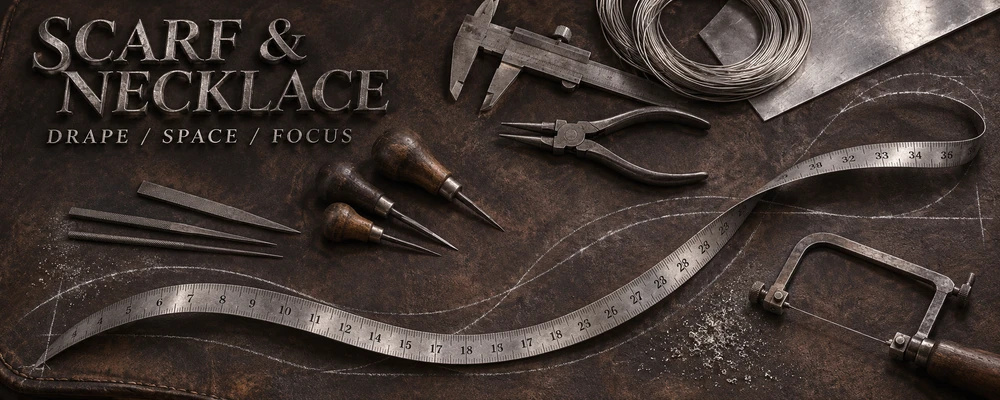
A scarf can cross in front of a necklace, expose it in sections, or place a knot where a pendant would otherwise sit. Arrange the scarf first, then identify the uninterrupted gap that remains. That gap – above the loop, between open ends, or below a crossing – is the only place the necklace needs to solve.
Quick answer: arrange the scarf first. With an open drape, keep a necklace inside the clear center lane or let one pendant sit below the lowest crossing point. With a centered loop or knot, a plain chain usually asks less of the already busy neckline. With fuller coverage, it is reasonable for the necklace to remain hidden rather than forcing a small fragment into view.
Arrange the scarf before judging the necklace
A crewneck, V-neck, or turtleneck holds a repeatable edge. A scarf does not. The same scarf can form two vertical sides, one rounded loop, a compact center knot, or several overlapping folds. Each arrangement changes the amount and location of clear background around the necklace.
Finish the scarf arrangement before evaluating jewelry. Let the ends fall naturally and look at the outfit from the front without pulling the folds apart. The remaining uninterrupted area is the necklace’s working space. This keeps the decision tied to what is actually visible instead of an imagined neckline beneath the scarf.
Open ends leave a usable lane
When both scarf ends fall separately, they make two long borders down the torso. The open area between them becomes a center lane. A plain chain can echo that vertical direction without adding another large object. A pendant can also occupy the lane when its complete outline remains visible and the scarf ends do not cut across it.
Notice where the two ends begin to angle inward or overlap. That point is the lower boundary of the clear lane. A pendant above it is framed by the scarf. A pendant directly on it becomes part of a dense crossing. A pendant below it is read against the shirt, sweater, or jacket rather than inside the scarf frame. Those are three different compositions, even if the necklace itself never changes.
A center knot already occupies the main position
A centered loop, wrap, or knot already places a rounded or compact shape at the throat. Adding a pendant immediately beneath it can create two stacked centerpieces with very little separation. The result may look crowded before color or material enters the discussion.
Test a plain chain as a line rather than another object. If only a short arc is visible above or beside the loop, decide whether that arc looks deliberate. If it appears as two unrelated metal fragments, letting the necklace stay under the scarf is cleaner than trying to display every part. For the broader format choice, the guide to a plain chain or pendant for men owns the comparison.
Dense folds may hide the necklace, and that is fine
Several folds can cover most of the neckline and upper chest. In that arrangement, the scarf supplies volume, edges, and a central mass by itself. A necklace does not need to be moved outside the scarf merely to remain visible. Hidden jewelry is still part of what the wearer chose; it is simply not carrying the public focal role in that version of the outfit.
If a small section of chain appears between folds, judge whether it reads as one continuous detail. Random flashes on both sides of a dense scarf can look accidental because the eye cannot reconstruct the line. Either open a stable window in the drape or allow the necklace to disappear. This is an editorial visibility choice, not a rule about scarf technique or necklace fit.
Give the necklace a specific job
A solid scarf with broad, quiet folds leaves more visual room for a distinct necklace outline. Stripes, checks, fringe, contrasting borders, and multiple crossings add more edges for the necklace to share. Count those visible elements before deciding that the outfit needs another central shape.
Assign each visible element a job. Open ends can frame one contained pendant; a compact knot can be the centerpiece while a plain chain contributes a short line. When the necklace adds no distinct line or shape, leaving it out of view is a finished choice, not a missing step. The guide to adding or skipping jewelry with an outfit covers that broader question.
Four common drapes at a glance
| Scarf arrangement | Clear necklace zone | First format to test | What to inspect |
|---|---|---|---|
| Open drape | Vertical lane between separate ends | Plain chain or one complete pendant | Whether an end cuts across the necklace outline |
| Centered loop or knot | Small arc above or a gap below the center shape | Plain chain | Whether two centerpieces are stacked too closely |
| Fuller layered coverage | One stable window, if any | Hidden necklace or one continuous chain section | Whether visible fragments look intentional |
| Ends crossing low | Upper lane inside the frame or shirt area below it | One format in one zone | Whether the necklace lands on the crossing point |
Position comes before chain length
This method uses relative zones: above a loop, inside an open lane, at a crossing point, or below the scarf frame. It does not prescribe a universal chain length. The same listed length can land differently because the necklace, clasp, pendant, garment, and wearer are not identical.
For measurement language and the differences among common necklace lengths, use the men’s necklace chain-length guide. Return to the scarf only after the actual necklace position is known. The scarf test then becomes simple: is the whole line or shape visible in the intended zone, partly interrupted, or fully covered?
A scarf is not a fixed high neckline
A turtleneck creates a fixed, continuous high-neck surface. A scarf creates movable folds and gaps. Placing a necklace over a turtleneck is therefore a background-and-outline decision, while wearing one with a scarf is an occlusion decision: the frame itself can cross in front of the jewelry.
Keep those owners separate. The guide to a silver necklace over a turtleneck covers the fixed high-neckline case. Applying that method to a scarf would miss the central issue here, which is whether the drape remains stable enough to preserve one readable necklace zone.
Confirm the arrangement in one chest-up photo
Take one chest-up photo with your arms relaxed and the folds untouched. The result should be easy to name: chain inside the open lane, pendant below the crossing, short arc above the loop, or necklace intentionally hidden. If no single description fits, the scarf is interrupting too many parts of the necklace.
If the description requires explaining several tiny visible fragments, simplify the presentation. Change the scarf arrangement, select the simpler necklace format, or remove the necklace from view. This photo check evaluates visual separation only. It does not establish comfort, safe wear, snag behavior, material compatibility, warmth, or performance.
Compare pendant outlines only after finding the gap
The silver pendant necklace collection can help compare current outline shapes after the scarf zone is known. It is commercial navigation, not proof that a particular pendant will sit in a specific gap or work with a particular scarf. Check the actual necklace with the actual outfit before making that judgment.
The scarf-specific method is practical: arrange the drape, locate the uninterrupted gap, decide whether that gap needs a chain line or a pendant shape, and inspect every crossing point. Repeat the check whenever the drape changes. A movable scarf cannot be reduced to one fixed necklace formula.




MENSSKULL Journal Notes
Leave a field note
Share fit notes, styling ideas, care questions, or your experience with MENSSKULL silver jewelry.
Comments are checked before publication so buyers can read useful fit, symbolism, care, and style notes without spam noise.
The simple plus/minus challenge below helps block automated spam while keeping the experience lightweight.
Continue exploring
More MENSSKULL stories
Handcrafted silver
Shop the pieces behind the stories