
Set the Henley buttons first. The placket already draws a vertical line down the chest, so the necklace should either stay clearly inside that opening, cross it deliberately, or sit below it with enough separation to read as a second shape. Choose the shirt setting before choosing between a plain chain and a pendant.
Quick answer: with the placket closed, judge the necklace against the shirt surface. With one or two buttons open, use the opening as a narrow frame and check whether the chain line or pendant stays visible inside it. With a wider opening, make sure the necklace does not land directly on the last button or split the placket into competing shapes.
Read the Henley placket as a moving frame
A crewneck gives a necklace one uninterrupted neckline. A V-neck creates a fixed point. A Henley is different because its button placket changes shape as buttons open or close. The same necklace can appear against fabric in one setup, partly inside the opening in another, and fully within the exposed chest frame in a third.
That means the shirt setting comes first. Put on the complete Henley, settle the fabric, and choose the button position you will actually keep. Do not judge the necklace while holding the placket open by hand. The useful frame is the one the shirt maintains on its own.
With the placket closed, treat the shirt as the background
When every button is closed, the placket becomes a stitched vertical panel. A chain or pendant will either sit above the neckline, remain hidden, or appear over the shirt. If it appears over the shirt, compare its outline with the button line. Two equally strong vertical elements can look accidental when they nearly overlap but do not align.
A plain chain creates a lighter line and can stay secondary to the buttons. A pendant adds a separate object, so its size and shape need enough plain fabric around them to remain readable. If the Henley has contrast stitching, decorative buttons, a chest logo, or a strong texture, count those details before adding a pendant over the same area.
A partly open placket creates the narrowest decision
Opening one or two buttons usually creates a slim vertical window. This is the most demanding setup because the chain can cross the fabric edge while a pendant may sit partly inside and partly outside the opening. Neither result is automatically wrong, but the position should look deliberate in the shirt’s resting state.
Look straight ahead in a mirror, then turn slightly to each side. Treat the last open button as the lower edge of the visible window. If the pendant repeatedly lands on that button or catches the fabric edge, change the button state or compare a simpler chain line before changing the whole outfit. For measurement questions, use the dedicated men’s necklace chain-length guide; this page does not prescribe one universal length.
A wider opening gives a pendant more background
With more of the placket open, a pendant can have a cleaner field between the two fabric edges. The key check is whether the pendant remains inside that field or drops onto the lower button area. A pendant that sits directly over the last visible button can merge two focal objects into one crowded spot.
Use the bottom of the opening as a visual boundary rather than a fixed measurement. Different Henleys have different placket depths, button spacing, and fabric behavior. If you want a pendant to remain within the open frame, verify that result on the actual shirt and chain. If you prefer only a line, compare the role of a plain chain versus a pendant before choosing the format.
Match necklace format to the available space
A plain chain contributes one continuous line. It works best when the placket already supplies enough detail and the necklace only needs to mark the neckline. A pendant contributes a line plus a central shape. It needs more empty background, especially when the Henley has large buttons or contrast stitching.
Do not choose by category alone. First decide whether the opening needs a line or an object. Then compare the actual chain or pendant against the shirt. The silver pendant necklace collection can show available forms, but a category page does not prove that every pendant will occupy a particular Henley opening correctly.
Use the button state to choose the first test
| Henley setup | Visible frame | First necklace test | Watch for |
|---|---|---|---|
| All buttons closed | Shirt surface and button line | Plain chain or one compact pendant over clear fabric | Pendant overlapping decorative buttons or strong stitching |
| One button open | Short, narrow opening | Chain line that remains readable at the neckline | Pendant sitting half inside and half outside the opening |
| Two buttons open | Longer vertical window | One pendant tested against the complete opening | Pendant landing on the lowest open button |
| Wider opening | Broad exposed field between fabric edges | Chain or pendant with a distinct silhouette | Necklace competing with chest graphics or layered details |
Use verified product geometry as a comparison, not a promise
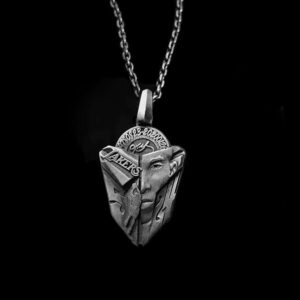
The Mamba Tribute Pendant, SKU SSP198, provides one current pendant reference. Its listing records a 50mm*28mm form, a 26g weight, and 925 Silver. Those facts describe the pendant itself. They do not determine where it will land on a specific chain, whether it fits inside a particular Henley opening, or how it will feel on a wearer.
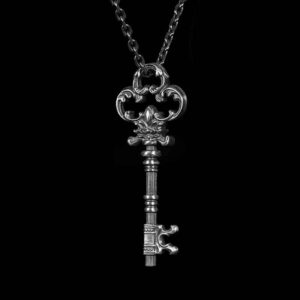
For a longer, narrower comparison, the Fleur-de-Lis Gothic Key Necklace, SKU SSP218, has a listed 63mm*24mm pendant, a 32g weight, 925 Silver construction, and Silver Chain or Steel Chain options. Compare its vertical outline with the Henley opening only after choosing the actual chain and button state. The listing does not establish exact on-body position or compatibility with a particular shirt.
The two verified outlines answer different questions. The 50mm*28mm SSP198 form asks whether the opening provides enough width around a central object. The 63mm*24mm SSP218 form asks whether the placket provides enough uninterrupted vertical space. Put each comparison against the actual button setting; if either outline meets the fabric edge or last open button, a plain chain is the cleaner next test.
Check the necklace from two distances
Start at conversational distance. The chain or pendant should be readable without staring at the button line. Then take a chest-up phone photo in ordinary indoor light. A photo compresses the placket, fabric texture, chain, and pendant into one small frame, which makes near-overlaps easier to notice.
If the necklace disappears, decide whether it can remain a quiet detail or whether the shirt setting should change. If it cuts across the placket awkwardly, adjust the button state before replacing the necklace. If the pendant and buttons form one dense cluster, remove the pendant or use a simpler chain. This is a visibility check, not a rule about fit, comfort, or safe wear.
Keep adjacent shirt questions with their existing owners
A Henley placket is not the same as a polo collar or a fixed V-neck. For collar-and-button interactions, use the guide to wearing a necklace with a polo shirt. For a fixed diagonal neckline, use the men’s V-neck necklace guide. For the broader question of whether an outfit needs jewelry at all, use the guide to adding or skipping jewelry with an outfit.
The Henley decision can be made in three checks: set the buttons, name the visible frame, and decide whether it needs a line or an object. Test the result on the actual shirt from normal viewing distance. Keep it when the necklace and placket remain legible as separate elements; simplify it when both collapse into the same button line.




MENSSKULL Journal Notes
Leave a field note
Share fit notes, styling ideas, care questions, or your experience with MENSSKULL silver jewelry.
Comments are checked before publication so buyers can read useful fit, symbolism, care, and style notes without spam noise.
The simple plus/minus challenge below helps block automated spam while keeping the experience lightweight.
Continue exploring
More MENSSKULL stories
Handcrafted silver
Shop the pieces behind the stories