
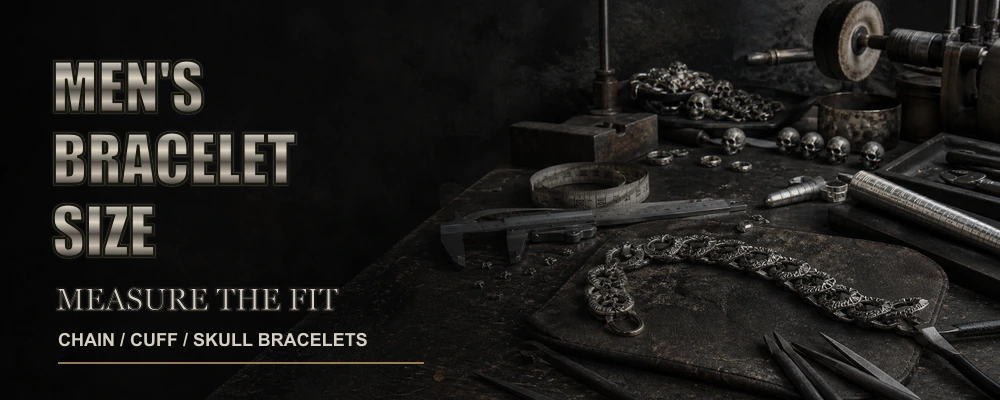
Quick answer: A men’s bracelet size guide should begin with your actual wrist circumference, then explain what the seller’s size option means. Measure at the position where the bracelet will sit, without squeezing the wrist. If the selector is labeled wrist circumference, do not automatically add an allowance before selecting it. If the seller instead lists finished bracelet length, ask how the closed clasp, link thickness and intended fit relate to your measurement. Chain bracelets, closed bangles and open cuffs require different checks; one universal extra-length rule cannot settle all three.
This guide keeps wrist measurement, product dimensions and fit preference separate. It uses current MENSSKULL examples to explain purchase-option labels, not to establish medical safety or guaranteed comfort. Prices, availability and terms belong on each live product listing.
Measure the wrist where the bracelet will sit
Use a flexible measuring tape. Wrap it flat around the intended wrist position and record the point where it meets. Keep it close to the skin without pulling it tight enough to indent the wrist. A narrow paper strip can be used instead: mark the overlap, lay the strip flat and measure from its starting edge to the mark with a ruler. Avoid a thick, stretchy cord that changes length or adds bulk to the measurement.
Measure the actual wrist you plan to use, not the other wrist and not the length of an existing watch strap. A watch strap may include overlap, holes, a folding clasp or a case connection. Those dimensions do not directly describe a jewelry bracelet’s usable interior space.
The official Tiffany bracelet sizing guide also starts with the intended wrist and recommends measuring each position when creating a stack. Its letter-size chart belongs to Tiffany’s system; do not transfer those labels to a MENSSKULL product. The useful shared principle is measuring the location you will actually use, then following the particular seller’s chart.
Record a repeatable measurement
- Choose the intended wrist and bracelet position.
- Keep the tape flat and note the wrist circumference before adding anything.
- Repeat the measurement to check for a loose tape or misplaced overlap mark.
- Record the unit and any difference between repeated readings.
- Read the product selector’s wording before choosing the option.
A second reading is useful because a small measuring error can change the option you investigate. Do not average away a large discrepancy without finding its cause. If the result sits at a boundary between options, ask the seller which option corresponds to your measurement and intended fit.
The ring size and fit research offers broader measurement cautions, but ring circumference charts are not bracelet charts. Wrist shape, cuff opening and bracelet closure introduce different questions. Use the bracelet-specific evidence here rather than converting a ring size into a wrist size.
Decode the number before selecting the size
Two listings can display the same number while describing different things. An 18 cm wrist option identifies the wearer’s wrist measurement. An 18 cm finished-length entry describes part of the bracelet’s construction. A separate 10 mm entry may describe a profile reference, not the bracelet’s length or wrist circumference. Read the label attached to each number.
| Listing label | What it describes | What to do |
|---|---|---|
| Circumference of wrist | The wearer’s wrist reference | Compare with your measured wrist; do not silently add a generic allowance |
| Finished bracelet length | A construction measurement defined by the seller | Ask whether the measurement includes the clasp and how it relates to closed fit |
| Inside cuff dimensions or opening | Interior shape or entry gap | Check both shape and opening against the seller’s fitting instructions |
| Profile size, width or diameter reference | A separate part or profile measurement | Do not treat it as wrist circumference; ask for the axis if undefined |
If a seller asks for wrist circumference, it may already use that measurement to make or select a bracelet with its intended fit. Adding a fixed amount first can therefore apply an allowance twice. Conversely, selecting a finished length equal to your wrist measurement may ignore the construction’s usable interior space. Clarifying the label is more valuable than memorizing one extra-length formula.
Keep unit conversion separate from fit
For conversion, multiply inches by 2.54 to obtain centimeters, or divide centimeters by 2.54 to obtain inches. For example, 7 inches equals 17.78 cm. That calculation changes the unit, not the recommended bracelet size. A product option labeled 18 cm wrist circumference is still a wrist option, not proof that the finished bracelet measures exactly 18 cm.
Inch and centimeter reference chart: These are equivalent measurements, not recommended finished bracelet lengths.
- 6 inches
- 15.24 cm
- 6.5 inches
- 16.51 cm
- 7 inches
- 17.78 cm
- 7.5 inches
- 19.05 cm
- 8 inches
- 20.32 cm
Some selectors round inch and centimeter labels for readability. When the two references do not align exactly, identify the seller’s controlling measurement instead of treating the rounded values as two independent specifications. This is particularly important at a size boundary or when grouped wrist ranges are offered.
Match the sizing check to the bracelet construction
Flexible chains, rigid closed bangles and open cuffs do not enter the wrist in the same way. A chain can usually be opened at its closure. A closed bangle must pass over the hand. An open cuff uses an entry gap and an interior shape. A wrist circumference alone cannot describe every part of those movements.
Chain bracelets: check the closed configuration
Ask how the finished length is measured and what portion of the closure is included. A toggle bar, hook or oversized end ring may have a different relationship to usable closed length than an ordinary small clasp. Link thickness and articulation also affect how the chain sits; neither a flat ruler photograph nor a total length proves the exact interior fit.
The current MENSSKULL examples below use selectors labeled circumference of wrist. Product references were checked September 17, 2026. They illustrate label and construction differences, not a standardized comfort ranking.
| Example | Current wrist options | Separate purchase check |
|---|---|---|
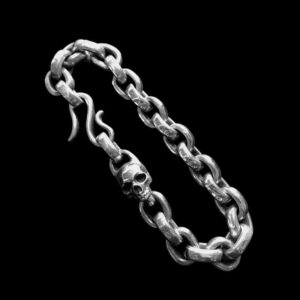
| Skull Clasp Chain Bracelet | 15-23 cm in individual centimeter steps | Inspect the skull and curved hook closure; the 10 mm profile reference is not wrist size |
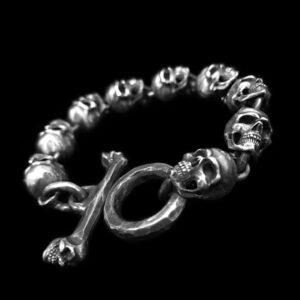
| Heavy Skull Link Bracelet | 15-17 cm, 18-20 cm or 21-23 cm grouped wrist ranges | Confirm the intended point within the range and how the bone-shaped toggle closes |
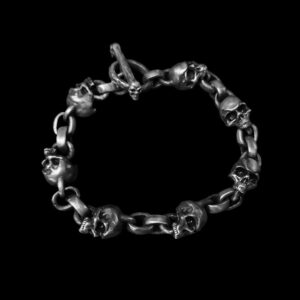
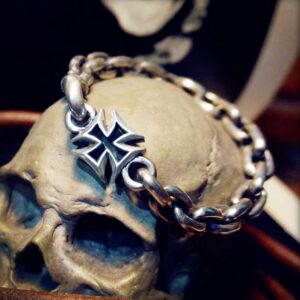
| Iron Cross Chain Bracelet | 15-23 cm in individual centimeter steps | Check the S-hook and centerpiece; the 19 x 15 mm reference has no named axes |
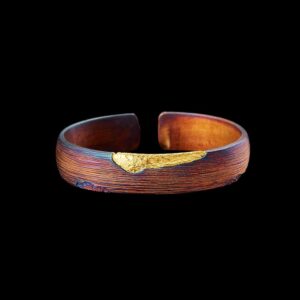
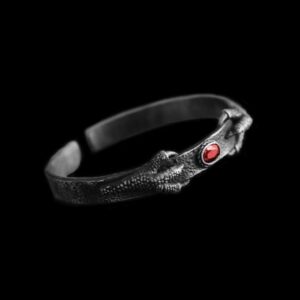
| Eagle Claw Red Stone Cuff | 17-22 cm in individual centimeter steps | Ask for the opening and interior dimensions; the 14 mm reference is not circumference |
A grouped wrist range is not the same thing as a published adjustable length. Do not assume that one option can be bent, stretched or shortened across the range. Ask how the chosen option is prepared for the specific wrist measurement if that detail is not clear.
Open cuffs: check shape and opening without reshaping by guesswork
An open cuff needs both an appropriate interior shape and a way to enter the wrist as designed. Ask the seller to define the opening gap, interior measurements and fitting movement. Do not assume that every silver cuff is meant to be repeatedly squeezed or pulled apart. Sculpted terminals, stone settings and twists can introduce additional constraints.
For a rigid closed bangle, ask for the seller’s hand-entry measurement as well as wrist fit guidance. A bangle that fits the wrist in theory can still fail to pass the hand. The flexible-chain measurement method does not settle that question.
Test movement rather than declaring one fit safest
Close, moderate and loose describe preferences, not universal safety grades. Check whether the piece allows normal wrist movement, whether the closure stays properly engaged and whether the bracelet travels farther than you want toward the hand. An acceptable amount of movement depends on the actual construction and intended use.
Weight does not create an automatic instruction to size up. The Skull Clasp example lists a 70-90+ g range, while the Heavy Skull Link example lists a product-level 120 g. Those entries do not map every option to a measured weight, and they do not establish the correct allowance. Ask for option-specific measurements when a precise weight or interior fit matters.
Include your usual sleeve and any watch in the check. Matching metal color does not establish room between two pieces. Do not force a tighter fit to keep jewelry away from a watch, and do not assume extra looseness will prevent contact. Where contact is unwanted, separating the pieces is a more direct decision than guessing a different size.
Material and care remain separate from sizing. Consult the 925 sterling silver research for material boundaries and the silver care research for finish-sensitive maintenance. Neither a 925 label nor a fitting preference guarantees allergy avoidance, scratch resistance or suitability for sports and machinery.
Questions to resolve before checkout
Should I add half an inch to every bracelet order?
No. First establish whether the seller wants your wrist circumference or lists finished bracelet length. Then follow that product’s sizing guidance. A universal addition can misread the selector or count an intended allowance twice.
What if my wrist falls between two options?
Repeat the measurement, record the unit and ask which option matches that wrist and your intended fit. Do not choose solely by weight or assume that the larger option is always more practical.
Can I use my watch-band size?
Not as a direct substitute. Watch straps and bracelets can include case connections, clasp overlap or adjustment holes. Measure the intended wrist position and compare with the jewelry seller’s own label.
Can I bend an open silver cuff to make it fit?
Only if the seller explicitly provides that instruction for the particular design. An open shape does not prove adjustability, and repeated reshaping should not be assumed acceptable.
How should I choose a bracelet size as a gift?
Obtain the recipient’s actual wrist measurement at the intended position if possible. An existing bracelet can provide useful context only when you know its construction, closed measurements and whether the recipient likes its fit. Do not infer wrist size from body weight, shirt size or a photograph. If the measurement is unavailable, check the seller’s current sizing-help and exchange terms before choosing, rather than describing one size as universally gift-safe.
Once the measurement and option meaning are clear, browse men’s silver bracelets or skull bracelets by construction and silhouette. For the broader purchase checklist, use the bracelet selection guide.
Prepared by MENSSKULL Editorial Team. Updated September 17, 2026. Catalog examples are first-party commercial evidence; the external measurement source uses its own size system. This guide does not provide medical or activity-safety advice.

MENSSKULL Journal Notes
Leave a field note
Share fit notes, styling ideas, care questions, or your experience with MENSSKULL silver jewelry.
Comments are checked before publication so buyers can read useful fit, symbolism, care, and style notes without spam noise.
The simple plus/minus challenge below helps block automated spam while keeping the experience lightweight.
Continue exploring
More MENSSKULL stories
Handcrafted silver
Shop the pieces behind the stories