
Choose a wallet-chain length by measuring between the two attachment points you will actually use, then decide how much visible drop you want. A shorter listed length usually creates a tighter curve, while a longer listed length creates a deeper, more noticeable line. The useful comparison is not a universal “best” length. It is the listed measurement, the positions of the two attachment points, and the proportion you want beside your trousers.
This guide covers observable length, connection points, visible drop, and outfit balance. It does not prescribe a length by height or body type, and it does not make claims about comfort, movement clearance, wallet retention, anti-theft value, hardware strength, safety, or durability. Product examples reflect current listing details only. This evidence does not prove that one length, width, or product is universally preferred.
Measure the route before comparing lengths
A wallet chain is read as a line between two points. Before looking at a size label, identify the exact front and rear points you expect to connect. On one outfit that may mean a front belt loop and a rear loop. On another, the points may sit closer together or farther apart. The same listed chain can therefore create a different visible curve when the connection points change.
Use a flexible tape or a piece of string to follow the route between those points. Do not pull the measuring line into a perfectly straight diagonal unless that is the visual effect you want. Let it form the approximate curve you expect to see, mark the endpoints, and measure the result. This gives you a practical comparison number rather than a rule based on someone else’s photograph.
For unit definitions, use the NIST SI length reference and the BIPM SI Brochure. These sources define measurement conventions; they do not recommend a wallet-chain length or product.
What the listed length changes visually
| Listed-length band | Likely visual role | Check on your outfit |
|---|---|---|
| About 12-16 in / 30-40 cm | Compact curve with less vertical depth | Whether the two chosen points leave enough visible separation for the line to read clearly |
| About 17-22 in / 43-56 cm | Moderate drop that can act as a distinct side detail | Whether the lowest point aligns with pockets, seams, or other hardware |
| About 23-32 in / 58-81 cm | Deep, prominent curve that occupies more of the trouser side | Whether the longer line becomes the main accessory in the outfit |
These are visual comparison bands, not fit prescriptions. Current listings use their own exact measurements and option names. Check the live product page before making a decision.
Short, medium, and long are relative labels
Words such as short, medium, and long are useful only when they refer to a stated number and a specific attachment route. A 20-inch chain may look moderate between widely separated points and deeper between points that sit closer together. Trouser rise, pocket placement, loop spacing, and the position of an attached wallet can all change the visible composition without changing the listed chain length.
Compare numbers rather than relying on the label alone. If a product offers two or three lengths, recreate each option with tape or string on the same trousers. Photograph the alternatives from the same distance. That keeps the garment, camera angle, and surrounding accessories constant while the line length changes.
Record the two endpoints beside each photograph. This matters when you compare another pair of trousers later: a different belt-loop layout can make the same template appear shorter or longer even though its measured length has not changed. Keeping the endpoint notes also prevents a product comparison from turning into a body-size rule. The repeatable inputs are the listed number, the chosen points, the resting curve, and the surrounding garment lines.
Choose the attachment points first
The endpoints determine where the chain begins and ends. Select them before judging the curve. A front-to-rear route creates a long diagonal frame along the side of the trousers. A shorter loop-to-loop route can keep the curve closer to one pocket area. The visual question is whether the two points create a clear path without merging into pocket edges, zipper lines, or multiple pieces of hardware.
Do not treat a photographed arrangement as a performance test. A gallery image can show proportion, connector shape, and listed configuration. It cannot establish how a particular combination will behave in every setting. This page stays with what can be checked directly: the endpoint positions, the listed length, and the resting visual line.
Use visible drop as the decision variable
Visible drop is the vertical depth between the higher endpoint area and the lowest part of the chain’s resting curve. You do not need a universal drop number. You need a drop that occupies the amount of visual space you intend.
A compact drop can act like a small hardware accent. A middle drop can divide the trouser side into a clear arc. A deep drop can become the leading accessory, especially when the rest of the outfit is visually quiet. Look at the whole outfit rather than only the chain. If the chain should lead, give it open space. If a jacket, print, belt, or boot hardware already leads, reduce the number of competing lines.
The wallet chain versus pants chain guide owns the category comparison. This page owns the narrower length and visible-drop decision.
Compare current catalog-defined options
The current MENSSKULL catalog includes examples across several listed length bands. These links are commercial examples, not evidence that one option fits a person, activity, or garment better than another.
| Current example | Listed options observed | What the listing helps you compare |
|---|---|---|
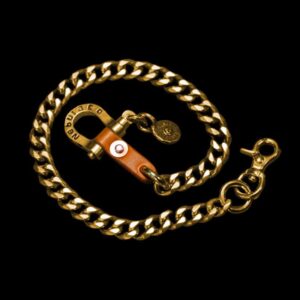
| Leather Shackle Brass Wallet Chain | 30 cm / about 11.8 in; 40 cm / about 15.7 in | Two compact listed routes and a leather-plus-metal visual form |
| Double Skull Clasp Brass Wallet Chain | 40 cm / about 15.7 in; 50 cm / about 19.7 in | A compact and a moderate option on the same listing |
| Brass Curb Wallet Chain with Key Rings | 45 cm / 17 in; 55 cm / 21 in | Two moderate listed lengths with the same overall chain style |
| Bearded Skull Hook Brass Wallet Chain | 45 cm / about 17.7 in; 55 cm / about 21.7 in | A second moderate comparison with different visible endpoints |
| Skull and Feather Wallet Chain | 50 cm / 20 in | A single listed reference point in the middle band |
| Octopus and Cross Pants Chain | 60, 70, or 80 cm / about 23.6, 27.6, or 31.5 in | Three deeper-drop options on one current listing |
Materials differ across these listings, including item-specific titanium steel, brass, and leather/brass labels. Do not generalize the examples as sterling silver. For evidence about what a 925 label means, use the separate 925 sterling silver research guide.
Keep length separate from chain type
Length does not answer whether you want a wallet chain or a pants-chain styling piece. It also does not determine the connector style, motif, link form, material label, or number of visible components. Make those decisions separately so a single product label does not carry too many assumptions.
Start with the intended role. If you are comparing the wider catalog rather than one measurement, browse the pants-chain collection. Then return to the selected item’s exact length options and recreate the route on your own trousers. This sequence prevents a bold product image from replacing the measurement step.
Coordinate the chain with the outfit
A wallet chain shares space with pockets, belt loops, belt hardware, jacket hems, boot hardware, and any graphics near the hip. The length determines how much of that space the chain occupies. A deep curve can create a strong vertical rhythm beside straight trouser seams. A shorter curve reads more like a concentrated detail near its endpoints.
Decide which element should lead. For a restrained outfit, a visible chain can provide the main side detail. For an outfit with several strong components, use a smaller visible arc or remove another competing accessory. The men’s biker jewelry collection can provide broader outfit context, but it does not set a universal wallet-chain length.
Run a three-template test
- Mark the two attachment points on the trousers you plan to use.
- Cut string or arrange a flexible tape at three candidate lengths.
- Let each template form a natural visible curve without forcing the lowest point.
- Photograph each version from the same front-side angle and distance.
- Compare where the lowest point sits relative to the pocket, side seam, and jacket hem.
- Choose whether the chain should be a compact accent, a moderate side line, or the leading accessory.
- Confirm that the live listing offers the selected number and unit.
This test is a visual planning method. It is not a physical-use assessment and does not establish performance in motion.
Common measurement mistakes
Using body height as the rule. Height does not specify the two connection points or the intended curve. Measure the route instead.
Comparing inches to centimeters without reading the number. Keep both units visible when moving between listings. Product pages may round their inch equivalents, so use the listed option as presented.
Measuring a straight line and expecting a deep curve. A curved route uses more length than the straight distance between endpoints. Shape the template before measuring it.
Ignoring the trousers. Loop spacing and pocket position are part of the visual result. Test the actual garment rather than a generic chart alone.
Combining length with unsupported promises. A longer or shorter number does not by itself prove retention, strength, safety, comfort, or durability.
A buyer checklist before ordering
- Identify the exact two attachment points.
- Measure the intended curved route, not only the straight endpoint distance.
- Choose compact, moderate, or deep visible drop as an outfit decision.
- Confirm the live listing’s exact inches or centimeters.
- Read the item-specific material and connector information without generalizing it to other products.
- Compare the lowest point with pockets, seams, jacket hems, and other visible hardware.
- Use product images to inspect form and proportion, not to infer untested performance.
- Recheck current price, availability, images, and variation options on the product page.
The practical answer
Measure between your chosen attachment points, build a curved template, and compare the lowest visible point against the rest of the outfit. About 12-16 inches creates a compact visual route, about 17-22 inches creates a moderate route, and about 23-32 inches creates a deeper, more prominent route in the current catalog examples. Those ranges organize the comparison; they are not universal fit rules.
Choose the number that creates the visual role you want, then verify that exact option on the live listing. Keep material, care, physical-use, and product-performance questions separate and route them to their appropriate evidence owners.
Sources and limitations: NIST and BIPM support measurement terminology only. Current MENSSKULL product pages support exact listed options, item identities, images, prices, and availability at the time checked. Neither source class proves ideal fit, safety, comfort, anti-theft value, strength, durability, popularity, or suitability for a particular activity.
MENSSKULL Journal Notes
Leave a field note
Share fit notes, styling ideas, care questions, or your experience with MENSSKULL silver jewelry.
Comments are checked before publication so buyers can read useful fit, symbolism, care, and style notes without spam noise.
The simple plus/minus challenge below helps block automated spam while keeping the experience lightweight.
Continue exploring
More MENSSKULL stories
Handcrafted silver
Shop the pieces behind the stories