
Quick answer: yes, a man can wear a necklace with a suit and tie. The cleanest approach is to decide whether the necklace should stay concealed, appear only at the collar, or become a visible secondary detail. The tie remains the center line; the necklace should support that line rather than compete with the knot, shirt opening, and jacket lapels.
A suit and tie already create a strong composition. The tie supplies a vertical center, the shirt collar frames the knot, and the jacket lapels create a larger V around both. A necklace introduces another line into that system. It can disappear behind the shirt, flash briefly at the collar, or sit within the visible opening. The right choice is the one that looks deliberate in the complete outfit.
This page owns one narrow decision: how to coordinate a necklace with a suit when a tie is present. For chain length, pendant compatibility, general formal jewelry, or shirt-only placement, use the linked specialist owners rather than treating this article as a replacement for them.
Choose visibility before choosing the necklace
Start with the result you want in the mirror. A concealed necklace is personal and leaves the tie as the only visible vertical accessory. A collar glimpse adds a small metal accent near the face. A more visible necklace creates a second focal point and therefore needs more separation from the knot and tie blade.
Make that choice while wearing the actual shirt, tie, and jacket. A product photo cannot show how much space remains between your collar points, tie knot, jacket button, and lapels. The outfit determines the frame; the necklace enters that frame afterward.
| Visibility route | What the viewer sees | Best mirror check |
|---|---|---|
| Concealed | Tie, collar, and lapels remain the visible structure | Does any part of the chain appear unintentionally at the collar? |
| Collar glimpse | A narrow accent beside or behind the collar line | Does the glimpse look consistent on both sides? |
| Visible above the tie | Necklace becomes a second detail near the knot | Is there clear space between metal, knot, and collar points? |
| Visible in an open jacket frame | Jacket V, tie, and necklace share one vertical area | Which item reads first from normal conversation distance? |
Let the tie remain the center line
A tie runs down the middle of the shirt and usually carries color, pattern, or texture. Treat it as the primary vertical line. If a necklace is visible, place its curve or pendant so the two shapes do not appear accidentally tangled or visually fused.
Step back rather than judging the arrangement from a close-up. From normal viewing distance, ask whether the eye can identify the tie first and the necklace second. If both demand attention at the same moment, simplify one of them. A quieter tie can support a more visible necklace; a patterned tie often benefits from a less visible chain.
Read the collar, knot, and lapels as three frames
The smallest frame is the shirt collar around the tie knot. The middle frame is the open area of the shirt and waistcoat, if worn. The largest frame is the jacket lapel V. A necklace can sit outside one frame while remaining inside another, so evaluate all three.
A compact metal glimpse near the collar may look balanced when the lapels are broad and simple. The same glimpse can feel crowded when the collar points, knot, tie pattern, lapel pin, and pocket square already create several details. The decision is not about a universal amount of jewelry. It is about how many visible shapes occupy the same upper-torso area.
Decide whether a pendant should be visible
A plain chain contributes a line and surface reflection. A pendant contributes a distinct object with its own outline. That difference matters with a tie because a pendant can become a second center marker directly above or beside the knot.
If the pendant stays concealed, the outfit remains visually unchanged. If it appears, compare its outline with the knot and tie width. A narrow vertical pendant can echo the tie, while a wide or highly sculpted pendant creates contrast. Neither route is automatically better; choose the relationship you want the viewer to read.
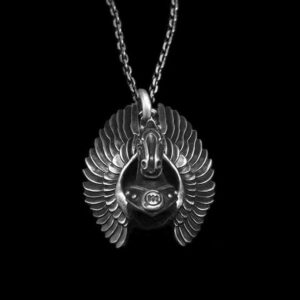
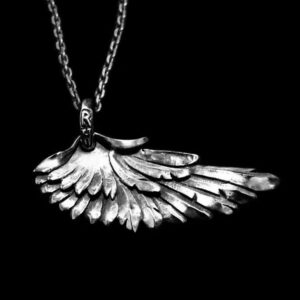
The current Layered Feather Wing Pendant and Armored Pegasus Pendant provide two catalog examples of different visible silhouettes. Their product pages support only the current names, photos, prices, and availability shown there. They do not prove suitability for a particular shirt, tie, chain, event, or wearer.
Use pattern and surface contrast deliberately
A solid tie presents a quieter field than a striped, paisley, knitted, or high-contrast tie. A polished or bright necklace can stand out strongly against a dark solid shirt, while a darkened or visually complex piece may merge into a patterned background. Look at the full arrangement rather than matching by color alone.
When the tie already carries the outfit’s main pattern, keep the necklace visually secondary through limited visibility or a simpler outline. When the tie is restrained, a visible metal accent can carry more of the detail. This is an outfit hierarchy decision, not a claim that one finish is inherently more formal.
Coordinate without forcing every metal to match
Exact matching is one option, not a requirement. Repeating one metal tone across a necklace, watch, ring, tie bar, or belt buckle can create continuity. Deliberate contrast can also work when one item is clearly dominant and the others remain supporting details.
Use the watch and belt-buckle coordination guide for the broader matching decision. This page stays focused on the necklace’s position relative to the tie and jacket frame.
Adjust the plan to the suit configuration
A two-piece suit leaves the shirt and tie more exposed when the jacket is open. A waistcoat adds another V and can reduce the visible shirt area. A double-breasted jacket creates a stronger front structure than a single-breasted jacket. These changes affect how much room the necklace has to appear without crowding the center.
| Suit configuration | Visible center area | Necklace planning cue |
|---|---|---|
| Two-piece, jacket open | Large shirt-and-tie field | Check whether the necklace adds a useful second detail or unnecessary competition |
| Two-piece, jacket closed | Smaller upper opening | Judge the collar and knot area more than the lower chain line |
| Three-piece | Layered collar, tie, and waistcoat V | Keep the visual route especially clear because another frame is present |
| Double-breasted | Strong jacket front with compact opening | Decide whether a collar glimpse is enough |
| Suit separates | Depends on contrast between jacket and shirt | Use the actual color and pattern combination as the test |
Account for other upper-body accessories
A tie bar, lapel pin, brooch, pocket square, boutonniere, and necklace all occupy the upper half of the outfit. You do not need to remove every other accessory, but each additional element changes the hierarchy.
List the visible details from largest to smallest. If the tie, pocket square, and lapel piece already provide three clear focal points, a concealed necklace may be the most coherent route. If the outfit is otherwise restrained, a small visible necklace can become the supporting accent. For lapel placement specifically, use the men’s brooch placement guide.
Use chain length guidance without duplicating it
Length changes where a necklace would fall, but the correct measurement and pendant relationship belong to the men’s necklace chain-length guide. Read that owner before buying, then return here to evaluate what is actually visible with the chosen shirt, tie, and jacket.
If your main question is whether a pendant belongs inside or outside a shirt, use the pendant visibility guide. If you are styling a different collar type, the necklace-with-polo guide owns that garment decision.
Run a four-view mirror test
First, stand with the jacket open and look straight ahead. Second, close the jacket and check the reduced opening. Third, turn slightly to each side to see whether the necklace remains a deliberate line rather than a random flash. Fourth, sit down and repeat the front view because the jacket, tie, and shirt can form a different visual frame.
Photograph the outfit from conversation distance if possible. A close mirror view exaggerates small details, while a photograph shows which element actually leads. Keep the version in which the tie, necklace, and jacket read in a clear order.
Compare the necklace before buying
Use product photos to compare outline, apparent visual weight, surface contrast, and whether a pendant is compact, wide, or directional. Then compare those observations with the open area created by your shirt and jacket. Do not infer exact dimensions, material, included chain, or compatibility from a styling photo; confirm those facts on the current listing.
Browse the men’s silver pendant-necklace guide for the broader buying framework and the gothic pendants category for current commercial options. Use the 925 sterling silver Research guide for alloy and terminology boundaries rather than treating outfit appearance as material evidence.
The practical decision
A necklace can work with a suit and tie when you assign it a clear role. Conceal it when you want the tie and tailoring to carry the entire visible composition. Allow a small collar glimpse when you want a restrained metal accent. Make it more visible only when the shirt opening, knot, tie, lapels, and other accessories leave enough visual space for a second focal point.
There is no need to invent a universal rule. Put on the complete outfit, choose one visibility route, and check the hierarchy from normal distance. If the tie reads first and the necklace reads as an intentional supporting detail, the arrangement is doing its job.

MENSSKULL Journal Notes
Leave a field note
Share fit notes, styling ideas, care questions, or your experience with MENSSKULL silver jewelry.
Comments are checked before publication so buyers can read useful fit, symbolism, care, and style notes without spam noise.
The simple plus/minus challenge below helps block automated spam while keeping the experience lightweight.
Continue exploring
More MENSSKULL stories
Handcrafted silver
Shop the pieces behind the stories