
Direct answer: Lion rings are popular because a lion’s face, mane and profile translate into a highly recognizable piece of small-scale sculpture. Historical objects connect lions with different ideas in different cultures, while modern wearers may read the motif as strength, leadership, pride or simply bold design. A ring cannot grant those qualities.
The best choice depends less on a universal meaning and more on relief, scale, material, finish, finger fit and the way the ring works with a wardrobe.
There Is No Single Universal Lion Meaning
Lions appear in art across many regions and periods, but their meanings are context-specific. A museum record can explain one object without establishing what every lion ring has meant throughout history.
The Metropolitan Museum of Art describes a 12th-century Iranian ring with a seated lion whose imagery may relate to glory and prosperity. That interpretation belongs to this documented object and should not be turned into a universal promise.
Royal and Protective Associations Depend on Context
Another Met object, an Asante gold lion ornament, relates the lion to royal power in a particular political and cultural setting. Its material, use and history differ from a modern men’s silver ring.
These records show why careful wording matters. It is reasonable to discuss historical associations; it is not reasonable to say that wearing any lion ring makes the owner powerful, royal or protected.
The Motif Works as Small-Scale Sculpture
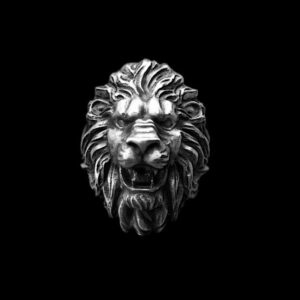
A lion supplies natural visual structure: brow, eyes, muzzle, ears and mane. Designers can compress those features into a signet-like face or expand them into a projecting three-dimensional head. Deep mane channels also create strong contrast when recesses are darkened.
This legibility explains much of the motif’s appeal. It remains identifiable from normal viewing distance when the carving is controlled and the proportions are clear.
Choose Between Signet and Sculptural Profiles
A signet profile places the lion on a flatter face and usually sits closer to the hand. A sculptural head projects farther and can feel more dramatic. Projection matters for comfort because high ears, a raised mane or an extended muzzle may catch clothing.
Compare the solid lion ring with the Simba lion ring. Use their current product photographs and listed dimensions; names alone do not establish identical size, weight or construction.
Read the Mane as Texture and Contrast
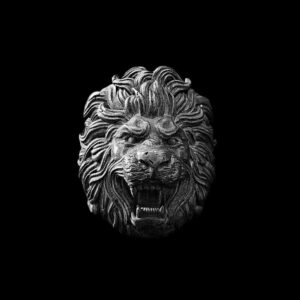
The mane can be carved as flowing strands, geometric blocks, a halo or a compact border. Long cuts create movement, while short repeated marks feel denser. Oxidized recesses can make the mane readable, and polished high points can separate the forehead and muzzle.
More texture is not automatically better. If every surface carries deep marks, the eyes and expression may disappear. A strong design controls where detail begins and ends. For a pronounced mane and open-mouth expression, compare the open-mouth lion ring in its front and side photographs.
Compare Face Dimensions and Projection
Face height runs along the finger, width reaches toward neighboring fingers and projection measures how far the ring rises. All three affect daily wear. A broad face can crowd adjacent fingers; a high head can catch a pocket; a long face may touch the knuckle when the hand bends.
Review top, side, back and interior views. A macro image shows carving but can exaggerate apparent size, so written measurements and an on-hand photograph remain important.
Verify Sterling Silver and Other Alloys
The FTC states that sterling silver contains 92.5 percent pure silver. Silver tone, plating and stainless steel are different descriptions. Check the exact product page rather than assuming every silver-colored lion ring has the same alloy.
The FTC precious-metal guide explains common terminology. Explore the broader men’s silver ring collection to compare forms, but verify each listing independently.
Measure the Finger and Account for Band Width
Measure the intended finger rather than copying a size from another hand. Wide bands can feel tighter than narrow bands with the same nominal size. Knuckle shape, temperature and time of day can affect the measurement.
The GIA sizing benchmark notes that wider bands need appropriate gauges. A stable fit is especially important when the face is top-heavy.
Style the Ring as One Focal Point
A detailed lion ring usually looks strongest when it leads the hand. Pair it with a quieter band or leave the other hand less crowded. Repeat the silver tone, darkened finish or leather texture rather than repeating lion imagery on every accessory.
Compact profiles can work with a jacket and cuff. Larger sculptural heads suit simpler outfits where they have enough visual space. Neither approach is inherently more masculine or confident.
Separate Symbolism From Personal Claims
A wearer can choose a lion to remember a personal value, family story, sports identity or favorite artwork. That meaning is valid as personal interpretation. It should not be presented as a historical fact unless a reliable source supports the connection.
Avoid claims that a ring increases courage, status, leadership or attraction. Those promises cannot be measured from alloy or design.
Maintain Relief and Darkened Detail
Sterling silver can tarnish and scratch. Store the ring dry, wipe it with a soft cloth and avoid abrasive compounds that can flatten polished edges or strip intentional oxidation from the mane. Remove high-relief rings before heavy work or activities where they can snag.
GIA’s jewelry care guidance recommends attention to materials and professional inspection when appropriate. Stones, plating or adhesives may need more conservative care.
Use a Practical Buying Checklist
Confirm the exact material, face height, width, projection, band width, selectable size and finish. Check several viewing angles, shipping and return terms, and whether the design remains comfortable when the hand bends. Treat symbolic language as interpretation rather than specification.
A lion ring earns its place through coherent sculpture and fit, not through an exaggerated promise about the wearer.
FAQ
Why do men wear lion rings?
Reasons include visual design, personal symbolism, cultural interest and statement styling; there is no single universal reason.
Does a lion ring make the wearer more courageous?
No. A ring can represent a personal value, but it cannot grant courage, leadership or status.
Which finger is best for a lion ring?
There is no mandatory finger. Choose one where the face remains stable, comfortable and clear of neighboring fingers.
Is every silver-colored lion ring sterling silver?
No. Verify whether the listing states sterling silver, plating, stainless steel or another material.
How do I care for an oxidized lion ring?
Use a soft cloth and conservative cleaning; aggressive polishing can remove the dark contrast that defines the carving.

MENSSKULL Journal Notes
Leave a field note
Share fit notes, styling ideas, care questions, or your experience with MENSSKULL silver jewelry.
Comments are checked before publication so buyers can read useful fit, symbolism, care, and style notes without spam noise.
The simple plus/minus challenge below helps block automated spam while keeping the experience lightweight.
Continue exploring
More MENSSKULL stories
Handcrafted silver
Shop the pieces behind the stories