

Direct answer: People wear skull rings for many reasons, including memento mori traditions, remembrance, gothic or biker-influenced style, sculptural design and private personal meaning. A skull is not a universal code. It does not prove courage, criminality, club membership, rebellion or a particular belief, and it cannot make a wearer confident by itself.
The most accurate interpretation begins with context: the ring’s documented source, accompanying symbols, inscription, date and the explanation offered by its wearer or maker.
Memento Mori Is a Documented Historical Context
The Latin idea of memento mori, commonly translated as remember that you must die, appears in European art and jewelry. Surviving objects connect skull imagery with mortality, remembrance and moral reflection rather than a single modern subculture.
The British Museum documents a memento mori ring in its collection. One museum object is evidence for a historical use, not proof that every skull ring carries the same intention.
Jewelry Meanings Change Across Time and Place
Materials, production methods and social uses shift as jewelry moves among court, memorial, religious, military, workwear and fashion settings. Skull imagery can therefore acquire new associations without erasing earlier ones.
The V&A’s history of jewellery provides broader context for changing techniques and meanings. Modern retail descriptions should distinguish documented history from imaginative storytelling.
Remembrance Can Be Public or Private
A wearer may associate a skull with a deceased person, a difficult period or a reminder to value limited time. An engraving, date or inherited provenance can make that meaning specific. Without such evidence, observers should not assign a memorial story to someone else’s ring.
Personal meaning is valid because the wearer gives it meaning, not because the symbol guarantees a universal interpretation.
Modern Subcultures Use Skulls in Different Ways
Skulls appear in biker, rock, punk, metal, gothic, tattoo and streetwear aesthetics. In these settings, the image may communicate toughness, mortality, dark humor, group taste or simply a preference for high-contrast anatomy.
A generic retail ring does not establish motorcycle-club membership or rank. Protected insignia, patches and organizational emblems should not be copied or worn to imply affiliation without permission.
Sculpture and Surface Can Be the Main Attraction
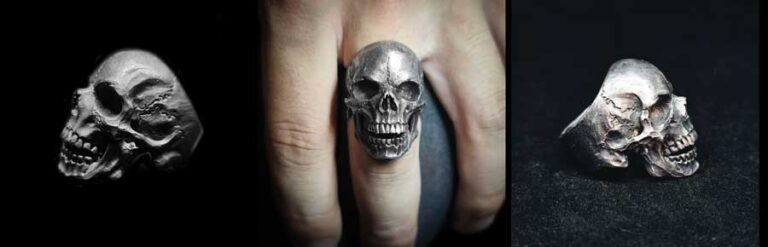
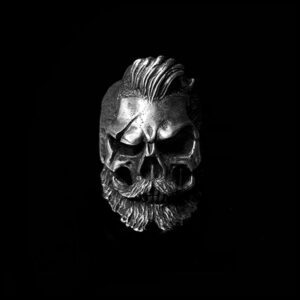
The skull offers deep eye sockets, teeth, cheekbones and curved surfaces that respond strongly to engraving, relief and oxidation. Polished high points against dark recesses produce readable contrast at a small scale.
Some people choose the motif for this visual structure alone. A design preference does not require a philosophical or subcultural explanation.
A Ring Cannot Create Confidence
Clothing and jewelry can help a person feel prepared or express a chosen style, but claims that a skull ring makes someone confident confuse an accessory with a psychological outcome. Confidence depends on the individual and the situation.
Use the ring as a visible preference, not a promise of power, fearlessness, protection or status.
Read Accompanying Symbols Carefully
Wings, crowns, roses, snakes, crosses, numbers and inscriptions can change the composition, but they do not have one automatic meaning. A rose may create contrast between life and death in one design and serve as decoration in another.
The skull ring meaning guide compares common interpretations while keeping personal and documented meanings separate.
Choose a Skull Ring by Profile and Fit
After meaning comes function. Compare face height, width, projection and band width. A tall skull casts dramatic shadow but can catch pockets or gloves. A lower relief design may be easier for everyday wear.
Measure the intended finger and remember that wide bands can feel tighter. GIA’s ring-sizing benchmark explains the use of appropriate gauges for wider bands.
Verify Metal and Finish
Sterling silver contains 92.5 percent pure silver. Silver tone, plating and stainless steel are different descriptions. Oxidation can emphasize a skull’s carving but does not establish the underlying alloy.
Consult the FTC’s precious-metal buying guide, then verify the actual listing. A 925 stamp does not prove origin, handmade production or every marketing claim.
Compare Designs Without Diagnosing the Wearer
Browse the skull ring collection by face shape, scale, finish and construction. The broader history of skull rings offers additional context for style changes.
Do not infer a person’s temperament, politics, religion, profession or risk tolerance from a ring. Ask when the meaning matters.
Style the Ring With Visual Hierarchy
A large skull ring can lead a simple outfit with denim, leather, knitwear or a plain shirt. A compact skull signet can sit beside a quieter band. Matching metal finish usually creates more cohesion than repeating several skull motifs.
Remove rings before machinery, electrical work, heavy lifting or any task where jewelry can catch or compress the finger.
Separate Provenance From a Retail Story
An antique or inherited ring may have a date, maker’s mark, inscription, receipt or family record that supports its history. A newly manufactured ring may accurately cite an artistic period or documented object as inspiration. Those are different forms of evidence.
Be cautious when a description calls a modern skull design ancient, sacred, protective or historically exact without identifying a source. Similar appearance does not prove that materials, methods or meaning were carried forward unchanged.
Ask Better Questions Before Buying
Instead of asking what every skull ring means, ask what this design depicts, which details are documented, how large it is and what material was used. Confirm whether stones are natural, laboratory-grown or imitation, and whether dark areas are oxidation, enamel, coating or photography.
These questions preserve space for personal interpretation while preventing symbolism from hiding missing specifications. A responsible listing can describe inspiration and style without assigning a personality or promised outcome to the buyer.
FAQ
What does a skull ring symbolize?
It may refer to mortality, remembrance, subculture, dark humor or design, but context and the wearer determine the meaning.
Are skull rings connected only with bikers?
No. Skull imagery appears in historical jewelry and many modern fashion and subcultural settings.
Can wearing a skull ring make someone more confident?
A ring can support self-expression, but it cannot guarantee confidence or another psychological outcome.
Does a skull ring mean club membership?
No. A generic skull ring does not prove membership, rank or authorization to use an organization’s insignia.
How should a skull ring be selected?
Compare size, projection, band width, material, finish, construction and the intended context of wear.



MENSSKULL Journal Notes
Leave a field note
Share fit notes, styling ideas, care questions, or your experience with MENSSKULL silver jewelry.
Comments are checked before publication so buyers can read useful fit, symbolism, care, and style notes without spam noise.
The simple plus/minus challenge below helps block automated spam while keeping the experience lightweight.
Continue exploring
More MENSSKULL stories
Handcrafted silver
Shop the pieces behind the stories