
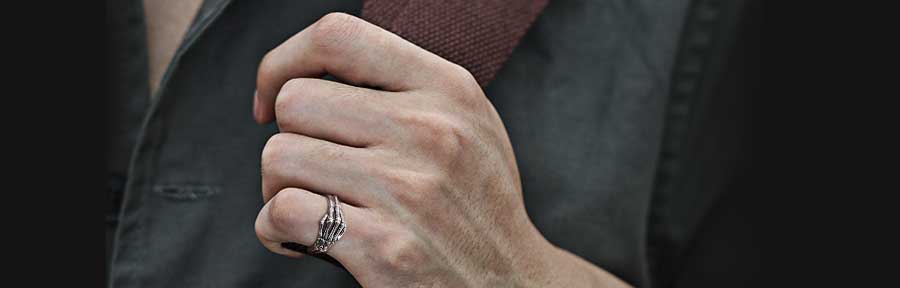
Direct answer: What makes men’s rings useful and expressive is their range, not one supposedly perfect design. Choose a ring by identifying its purpose, measuring the intended finger, comparing face height and projection, verifying the material and checking whether the construction suits everyday wear. A ring can communicate taste or personal meaning, but it cannot prove character, status or confidence.
The best comparison begins with measurable details and the wearer’s routine rather than a dramatic close-up photograph.
Decide What Role the Ring Will Play
An everyday band should remain comfortable through normal hand movement. A signet can provide a compact focal point, while a sculptural skull or animal ring creates stronger visual weight. A wedding or memorial ring may prioritize symbolism and long-term wear over seasonal styling.
Browse the men’s ring collection to compare these profiles, then verify the specifications on each live listing.
Understand the Main Ring Profiles
Plain bands emphasize proportion and finish. Signets use a flat or raised face that may be engraved. Stone-set rings add color and require secure settings. Sculptural rings use relief, undercuts and darkened recesses to create depth.
None of these forms is inherently more masculine. The relevant differences are scale, comfort, construction and how the design relates to the wearer’s clothing.
Measure the Intended Finger
Finger size differs between hands and between fingers. Temperature and time of day can also change fit. Measure the exact finger and avoid copying the size of an unrelated ring unless its interior shape and band width are comparable.
GIA’s ring-sizing benchmark explains why suitable gauges and wider-band measurements matter.
Account for Band Width and Interior Shape
A wide band contacts more skin and often feels tighter than a narrow band at the same nominal size. A comfort-fit interior has a rounded profile, while a flatter interior may provide more contact. Neither should be assumed from the front photograph.
Ask for band width at the palm side and confirm whether the seller recommends a sizing adjustment for the exact design.
Read Face Height, Width and Projection
Face height runs along the finger, width approaches neighboring fingers and projection shows how far the design rises. Tall relief can look impressive but catch pockets, gloves or straps. A wide face may touch adjacent fingers during grip.
Use millimeter dimensions and side views for scale. Macro photography is valuable for detail but can make a compact ring appear much larger.
Verify Material Descriptions
Sterling silver contains 92.5 percent pure silver. Silver tone, silver plate and stainless steel are different descriptions. A 925 mark supports a fineness claim but does not prove origin, handmade production or the material of every added component.
The FTC’s precious-metal buying guide explains common terminology. Confirm stones, enamel, plating and mixed-metal parts separately.
Use Finish to Control Contrast
Polished silver reflects light strongly. Brushed surfaces appear quieter, and oxidized recesses emphasize carving. Hammered or engraved texture can disguise minor wear but may collect residue. Finish changes appearance and care requirements; it does not prove alloy quality.
Do not aggressively polish intentional darkening or fine texture. Ask how the photographed finish is expected to age.
Inspect Construction and Stress Points
Check the shoulders where the face meets the band, thin projections, soldered seams and stone settings. An open-back design may reduce weight but should have finished edges. A heavy appearance does not guarantee solid construction.
For sculptural examples, compare the skull ring collection by side, interior and rear views rather than front design alone.
Treat Symbols as Contextual
Skulls, snakes, lions, crosses and heraldic devices can have historical, subcultural or personal associations. There is no universal meaning that applies to every wearer. A retail motif does not establish club membership, profession, religion or personality.
When a specific historical claim matters, look for a named object, period or source rather than accepting a broad legend.
Match the Ring to Daily Activities
Low-profile rings are generally easier around pockets and gloves. Remove rings before machinery, electrical work, heavy lifting, contact sports or tasks where jewelry can catch or compress the finger. Workplace rules take priority over styling.
Try a new ring during an ordinary day before wearing it for travel or a long event. Persistent pressure, spinning or deep impressions suggest a fit or proportion problem.
Coordinate One Dominant Ring
A large statement face reads clearly when neighboring rings and wrist accessories are restrained. A compact signet can share a hand with a plain band if their widths leave comfortable space. Matching finish often creates more cohesion than repeating the same motif.
The goal is visual hierarchy, not a fixed rule about the number of rings a man may wear.
Check the Complete Product Specification
Before ordering, record ring size, face dimensions, band width, weight range, material, finish, stone information and return or resizing terms. Confirm whether photographs show the exact selectable variation.
The current MENSSKULL catalog can help compare styles, but the individual product page remains the source for current options.
Plan Care and Storage
Store rings separately so projecting details and stones do not scratch other pieces. Wipe after wear and inspect settings, seams and thin areas. GIA’s jewelry care guidance recommends suitable storage and periodic inspection.
Cleaning methods should follow the least tolerant component, especially when a ring includes stones, enamel, plating or intentional oxidation.
FAQ
What is the most versatile men’s ring style?
A low- or medium-profile band or signet is often easy to coordinate, but fit and routine determine actual versatility.
Why can a wide ring feel tighter?
It contacts more skin than a narrow band and may require a different sizing approach.
Does a 925 stamp prove a ring is handmade?
No. It relates to a sterling-silver fineness claim, not production method or origin.
Can a large ring be worn every day?
It can when dimensions, fit and activities are compatible, but it should be removed for hazardous tasks.
How many rings should a man wear?
There is no fixed number. Prioritize comfort and give one design visual emphasis when clarity is desired.







MENSSKULL Journal Notes
Leave a field note
Share fit notes, styling ideas, care questions, or your experience with MENSSKULL silver jewelry.
Comments are checked before publication so buyers can read useful fit, symbolism, care, and style notes without spam noise.
The simple plus/minus challenge below helps block automated spam while keeping the experience lightweight.
Continue exploring
More MENSSKULL stories
Handcrafted silver
Shop the pieces behind the stories