
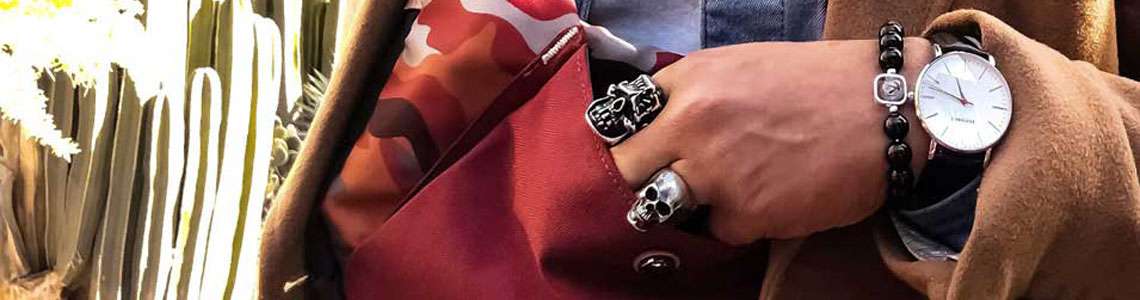
Short answer: men’s skull accessories look strongest when one piece leads and the others support it through scale, metal tone or texture. Start with a ring, pendant, bracelet, brooch or chain that suits the outfit and occasion. Then add fewer, quieter elements rather than repeating the same skull motif across every visible accessory.
Skull Accessories Are a Design Category, Not One Trend
Skull imagery appears in rings, necklaces, bracelets, skull earrings for men, brooches, wallet chains, belt hardware and other accessories. Those products serve different functions and sit in different visual zones. A ring moves with the hand, a pendant occupies the chest, and a brooch creates a fixed point near the collar or lapel.
Because the category is broad, “skull accessory” does not describe one size or style. The skull accessories collection can be approached by product type, then narrowed by dimensions, material, finish and intended use.
Choose One Focal Zone
Decide where the eye should land first. A large skull ring makes the hand the focal zone. A detailed pendant makes the chest the focal zone. A wallet chain creates movement at the hip. If all three are equally large, the outfit loses hierarchy.
Supporting accessories do not have to disappear. They can repeat oxidized silver, a brushed surface or a geometric line without repeating another large skull. This approach makes the central motif clearer and allows each piece to remain useful beyond one themed outfit.
Understand the Historical Reference Without Overstating It
Skull imagery has appeared in remembrance and memento mori jewelry, among other contexts. The Metropolitan Museum of Art’s discussion of life-and-death imagery in jewelry provides a documented historical example. The Victoria and Albert Museum’s jewelry history overview also shows that adornment changes meaning across time and society.
Modern wearers may connect skulls with mortality, resilience, remembrance, rebellion, music culture or sculptural design. Those meanings can be genuine without being universal. Product descriptions should identify documented references and leave personal interpretation to the wearer.
Match the Accessory to the Garment
Rings pair easily with denim, leather, workwear and plain tailoring because they occupy a small visual area. Pendants need a shirt opening or uninterrupted fabric that lets the chain and motif read. Brooches work best when the fabric can support the pin without sagging. Wallet chains require secure attachment points and enough length for movement without reaching the knee or catching furniture.
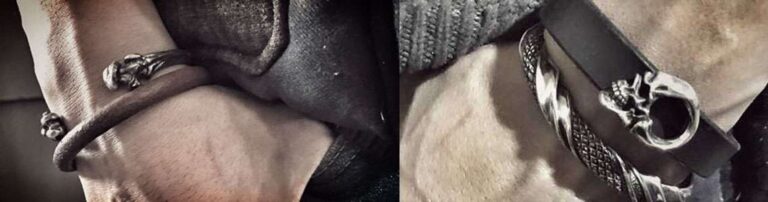
Heavy textures support more visual weight. A substantial bracelet may suit a leather jacket but overpower a fine summer shirt. A compact oxidized ring can provide enough contrast with a clean knit. Style decisions become easier when the product’s real dimensions are known.
Build From Ring, Necklace or Bracelet First
A ring is a controlled starting point because it is visible but easy to remove. Compare face height, width, band size and weight in the skull ring collection. A necklace creates more impact and should be evaluated by pendant dimensions, bail opening, chain length and total drop through the skull necklace collection.
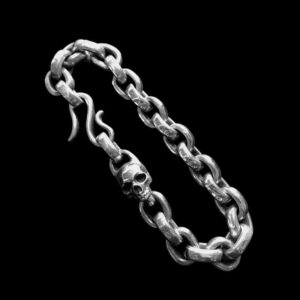
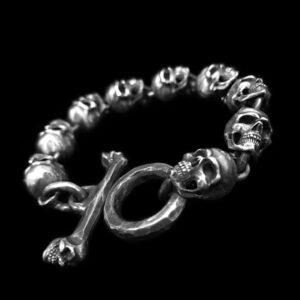
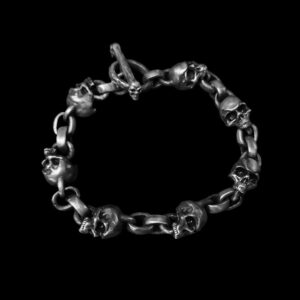
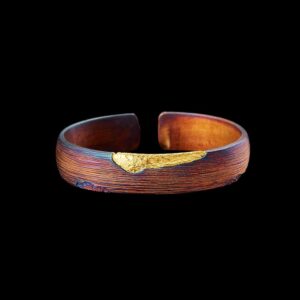
A bracelet adds movement and texture at the wrist. Check wearable length, clasp, articulation and watch clearance in the men’s bracelet collection. Choose whichever zone best matches your routine, then add only what the outfit still needs.
Use Scale to Prevent Costume Effect
Scale is the relationship between the accessory, the wearer and nearby clothing. A large skull face, thick chain and broad bracelet can each work individually, but wearing all three at maximum scale may feel staged. Reduce at least one dimension: choose a smaller pendant, a narrower bracelet or a ring with shallower relief.
Count visual mass rather than item count. Two compact rings may be quieter than one deep sculptural ring. A fine chain with a detailed pendant may be more controlled than a plain but extremely thick chain. Measurements make these comparisons objective.
Coordinate Finish Instead of Repeating Motifs
Polished silver creates highlights, brushed silver is quieter, and oxidized recesses emphasize sculpture. Matching the finish family across two pieces creates cohesion without requiring matching skulls. A polished chain can support a polished edge on a darkened ring; a brushed bracelet can echo matte clothing hardware.
Mixed metals can also work when the contrast is deliberate and repeated once elsewhere, such as a belt buckle or watch detail. Avoid assuming every dark surface is the same treatment. Blackened metal, oxidized silver, enamel and coatings have different care requirements.
Verify Material and Construction
Read “sterling silver,” “silver plated” and “silver tone” as different descriptions. The Federal Trade Commission’s consumer guidance on buying precious-metal jewelry explains why metal representations matter. If a product includes a chain, clasp, pin, spring or stone, confirm those components separately.
Construction should suit the accessory. Ring interiors need smooth edges. Pendant bails must accommodate the chain’s end hardware. Bracelet clasps need secure alignment. Brooch pins must lock and suit the fabric. Wallet-chain clips should close reliably and should not have sharp edges that damage clothing.
Protect Comfort and Safety
Remove jewelry around machinery, impact, chemicals and activities where a ring, chain or bracelet can catch. Heavy pendants should not swing into tools or exercise equipment. Long wallet chains should stay clear of moving parts and walking hazards. Brooch pins should be closed before the garment is put on or stored.
Comfort is measurable. Check ring size, bracelet circumference, chain length, pendant weight and accessory projection. A meaningful design that cannot be worn safely is not a useful purchase.
Care for the Entire Accessory System
Store pieces separately so raised skull details do not scratch polished surfaces. Wipe skin oils after wear, inspect clasps and connecting rings, and avoid aggressive polishing over intentional oxidation. GIA’s jewelry-care guidance recommends considering every material and treatment before selecting a cleaner.
Rotate pieces rather than wearing the same heavy combination daily. Rotation reduces repeated contact and also makes the wardrobe more flexible. The goal is not to display the maximum number of skulls; it is to build a small group of accessories that remain distinct and wearable.
FAQ About Men’s Skull Accessories
Are skull accessories only for Gothic or biker outfits?
No. A compact ring, restrained pendant or small brooch can work with denim, workwear, monochrome casual clothing or simple tailoring. Scale and finish matter more than a fixed label.
How many skull accessories should I wear at once?
Start with one focal piece. Add a second only if it supports the first through metal tone or texture without competing at the same scale.
Can I mix a skull ring with a skull necklace?
Yes, but vary their visual weight. Pair a large ring with a smaller pendant, or let a detailed pendant lead while the ring remains compact.
How can I tell whether an accessory is sterling silver?
Review the complete material disclosure and any fineness information. Do not infer composition from color, price or a close-up photograph.
What is the safest skull accessory for daily wear?
The safest choice depends on work and routine. A correctly sized low-profile ring or compact pendant may be practical, but all jewelry should be removed when machinery, chemicals or impact create risk.
MENSSKULL Journal Notes
Leave a field note
Share fit notes, styling ideas, care questions, or your experience with MENSSKULL silver jewelry.
Comments are checked before publication so buyers can read useful fit, symbolism, care, and style notes without spam noise.
The simple plus/minus challenge below helps block automated spam while keeping the experience lightweight.
Continue exploring
More MENSSKULL stories
Handcrafted silver
Shop the pieces behind the stories