
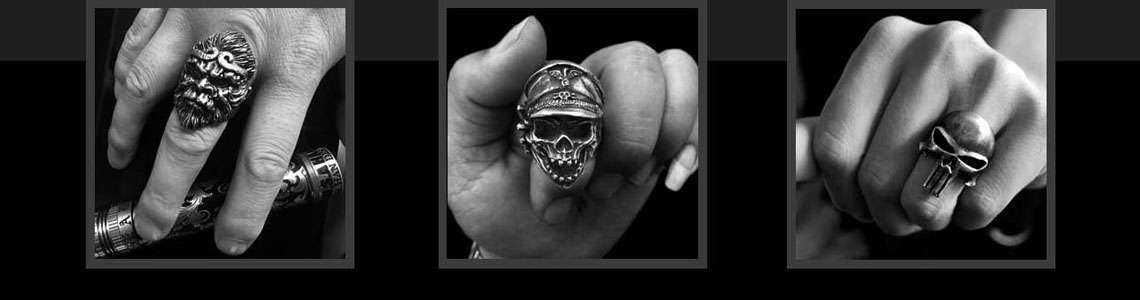
Direct answer: Style men’s skull jewelry with dark elegance by choosing one dominant skull piece, repeating its metal tone or finish in quieter accessories, and balancing its scale against the clothing. Dark elegance comes from controlled contrast and precise fit, not from wearing the motif everywhere.
Skull jewelry can work with denim, leather, knitwear and tailoring. The result depends on relief, placement, finish and context rather than a fixed subculture uniform.
Define Dark Elegance as Controlled Contrast
Dark elegance combines a strong subject with restraint. A skull may provide the focal image while clean clothing, limited color and deliberate spacing keep the outfit readable. This is different from turning every accessory into a matching costume set.
Begin with the men’s skull jewelry collection to compare formats. Use each product page for exact dimensions, material and selectable options.
Choose One Primary Focal Point
A large ring, detailed pendant or heavy bracelet can each lead an outfit. Select one. Supporting jewelry can repeat silver tone, oxidized contrast or geometric weight without repeating another skull.
View the complete outfit at normal distance. Fine carving that dominates a close-up may appear as texture across a room, while a high-relief silhouette remains immediately visible.
Style a Skull Ring Around the Hands
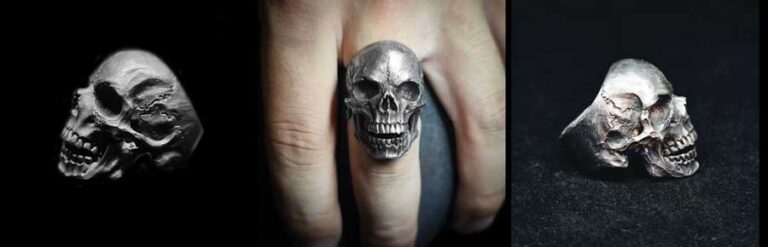
A skull ring is visible during gestures, so face width, height and finger placement matter. Pair a tall sculptural ring with a quiet watch or bare opposite wrist. If adding another ring, leave enough space to prevent neighboring bands from rubbing.
Compare scale through the skull ring collection. A compact signet-like form can work with tailoring; a larger carved design often suits heavier fabrics and more open hand styling.
Use a Skull Necklace to Control the Vertical Line
A pendant creates a destination along the chain. Shorter lengths sit near the collar, while longer lengths interact with the chest and shirt opening. Include pendant height when estimating total drop.
Browse skull necklaces for format comparison. With a detailed pendant, use a simpler ring or bracelet so the neckline remains the clear focus.
Use a Bracelet for Repetition and Movement
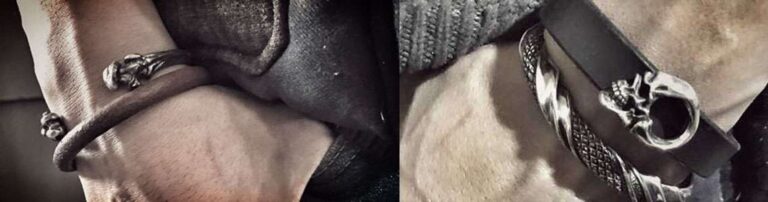
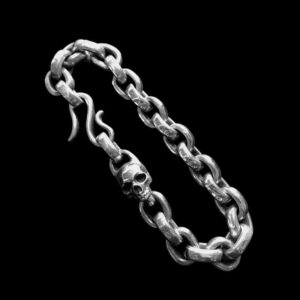
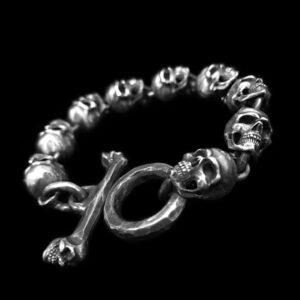
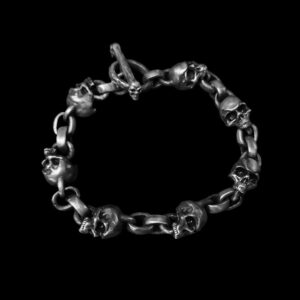
Bracelets can repeat links, place one motif at the center or use a compact clasp detail. Check inner circumference or usable length, width, weight and closure. Loose heavy pieces rotate and strike surfaces; tight designs can pinch.
The skull bracelet collection shows different structures. Separate hard metal bracelets from watches when repeated contact could scratch either surface.
Let Finish Determine Visual Volume
Oxidized recesses increase contrast around eyes, teeth and scrollwork. Polished high points reflect more light. Brushed areas reduce glare. A darkened finish can make compact carving read more strongly, so scale should be judged with finish rather than dimensions alone.
Do not treat oxidation as damage or as proof of material. The listing should identify both alloy and surface treatment.
Combine Skull Jewelry With Casual Clothing
Denim, leather, workwear and textured knits can absorb stronger relief because their surfaces already carry visual weight. Use one skull object and let seams, hardware or fabric texture provide secondary detail. Avoid repeating the motif across shirt graphics, buckle, ring and necklace unless a theatrical effect is intentional.
Combine Skull Jewelry With Tailoring
For a jacket or dress shirt, reduce quantity before removing character. A compact ring, small lapel object or pendant hidden partly beneath the shirt can retain the theme without overwhelming the garment. Confirm workplace and event expectations.
For a darker category context, review gothic jewelry for men, but treat labels as design references rather than identity tests.
Build the Palette From Materials Already Present
Start with existing hardware: watch case, belt buckle, eyeglass frame, jacket zipper and shoe details. Jewelry does not need an exact color match, but one dominant metal tone makes mixed finishes easier to control. Blackened silver can bridge charcoal fabric and polished hardware, while a brighter silver edge can connect to a watch or buckle.
Use clothing color to manage contrast. Black-on-black emphasizes shape and texture; a pale shirt makes a dark pendant more visible; muted earth tones can soften a highly polished ring. The goal is not a fixed palette but a deliberate relationship between the piece and its surroundings.
Run a Three-Outfit Wear Test
Test the same skull piece with an ordinary daytime outfit, an evening combination and the most formal clothing in the wardrobe. Photograph each at arm’s length rather than only in a mirror close-up. Note where the piece catches fabric, disappears, or competes with graphics and hardware.
If it works in one setting only, treat it as a specialist item. If it remains comfortable and visually clear across all three, it can serve as an anchor. This practical test is more reliable than copying a single styled photograph.
Understand the Motif Without Claiming One Meaning
Historical skull imagery includes mortality, remembrance and memento mori. The Metropolitan Museum of Art discussion of memento mori jewelry documents one Renaissance context. Modern wearers may instead choose anatomy, rebellion, memorial meaning or visual preference.
The V&A history of jewelry shows that jewelry roles and techniques change across eras. Do not assign a historic belief to a buyer without evidence.
Verify Material and Wearability
The FTC explains that sterling silver contains 92.5 percent pure silver. Silver tone, plating and stainless steel are different descriptions. The FTC jewelry buying guide explains common precious-metal terms.
Check all components, dimensions, projection, closure and weight. Remove jewelry for machinery, impact, chemicals and activities where snagging is possible. Style only works when the object remains safe and comfortable.
FAQ
Can skull jewelry look elegant rather than aggressive?
Yes. Controlled scale, a refined finish and one clear focal point can create a restrained result.
Should a ring, necklace and bracelet all use skulls?
No. Repeating metal tone or finish usually creates cohesion without repeating the motif everywhere.
Can skull jewelry be worn with a suit?
Yes, subject to the setting. Reduce quantity and choose controlled scale near tailoring.
Does an oxidized finish prove sterling silver?
No. Finish and alloy are separate facts that should both be stated.
Does wearing skull jewelry identify a subculture?
No. It may reference a design influence, but one accessory does not establish the wearer’s identity or beliefs.
MENSSKULL Journal Notes
Leave a field note
Share fit notes, styling ideas, care questions, or your experience with MENSSKULL silver jewelry.
Comments are checked before publication so buyers can read useful fit, symbolism, care, and style notes without spam noise.
The simple plus/minus challenge below helps block automated spam while keeping the experience lightweight.
Continue exploring
More MENSSKULL stories
Handcrafted silver
Shop the pieces behind the stories