
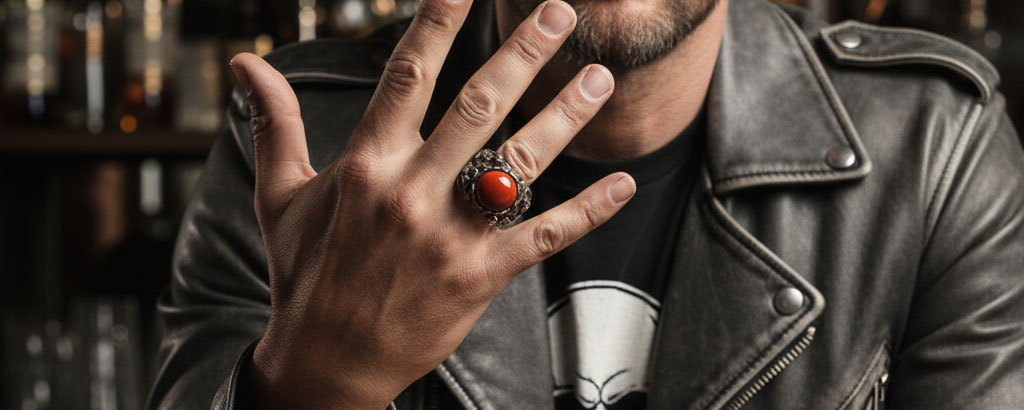
Answer first: a 925 sterling silver men’s ring is not automatically the right ring because of its material label alone. The practical decision is to verify the material wording, then compare the ring’s face dimensions, finished weight, selectable size, finish, stones or other components, and the way that profile will sit on your hand. Use the live product record for the piece-specific facts and use the MENSSKULL Research Library for composition, testing and care evidence.
This guide is a buyer-decision layer for men’s rings. It does not claim that sterling silver is universally best, hypoallergenic, waterproof, maintenance-free, investment-grade or laboratory authenticated. It also does not turn a product photograph into proof of dimensions, comfort or durability. Those boundaries make the comparison more useful: the material name answers one question, while fit, mass, shape and construction answer several others.
What “925 sterling silver” tells you, and what it does not
For U.S. shoppers, the Federal Trade Commission’s precious-metals consumer guidance explains that “sterling silver,” “sterling” and “925” are terms associated with silver that is 92.5 percent pure. MENSSKULL’s 925 sterling silver research guide owns the fuller explanation of composition language, fineness marks, testing limits and claim boundaries.
That wording does not, by itself, tell you how large the ring face is, how much a selected size weighs, whether a stone or accent uses another material, how the finish was applied, or how a wide ring will feel on your hand. It is also not a universal quality score. Two rings can both use verified 925 terminology yet differ greatly in profile, mass, surface treatment, sculptural depth and wearing purpose.
| Buyer question | Best evidence source | What not to assume |
|---|---|---|
| What does 925 terminology mean? | FTC guidance and the MENSSKULL 925 Research owner | That every seller claim or every pictured item has been independently tested |
| How large is this ring? | The current product record’s face dimensions and gallery scale | That all ring sizes have identical finished mass |
| How heavy is it? | The product’s listed weight or weight range | That weight proves strength, comfort or durability |
| Will it fit? | Selectable size, finger measurement and fit guidance | That a familiar US size always feels identical across every width and profile |
| How should it be cleaned? | The care Research owner plus product-specific component notes | That one chemical, machine or method suits every finish, stone and construction |
Use this five-part decision order
A useful way to compare men’s sterling silver rings is to make the material check first, but not stop there. The next four checks turn a broad material search into a purchase decision tied to the actual ring.
1. Confirm the current material wording
Read the live material field and the current product description. Look for clear wording rather than inferring composition from color, polish or price. If the listing includes a stone, plated accent, inset, mixed-metal detail or other non-silver component, evaluate that component separately. A 925 label for the ring body does not automatically describe every attached part.
2. Read face dimensions as width and height, not ring size
Face dimensions describe the visible top of a statement ring. They do not replace the finger-size selection. A face that is tall, wide or deeply sculpted may cover more of the finger and sit closer to adjacent fingers even when the inner ring size is correct. Compare the listed millimeters with a ruler and with a ring you already wear rather than relying on an enlarged gallery image.
3. Treat listed weight as wearing context
Finished mass helps you anticipate whether a ring is relatively light or deliberately substantial. It does not establish tensile strength, impact resistance, clasp security or a comfort guarantee. When a product uses a plus sign or approximate value, read that as a boundary rather than a promise that every size will weigh exactly the same. Larger sizes can require more material, and sculptural details can make similarly sized faces differ in mass.
4. Match the selectable size to the actual profile
Start with a measured finger, then consider band width, knuckle size and the ring’s top-heavy or low-profile shape. The men’s ring size and fit research owns the measurement framework. For large skull faces and other sculptural designs, the skull ring size guide applies that framework to statement-ring scale. Neither page can guarantee comfort without the wearer’s measurements and preferences.
5. Separate finish and component decisions from the base material
Oxidized recesses, polished high points, stones and mixed-material accents change appearance and may change the appropriate care boundary. Do not assume that a method used on plain polished silver is suitable for every finished ring. For any cleaning method, chemical, ultrasonic device, steam process or tarnish explanation, use the sterling silver jewelry care research and then check the live product’s component notes. This article intentionally does not prescribe a universal cleaning method.
Four current ring examples show why the decision cannot stop at “925”
The examples below are current MENSSKULL product records rechecked for this refresh. They illustrate differences in scale and construction language; they are not scientific evidence for silver composition and do not prove comfort or performance.
Heavy Full Jaw Skull Ring: sculptural face and approximate weight
The current Heavy Full Jaw Skull Ring – Solid 925 Sterling Silver record identifies solid 925 sterling silver, an approximately 24 × 19 mm face, an approximate 26 g+ weight, an oxidized-and-polished finish, and selectable US sizes. This is a useful example of why a buyer should read material, face size, mass, finish and ring size as separate fields. The skull face is the visual decision; “925” alone does not describe that profile.
Heavy 925 Silver Skull Ring: larger listed face and 30 g context
The current Heavy 925 Silver Skull Ring for Men record lists a 30 × 20 mm size, a 30 g product weight field, 925 silver material wording and selectable ring sizes. Compared with the first example, the dimensions and listed mass offer a different scale reference even though both records use 925 language. A buyer choosing between them should compare the face proportions and hand coverage, not just repeat the shared material term.
Homelander Portrait Ring: height, mass and character profile
The current Homelander Portrait Ring – 925 Sterling Silver Statement Ring record lists a 45 × 25 mm face, 45 g weight wording, 92.5% sterling silver and selectable sizes. Its tall portrait format makes the height measurement especially relevant. The listed 45 g also signals a different wearing presence from the 26 g+ and 30 g examples, but it remains product mass rather than a strength or durability rating.
Red Cabochon Ring: evaluate the non-silver component too
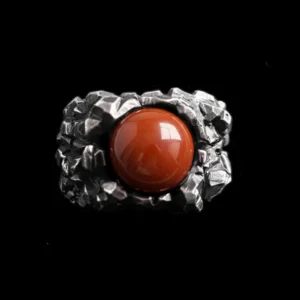
The current Red Cabochon Ring for Men – 925 Silver record lists a 28 × 19 mm size, a 27 g attribute, 925 silver and selectable sizes. The visible cabochon means a buyer should not reduce the decision to the metal body alone. The stone or inset, its setting and the ring’s finish create their own product-specific questions, particularly before choosing a care method.
| Current product example | Material wording | Listed face or size | Listed weight context | Primary decision cue |
|---|---|---|---|---|
| Heavy Full Jaw Skull Ring | Solid 925 sterling silver | Approx. 24 × 19 mm | Approx. 26 g+ | Sculptural skull face and oxidized/polished finish |
| Heavy 925 Silver Skull Ring | 925 silver | 30 × 20 mm | 30 g product field | Larger skull-face proportions |
| Homelander Portrait Ring | 92.5% sterling silver | 45 × 25 mm | 45 g wording | Tall portrait profile and substantial mass |
| Red Cabochon Ring | 925 silver | 28 × 19 mm | 27 g attribute | Metal body plus cabochon and setting |
These records can change if a product is revised, so verify the live selectable option and specification before ordering. Prices, stock levels and promotional status are intentionally not reproduced here because they are volatile purchase data rather than evergreen material evidence.
How to compare a polished ring with an oxidized statement ring
Finish is a design choice, not a shortcut for proving composition. A highly polished surface reflects more light and can make a ring appear smoother or larger in photographs. Oxidized recesses increase visual contrast and can make sculpted teeth, eyes, hair or engraving easier to read. Neither appearance tells you the exact alloy, and neither finish is universally better.
Use the gallery to identify where polished highlights and dark recesses appear, then compare that layout with the product’s finish field. If the ring has a broad polished plane, expect fingerprints and small surface marks to be more visible in some lighting. If it has deliberately dark recesses, do not assume that removing all dark color is the intended result. Product-specific care remains a separate evidence question.
Fit questions to answer before choosing a size
- Which finger will wear the ring? Measure that finger rather than transferring a size from another finger.
- Is the band wide? A broad band can feel different from a narrow ring at the same nominal US size.
- Does the face extend toward adjacent fingers? Compare face width with the space available on your hand.
- Is the ring top-heavy? A tall or heavy face may rotate differently depending on fit and hand movement.
- Is the value exact or approximate? Preserve the distinction between a measured specification, an approximate value and a plus-sign weight boundary.
If your measurement falls between available sizes, do not guess from the model photograph. Recheck the finger circumference and the product’s current options, then use the fit Research owner for the measurement method. Wearer preference, finger shape and temperature-related size changes cannot be resolved from a material label.
Common buying mistakes this guide is designed to prevent
Calling every silver-colored ring “925”
Color is not composition evidence. Use explicit material wording and the seller’s current record. If composition is critical to your decision, ask what evidence supports the claim rather than relying on appearance.
Using “heavy” as a substitute for dimensions
A heavy ring may have a compact dense form or a large hollow-looking profile; the word alone does not explain face coverage. Compare millimeters and grams separately, and keep approximate values labeled as approximate.
Assuming a statement ring fits like a slim band
Nominal finger size is only one part of the wearing decision. Face width, band width, balance and adjacent-finger clearance can affect how the ring feels. Use the exact selectable size and the actual profile.
Treating a stone-set ring like plain silver
A cabochon, adhesive, setting or mixed finish can change the care boundary. Check the component notes and the care Research owner before applying a chemical or machine-based process.
Turning a material claim into a universal recommendation
Sterling silver may suit buyers who want a precious-metal ring with the specific look and construction shown, but it is not automatically the best choice for every budget, sensitivity, activity or maintenance preference. A responsible comparison keeps those personal decisions explicit.
A concise pre-purchase checklist
- Confirm that the live product record explicitly states the material.
- Check whether every visible component is covered by that material statement.
- Read face width and height in millimeters.
- Read the listed mass and note whether it is exact, approximate, a range or a plus-sign value.
- Measure the intended finger and compare the current selectable sizes.
- Review band width, face balance and adjacent-finger clearance.
- Identify polished, oxidized, stone-set or mixed-material areas.
- Route composition, testing and care questions to the appropriate Research Library owner.
- Verify the live product page before purchase instead of relying on an old cached specification.
Where to continue your decision
Use the 925 sterling silver research guide for composition and terminology, the men’s ring size and fit research for measurement, and the sterling silver jewelry care research for care evidence. Browse the current men’s silver rings collection only after deciding which profile, mass and fit information you need from each product record.
Final decision rule: verify 925 terminology, then buy the ring rather than the keyword. The right comparison joins material wording with the current face dimensions, listed weight, selectable size, finish and components. When any one of those facts is missing or ambiguous, ask for clarification instead of filling the gap with an assumption.




MENSSKULL Journal Notes
Leave a field note
Share fit notes, styling ideas, care questions, or your experience with MENSSKULL silver jewelry.
Comments are checked before publication so buyers can read useful fit, symbolism, care, and style notes without spam noise.
The simple plus/minus challenge below helps block automated spam while keeping the experience lightweight.
Continue exploring
More MENSSKULL stories
Handcrafted silver
Shop the pieces behind the stories