
Direct answer: Design and install a custom car badge by measuring the available surface, choosing a weather-appropriate material and attachment system, checking clearance from cameras, sensors, lights, vents and required labels, and following the vehicle and adhesive manufacturers’ instructions. A decorative emblem should never compromise safety equipment or paint.
Custom badges can personalize a vehicle, but they do not automatically increase resale value. Reversible placement and documented installation usually reduce avoidable risk.
Decide Whether to Add, Replace or Restore a Badge
An added badge creates a new decorative element. A replacement occupies the location of an existing emblem. A restoration aims to preserve original appearance. These projects have different requirements for dimensions, alignment, mounting holes and reversibility.
If an original badge is damaged, identify whether it uses adhesive, pins, clips or a combination before removal. Do not pry blindly through painted panels.
Check the Placement Before Designing
Measure width, height and curvature at the exact location. Confirm that doors, trunk lids and fuel doors can move without contact. Avoid placing an emblem over cameras, radar modules, parking sensors, lamps, air intakes, drainage paths, vehicle identification labels or warning information.
Consult the owner’s manual or a qualified installer when the panel contains driver-assistance hardware. A visually open area may still conceal a sensor behind a bumper or grille.
Choose Original Artwork and Legible Scale
Simple silhouettes, controlled line weight and adequate spacing remain clearer at automotive viewing distance. Fine engraving that looks sharp on a screen may disappear after casting, enamel filling or weather exposure.
Use original graphics or obtain permission for protected logos and names. A custom commission does not automatically authorize use of a vehicle maker’s trademark, club mark or another artist’s design.
Compare Metal, Enamel and Flexible Constructions
Metal badges can provide weight and relief but require a finish suited to exterior exposure. Enamel or colored inlays add contrast but can chip. Flexible domed badges conform to some surfaces but may age differently under heat and ultraviolet exposure.
Do not assume brass is rustproof: brass does not form iron rust, but it can tarnish and its finish can change. The exact coating, backing and adhesive determine exterior performance.
Use Current Product Attributes, Not Generic Claims
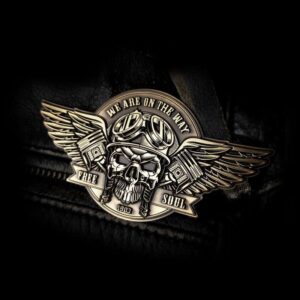
Browse the car badge collection to compare forms. Current examples include the brass skull metal car badge, eagle motorcycle emblem and Mustang-style brass badge.
Open the exact listing for present dimensions, material and selectable options. Do not transfer attributes from one badge to another.
Select an Automotive Attachment System
General craft tape is not automatically suitable for a painted exterior. Adhesive selection depends on badge weight, backing material, paint, curvature, temperature and environmental exposure. The 3M automotive attachment resource explains that different tapes and adhesion promoters serve different repair applications.
Use the badge, vehicle and adhesive manufacturers’ compatible system. Mechanical pins or drilled mounts require professional assessment because holes can affect corrosion protection and panel integrity.
Remove an Existing Badge Conservatively
A manufacturer service bulletin hosted by NHTSA describes controlled warming, a fiber trim tool or line, and suitable adhesive cleanup for a specific badge repair. It warns against holding a heat gun in one place. That procedure is model-specific evidence, not permission to apply identical heat to every paint or plastic.
Review the badge reinstallation service bulletin, then follow instructions for the actual vehicle. Stop if paint lifts, plastic deforms or mounting holes appear.
Prepare and Align Before Exposing Adhesive
Work on a clean, dry surface within the temperature range specified by the attachment system. Remove wax, oil and residue only with products approved for the vehicle finish. Test cleaners in an inconspicuous area.
Use low-tack tape to create horizontal and vertical reference lines. Step back and check alignment from the center and both sides. Once pressure-sensitive adhesive touches the panel, repositioning may weaken the bond or mark the finish.
Apply Pressure and Respect Cure Conditions
Follow the specified pressure, temperature and cure time. Do not invent a universal 24-hour rule because products differ. Avoid washing, high-speed driving or severe weather until the chosen system reaches its stated handling strength.
Inspect the full perimeter for gaps. A lifted edge can collect dirt and water and may allow the badge to detach.
Maintain Without Damaging the Finish
Wash gently with products compatible with both vehicle paint and badge finish. Avoid abrasive pads, aggressive compounds and direct high-pressure spray at lifted edges. Check adhesion after temperature extremes and automated washes.
Document the product, placement, adhesive and installation date. This makes future removal or repair easier.
Account for Climate and Vehicle Use
Sun exposure, freezing conditions, road salt, frequent washing and engine-bay heat create different demands. A badge that works on a protected trunk panel may not suit a grille or motorcycle surface. Select materials and adhesive using the harshest expected condition, not indoor appearance alone.
Plan for Removal and Resale
A custom emblem may appeal to one owner and reduce appeal for another. Preserve the original badge when practical and photograph factory alignment before removal. Do not claim a badge increases resale value without specific evidence.
Professional removal may be preferable for valuable paint, complex trim, drilled mounts or sensor-adjacent locations.
FAQ
Can a custom badge be placed anywhere on a vehicle?
No. Keep it clear of sensors, cameras, lights, vents, moving panels and required labels.
Is ordinary double-sided tape suitable for a car badge?
Not necessarily. Use an automotive attachment system compatible with the badge, surface and environment.
Can a heat gun always be used to remove an emblem?
No. Heat can damage paint or plastic; follow model-specific guidance or use a qualified installer.
Do metal badges increase vehicle resale value?
Not automatically. Taste varies, and permanent modifications can reduce buyer appeal.
Should a badge cover the original mounting holes?
Only when fit and sealing are correct. Exposed or poorly sealed holes can create corrosion and water risks.


MENSSKULL Journal Notes
Leave a field note
Share fit notes, styling ideas, care questions, or your experience with MENSSKULL silver jewelry.
Comments are checked before publication so buyers can read useful fit, symbolism, care, and style notes without spam noise.
The simple plus/minus challenge below helps block automated spam while keeping the experience lightweight.
Continue exploring
More MENSSKULL stories
Handcrafted silver
Shop the pieces behind the stories