
Short answer: a men’s snake bracelet works best when its size, construction and visual weight suit the wearer before any symbolism is considered. Snake imagery has a long and varied jewelry history, but it does not carry one universal meaning. Treat the motif as a personal design choice, verify the bracelet’s measurements and material, and make sure the clasp or opening is practical for daily use.
What Defines a Snake Bracelet for Men?
A snake bracelet can be a rigid cuff, a hinged bangle, a flexible link bracelet or a chain with a sculpted serpent element. These forms behave differently on the wrist. A cuff depends on the opening and inside circumference; a hinged bangle depends on hinge alignment and closure security; a flexible bracelet depends on link articulation and clasp quality.
The strongest design is not automatically the largest. Look at the head, scales, coil direction and transition between sculpted and functional sections. A detailed head can create a focal point, while a continuous scale texture can read more quietly. Buyers comparing the broader men’s bracelet collection should use actual dimensions rather than judging size from close-up photography.
Documented History Without Inventing a Universal Meaning
Snake jewelry appears in different periods and regions, so its significance must be tied to a specific object and culture. The Metropolitan Museum of Art records a Greek Ptolemaic snake-form bracelet from about 300–250 BCE and a Roman silver bracelet terminating in snake heads. Another Met record explains that snake bracelets reached Egypt during the Hellenistic period rather than being a timeless, uniquely Egyptian category.
Those museum records demonstrate historical use, not a fixed modern message. Depending on context, people may associate snakes with renewal, vigilance, healing, danger or transformation. A present-day wearer can value one of those ideas, but a seller should not present a personal interpretation as a proven belief shared by every culture.
Choose the Bracelet Form Before the Motif
Begin with how the bracelet must function. A rigid cuff should have a smooth interior and an opening that passes the narrow side of the wrist without repeated bending. A hinged piece should open cleanly and close without lateral play. A flexible bracelet should drape without sharp link edges and should not bunch when the wrist bends.
- Cuff: clean profile, quick to put on, but highly dependent on opening width.
- Hinged bangle: structured appearance with easier entry when the hinge and catch are well made.
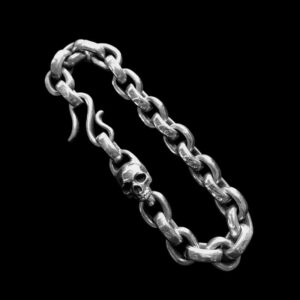
- Flexible links: more movement and adjustability, but clasp and link wear deserve close inspection.
- Chain with serpent detail: lighter visual weight and easier pairing with a watch.
Measure Wrist Fit Instead of Guessing
Wrap a flexible tape around the wrist where the bracelet will sit, keeping it snug without compressing the skin. If only a strip of paper is available, mark the overlap and measure it against a ruler. Compare that number with the product’s stated inside circumference or wearable length, not only its total end-to-end length.
Ease is a preference and also a safety issue. A close fit limits rotation and keeps a sculpted snake head in place; a looser fit allows more movement but can catch on objects. Thick cuffs usually need less extra movement than fine chains. Buyers should also check the widest point, opening width, thickness and weight, because each affects comfort independently.
Evaluate Material, Finish and Construction
If a listing claims sterling silver, look for a clear material description and any available fineness marking. The U.S. Federal Trade Commission’s guidance on buying silver jewelry explains why metal descriptions and markings matter. A “silver color” description is not the same as a sterling-silver claim.
Oxidized recesses can make scales and facial details easier to read, while polished high points create contrast. That finish may evolve with wear. Inspect whether the serpent head is integrated into the bracelet or attached, whether solder joins are smooth, whether moving parts align and whether rough edges touch the wrist. On an adjustable cuff, frequent bending can fatigue metal; adjust it carefully and only when necessary.
Style One Strong Motif at a Time
A snake bracelet already carries directional lines and surface detail, so it usually needs fewer competing accessories. With denim, boots or a leather jacket, an oxidized finish reinforces texture. With a plain knit, overshirt or tailored coat, a cleaner silver form can provide contrast without turning the outfit into a costume.
If you wear a watch, place the bracelet on the opposite wrist or choose a narrow design that cannot scrape the case. If you add rings, repeat one visual element—silver tone, dark recesses or a restrained animal motif—rather than repeating several literal snakes. The same principle applies when pairing with men’s rings or pieces from the skull jewelry collection. If you prefer the serpent motif on the hand rather than the wrist, compare a double snake ring with opposing heads and choose either piece as the focal point.
Care for Texture and Moving Parts
After wear, wipe the bracelet with a soft dry cloth, especially around textured recesses and the clasp. Keep it separate from harder objects that can mark raised scales. Avoid abrasive household products, and do not assume one cleaning solution is safe for every finish, adhesive or stone. GIA’s general jewelry-care guidance recommends considering the metal, finish and any set material before choosing a cleaning method.
Check hinges, catches and connecting rings periodically. If a closure feels loose, a link begins to open or a rigid bracelet develops a sharp bend, stop wearing it until it can be assessed. Preventive inspection is more useful than aggressive polishing after damage has started.
A snake motif can continue beyond the wrist without repeating the same jewelry shape. Compare men’s snake earrings when you want a smaller serpent detail that can be worn alone or paired with a snake bracelet.
FAQ About Men’s Snake Bracelets
What does a snake bracelet symbolize?
There is no single universal meaning. Historical and modern interpretations may include renewal, protection, healing, danger or personal transformation. The most accurate explanation identifies the cultural context or states clearly that the meaning is personal.
How should a snake bracelet fit?
It should sit securely without compressing the wrist or sliding over the hand. Compare wrist circumference with the bracelet’s wearable length, inside circumference and opening rather than relying on a generic size label.
Can a snake bracelet be worn with a watch?
Yes, but a narrow bracelet is safer than a heavy cuff beside a watch. Prevent metal surfaces from rubbing together, or wear the bracelet on the opposite wrist.
Is every silver-colored snake bracelet sterling silver?
No. Color alone does not identify composition. Read the material disclosure, markings and seller documentation, and distinguish solid sterling silver from plated or unspecified silver-tone metal.
How do I keep dark detail in an oxidized bracelet?
Use gentle wiping rather than abrasive polishing over recessed areas. Because finishes and constructions vary, follow the care instructions for the specific bracelet and seek professional advice if the piece includes stones or delicate moving parts.
MENSSKULL Journal Notes
Leave a field note
Share fit notes, styling ideas, care questions, or your experience with MENSSKULL silver jewelry.
Comments are checked before publication so buyers can read useful fit, symbolism, care, and style notes without spam noise.
The simple plus/minus challenge below helps block automated spam while keeping the experience lightweight.
Continue exploring
More MENSSKULL stories
Handcrafted silver
Shop the pieces behind the stories