
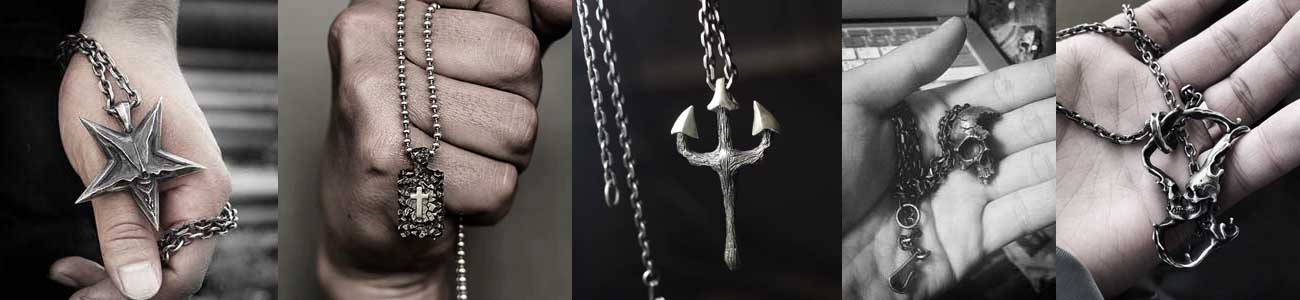
Short answer: choose a men’s silver skull necklace by evaluating the pendant as a wearable object, not only as a close-up image. Confirm its height, width, depth, weight, bail opening, chain length, material description and return conditions. Then decide whether the skull should be a small accent, a mid-scale daily pendant or a large statement piece.
Start With the Pendant’s Real Dimensions
Product photography often enlarges small details, so a skull that fills the screen may still be compact in person. Record the pendant’s height and width in millimeters, then sketch that rectangle on paper or compare it with an object of known size. Depth matters too: deep relief produces stronger shadows but also projects farther from the chest.
Weight changes how a necklace moves and how long it remains comfortable. A heavy pendant can pull a fine chain forward, rotate a clasp or feel tiring during extended wear. When browsing the skull necklace collection, compare the listed measurements of each design rather than assuming similar photographs mean similar scale.
Check the Metal Claim Carefully
“Silver,” “sterling silver,” “silver plated” and “silver tone” are not interchangeable descriptions. The Federal Trade Commission’s consumer guidance for buying gold and silver jewelry explains the importance of accurate metal representations and fineness information. If a product is described as 925 sterling silver, look for a consistent material disclosure across the product page, specifications and packaging information.
A hallmark can be useful evidence, but it should be considered alongside the seller’s description and construction details. It does not tell you the pendant’s weight, finish quality or whether every included component uses the same alloy. If the chain is included, confirm its material separately rather than assuming it matches the pendant.
Match the Bail to the Chain
The bail is the loop or passage that connects a pendant to a chain. Its internal opening must accommodate the chain’s widest fixed point, often the end tab or clasp rather than the chain body. A thick curb chain may fit through the center of a bail but fail at the end fitting.
Ask for the bail’s usable dimensions when they are not listed. Also inspect whether it is a fixed loop, a hinged fitting or an integrated part of the sculpture. A centered, well-finished bail helps the skull face forward. If you already own a chain, compare both width and end hardware before ordering. Buyers starting from scratch can review the broader men’s necklace collection to compare chain proportions and lengths.
Choose a Chain Length for Placement, Not a Trend
Chain length determines where the pendant lands, but body proportions, neck size, shirt opening and pendant height all influence the final position. Measure a necklace you already wear comfortably, or use a soft cord to test different lengths in front of a mirror. Include the pendant’s height when judging the total drop.
A shorter placement keeps a small skull close to the collar and makes it visible with an open overshirt. A mid-chest placement gives a larger pendant more space. Very long chains create more swing and increase the chance of impact. The correct length is the one that stays clear of work equipment, seat belts and frequently handled objects.
Read the Skull’s Design Language
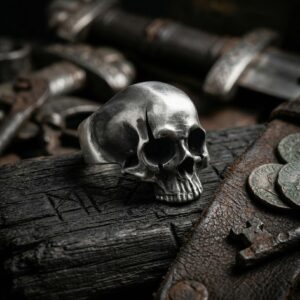
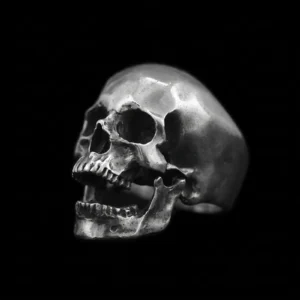
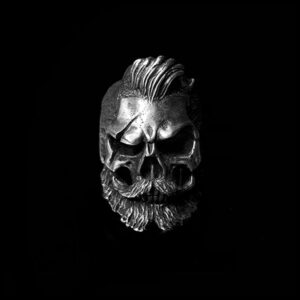
Skull pendants range from anatomical studies to stylized Gothic faces. Anatomical designs rely on recognizable brow, jaw and tooth structure. Sculptural designs may exaggerate depth or expression. Motif combinations—crowns, wings, snakes, crosses or flames—add visual information, but they do not have one universal interpretation.
The Victoria and Albert Museum’s overview of jewelry history shows how adornment changes across periods, materials and social contexts. For a modern buyer, the safest approach is to distinguish documented historical references from personal symbolism. Our guide to skull meaning applies the same context-first method.
Inspect Relief, Finish and Wear Points
Oxidized recesses can separate teeth, eye sockets and surface texture from polished high points. A mirror finish looks bright but reveals fingerprints and fine wear more quickly. A matte or brushed surface is quieter and may disguise minor marks, while mixed finishing produces the strongest depth.
Examine the back as carefully as the front. A hollow back reduces weight but may have edges that contact clothing. A solid back feels different and can increase cost and mass. Check the bail join, raised points, narrow projections and any articulated parts. A pendant intended for everyday use should not have unfinished edges that catch knitwear.
Style the Necklace Around One Focal Point
A detailed skull pendant is easiest to wear over a plain crewneck, dark shirt or open collar. If the pendant is large, keep other necklaces minimal. If it is small, it can sit above a longer plain chain, but leave enough spacing to prevent tangling. Repeating the same skull motif across necklace, bracelet and several rings can flatten the outfit into one theme; repeating the silver tone or finish is usually more controlled.
For a coordinated look, compare texture with men’s bracelets or a single piece from the skull ring collection. The necklace should still read clearly when those accessories are removed.
Plan Care Before You Buy
Store the necklace so the chain is not knotted beneath the pendant. Wipe skin oils from the surfaces after wear and inspect the bail and clasp. Avoid abrasive cleaners on oxidized detail. GIA’s jewelry-care guidance notes that cleaning choices should account for every material and treatment in a piece, not just the main metal.
Before purchase, review return timing, chain inclusion, replacement options and whether dimensions are measured with or without the bail. These details are more predictive of satisfaction than promotional phrases such as “perfect size” or “premium feel.”
FAQ About Men’s Silver Skull Necklaces
What pendant size is best for daily wear?
There is no universal size. A compact pendant is usually easier under jackets, while a larger pendant needs more chest space and a stronger chain. Use actual millimeter dimensions and weight to decide.
Does a 925 mark prove the entire necklace is sterling silver?
A mark is useful information but does not replace a clear product disclosure. Confirm the pendant, chain, clasp and any additional parts separately, especially when the chain is included.
How do I know whether my chain fits the bail?
Compare the bail’s internal opening with the widest part that must pass through it, usually the chain’s end tab or clasp. Chain width alone may not answer the question.
Should a skull pendant sit high or low?
Choose placement by testing the chain against your neck, shirt opening and pendant height. The pendant should remain visible, balanced and clear of objects it could strike.
Can I polish an oxidized skull pendant?
Use caution. Aggressive polishing can remove intentional dark contrast from recessed areas. Start with gentle wiping and follow the care instructions for the specific finish and any stones or treatments.
For a skull necklace built around the fastening hardware rather than a hanging pendant, compare the 925 silver skull hook clasp necklace in its listed 20, 23 and 27 inch lengths.

MENSSKULL Journal Notes
Leave a field note
Share fit notes, styling ideas, care questions, or your experience with MENSSKULL silver jewelry.
Comments are checked before publication so buyers can read useful fit, symbolism, care, and style notes without spam noise.
The simple plus/minus challenge below helps block automated spam while keeping the experience lightweight.
Continue exploring
More MENSSKULL stories
Handcrafted silver
Shop the pieces behind the stories