
Heavy rings for men should be chosen by more than gram weight. Weight tells you how much metal a seller lists, but face height, side projection, shank width, balance and finger clearance determine how that mass behaves on the hand. A 30 g ring with a tall forward face can feel more noticeable during ordinary movement than a heavier ring whose mass sits lower and closer to the finger.
The practical buying method is simple: verify your ring size with an appropriate gauge, compare the ring’s listed weight and dimensions, inspect front, side and worn views, and decide where and how often you expect to wear it. There is no universal gram threshold that makes a ring “too heavy,” and product weight alone cannot prove comfort or suitability for every hand.
What makes a men’s ring feel heavy?
“Heavy” can describe measured mass, visual scale or the sensation of a ring moving on the finger. Those meanings overlap, but they are not interchangeable. A seller-listed 30 g figure is measurable product information. “Feels balanced,” “comfortable all day” or “does not rotate” are wearer-dependent judgments that cannot be guaranteed from the same number.
Five construction variables matter when you compare substantial rings:
- Total listed weight: the gram figure for the finished ring or the seller’s stated range. Confirm whether it applies to one size, all sizes or an approximate family of sizes.
- Face height and width: the area the design occupies above the finger. A tall skull jaw, horn, wing or portrait can influence clearance even when two rings weigh the same.
- Projection: how far the face rises or extends from the shank. Side-profile photographs are more useful than a straight front view for this question.
- Shank contact: how much metal wraps the underside and sides of the finger. Broad, tapered, split and open constructions distribute contact differently.
- Balance: where the mass sits relative to the finger. A top-heavy face may be more prone to rotation if sizing or shank support is wrong.
Because these variables interact, do not sort rings by grams and assume the list is also a comfort ranking. A lighter but taller face may touch an adjacent finger sooner. A heavier low-profile ring may occupy less vertical space. The useful comparison is weight plus geometry, supported by photographs and verified specifications.
Size the finger before comparing weight
A substantial ring cannot compensate for an uncertain size. If the opening is too large, the face may rotate and make its weight more noticeable. If the opening is too small, choosing a lighter design does not fix the fit problem. Measure the exact finger on the hand where the ring will be worn, and pay attention to the knuckle as well as the resting position.
The MENSSKULL ring size and fit Research guide owns the site’s detailed measurement evidence. Its role is to explain diameter, circumference, regional size systems and measurement boundaries. This buying guide uses that foundation only to help compare substantial ring designs.
The Gemological Institute of America’s finger and ring sizing benchmark distinguishes narrow gauges from gauges for rings wider than 4 mm and advises against forcing a gauge over the joint. That distinction matters because a slim sample ring is not always a good proxy for a broad shank. A professional jeweler can use gauges that better resemble the contact width you are considering.
A practical sizing sequence
- Identify the exact finger and hand.
- Measure with a rigid ring gauge or have a jeweler measure it.
- Check whether the target ring uses a broad, tapered or unusually sculpted shank.
- Compare the knuckle passage with the resting fit.
- Use the seller’s live size selector rather than assuming every product offers the same range.
Do not silently “size up” because a ring looks heavy. That may create rotation without solving a genuine width issue. Likewise, do not copy the size of a ring worn on another finger. For a skull-specific measurement walkthrough, the men’s skull ring size guide shows how broad faces and shanks affect the decision process.
Read face height and finger clearance separately
Face dimensions describe visual scale, not fit by themselves. A listing may provide two numbers without defining which axis is height or width. In that case, retain them as a two-axis reference instead of relabeling them. A 30 x 20 mm listing does not automatically prove 30 mm of vertical finger coverage unless the product record defines the axes.
Use the gallery to answer three questions:
- Does the face extend toward the knuckle or toward the neighboring fingers?
- Are horns, jaws, wings or other points raised beyond the main face?
- Does a side view show open clearance under the sculpture or a low solid profile?
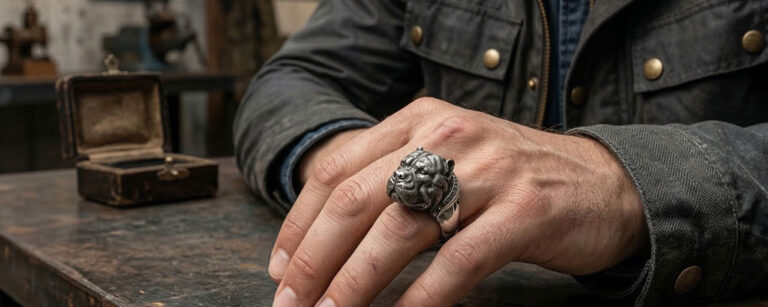
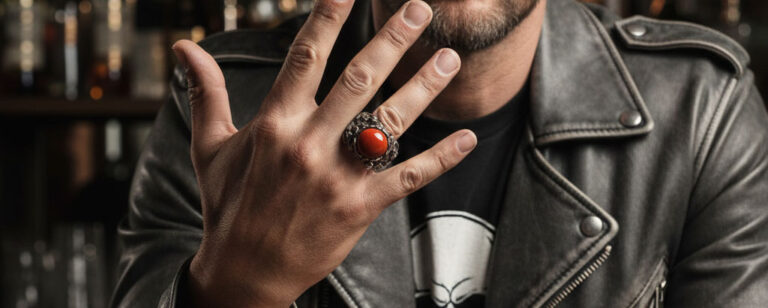
Front photographs establish motif and width. Side photographs establish projection. Worn photographs establish approximate hand coverage, but they do not replace measurements because the model’s finger size is usually unknown. When a gallery lacks one of those views, treat the missing angle as uncertainty rather than filling the gap with a claim.
Neighboring-finger clearance is especially relevant to wide side panels, full jaws and outward-facing wings. It is not only a question of the top face. A ring can have a compact face while its shoulders flare sideways. Conversely, a long portrait can sit within a narrow shoulder line. Compare the complete silhouette, not just the central emblem.
Compare verified examples without creating a universal scale
MENSSKULL currently lists several substantial rings with different masses and face references. They are useful examples of why grams and geometry must be read together. The figures below come from live product attributes checked on August 21, 2026. They describe those offers only and do not establish a universal heavy-ring grading standard.
| Example | Listed weight | Listed face reference | Decision cue |
|---|---|---|---|
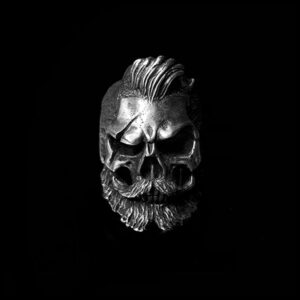
| Full Jaw Skull Ring | Approx. 26 g+ | Approx. 24 x 19 mm | Full jaw projection and broad polished crown |
| Heavy Skull Ring | 30 g | 30 x 20 mm | Compare the two-axis face reference with the worn and profile views |
| Portrait Statement Ring | 45 g | 45 x 25 mm | Tall portrait face and sculpted shoulders require clearance review |
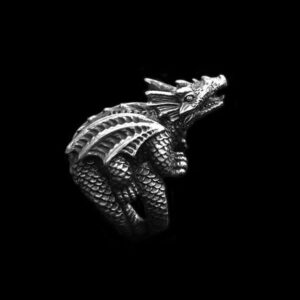
| Winged Dragon Ring | 50 g | 53 x 30 mm | Winged silhouette creates a different clearance question from a compact skull |
The 26 g+ skull and the 30 g skull are relatively close in listed mass, yet their jaw, crown and face construction differ. The 45 g portrait and 50 g dragon are also not interchangeable merely because their weights are closer to one another than to the lighter examples. The correct question is not “Which number is best?” It is “Which verified combination of size, mass and silhouette matches my intended use?”
The Winged Dragon page remains a protected supporting example. Its existing fit and clearance guide should be used for that specific 50 g design; this hub does not replace or expand it. The existing heavy skull ring guide remains the support page for its particular 30 g example.
Use a decision matrix instead of a gram cutoff
A fixed statement such as “anything above 20 g is too heavy” sounds convenient but ignores ring size, construction and wearer preference. A better method is to score uncertainty rather than declare a universal pass or fail.
Lower-uncertainty purchase
- Your exact size is available and recently verified.
- The page provides weight plus usable front, side and worn views.
- Face dimensions are defined or clearly presented as an unlabeled two-axis reference.
- The shank shape is visible.
- You already wear a ring with reasonably similar mass and geometry.
Higher-uncertainty purchase
- You are estimating size from string, paper or another finger.
- Only a front photograph is available.
- The weight conflicts across page fields or is not mapped reliably to sizes.
- The design has long points, a full jaw or broad side extensions without a worn view.
- You are assuming dramatic visual scale can substitute for verified fit.
If several higher-uncertainty conditions apply, ask for the missing fact or choose a better-documented design. More copy cannot replace absent measurements. A buyer-focused page should make uncertainty visible rather than convert it into a confident promise.
For broad visual browsing, compare the complete men’s silver ring collection. If your priority is sculptural skull construction rather than weight alone, use the skull rings for men collection. Those category pages own commercial browsing intent; this hub owns the decision method.
Evaluate rotation and movement before regular wear
When a substantial ring arrives, verify the selected size and inspect it before treating it as a regular-wear piece. Confirm that it settles where intended, then move the finger through ordinary motions and notice whether the face rotates, touches an adjacent finger or makes the selected size feel different from a narrower ring.
Start with a short indoor comparison. It cannot predict personal long-term comfort, but it can reveal obvious rotation, neighboring-finger contact or a mismatch between the product’s face scale and your expectation. If the ordinary fit is not what you expected, pause regular wear and ask the seller or a jeweler about available sizing options rather than guessing at an adjustment.
This comparison is limited to ordinary jewelry selection. It does not grade rings for work, sports or specialized activities, and it should not be used as a substitute for rules that apply in those settings.
Check material claims and listing scope
Weight does not prove material. A 45 g ring could be made from different metals, and an image cannot establish fineness. Look for an explicit material attribute and keep terms such as “925,” “sterling silver,” plated, brass or stainless steel tied to the exact offer.
The U.S. Federal Trade Commission’s Jewelry Guides explain that jewelry marketers should represent precious-metal content accurately. For buyers, the practical lesson is to prefer a clear material statement over assumptions based on color, price, title wording or ring weight.
Also check whether a weight applies to the ring alone, a size-specific variation or an approximate range. Larger ring sizes can use more metal, but do not invent a variant-by-variant mapping when the seller has not supplied one. If a page lists a range without mapping it to sizes, keep it as an overall range.
Common heavy-ring buying mistakes
Treating the heaviest ring as the highest quality
Mass can reflect scale and metal volume, but it does not independently prove workmanship, purity, durability or value. Inspect material, construction, surface detail and seller facts separately.
Choosing by a front image alone
A front image hides projection and underside construction. Look for side, rear and worn views before deciding how a tall face or full jaw may behave.
Using another finger’s size
Finger sizes differ between hands and positions. Measure the intended finger rather than transferring a familiar number without checking.
Assuming bigger automatically means looser
An unnecessarily large opening can let a heavy face rotate. Width-related sizing decisions should be made with an appropriate gauge, not a blanket size-up rule.
Ignoring the page’s uncertainty
Missing axes, conflicting weights or absent profile photographs are genuine information gaps. Do not let a dramatic design persuade you that those gaps have been resolved.
A final checklist for choosing a heavy ring
- Confirm the exact finger and ring size.
- Verify the selectable size exists on the live product page.
- Record the seller-listed weight without turning it into a universal comfort rating.
- Check whether dimensions have defined axes.
- Inspect front, side, underside and worn views where available.
- Note jaws, horns, wings, points or shoulders that affect clearance.
- Confirm the material from a written attribute, not appearance.
- Compare the design with a ring you already wear, if possible.
- Keep work, sports and specialized-use questions outside an ordinary fashion-fit comparison.
- Choose the better-documented ring when two designs otherwise appeal equally.
The best heavy ring is not necessarily the one with the largest number. It is the one whose verified size, mass, face geometry, shank and intended wearing context you understand before ordering.
Heavy rings for men: frequently asked questions
What weight counts as a heavy men’s ring?
There is no universal gram cutoff. Use weight as one comparison point alongside ring size, face height, projection, shank width and your experience with similarly constructed rings.
Should I size up for a heavy ring?
Not automatically. An oversized ring may rotate. Measure the intended finger with a suitable gauge and account for broad shank contact rather than applying a blanket size increase.
Is a 30 g ring suitable for all-day wear?
A 30 g listing cannot prove all-day suitability. Fit, balance, face geometry, activity and individual preference all matter. Begin with a short ordinary-wear comparison and reassess the selected size if the face rotates or creates unwanted neighboring-finger contact.
Why does face height matter if the ring size is correct?
Ring size describes the opening, while face height and side extensions affect clearance, visual coverage and contact with neighboring fingers. They answer different buying questions.
Can product photos prove how a heavy ring will feel?
No. Photos help evaluate silhouette, projection and approximate scale, but they cannot establish your finger size, comfort or movement. Use them with verified specifications.
How can I compare two heavy rings online?
Compare verified size availability, listed weight, defined face dimensions, side projection, shank construction and worn-scale views. Choose the page that resolves more of those questions rather than relying on the larger gram figure.



MENSSKULL Journal Notes
Leave a field note
Share fit notes, styling ideas, care questions, or your experience with MENSSKULL silver jewelry.
Comments are checked before publication so buyers can read useful fit, symbolism, care, and style notes without spam noise.
The simple plus/minus challenge below helps block automated spam while keeping the experience lightweight.
Continue exploring
More MENSSKULL stories
Handcrafted silver
Shop the pieces behind the stories