
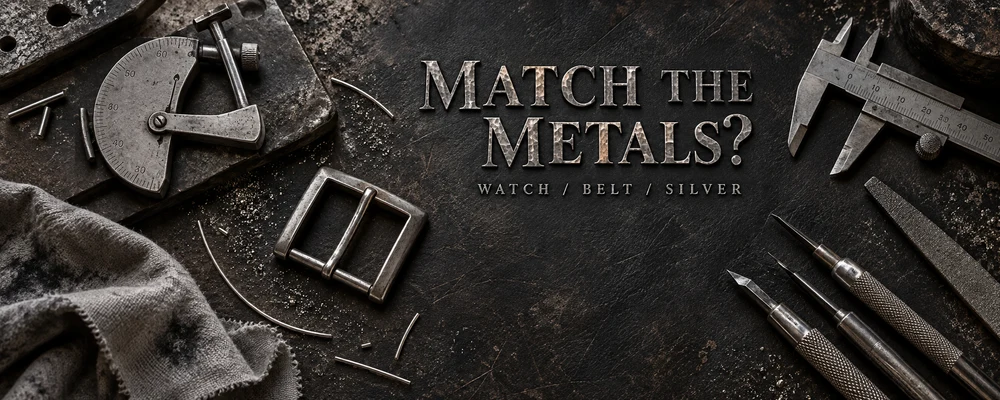
Quick answer: Men’s jewelry does not have to match a watch and belt buckle exactly. A useful starting point is to choose one leading metal family, then repeat either its color or its finish once elsewhere. Silver jewelry can work with a steel watch, blackened hardware or a muted buckle without every item being identical. Judge the whole outfit at normal viewing distance, keep fit and function separate from color coordination, and do not buy a new accessory only to satisfy a rigid matching rule.
This is an original MENSSKULL buyer guide, not a report of a new fashion-week result or a claim that one combination is currently the most popular. The framework below helps answer a practical wardrobe question while leaving personal style open. It does not convert a visual preference into a material test, quality grade or safety guarantee.
Match the visual family, not every metal label
Exact matching is one option, not a requirement. A polished steel watch case and a bright silver ring may appear related because both read as cool, reflective metal. An oxidized silver ring can still belong in the same outfit, but its dark recesses introduce more contrast. A matte buckle may recede even when its base color is similar. Finish, scale and placement often matter as much as the broad color name.
Start by identifying which object already has the strongest visual presence. A large watch, bright buckle or sculptural ring can each become the leading metal. Let the other pieces support it rather than asking three focal items to compete. This does not mean the largest item must always lead; it means the outfit becomes easier to evaluate when you know where attention is intended to land.
Use color, finish and scale as separate controls
| Control | What to compare | What not to assume |
|---|---|---|
| Metal color | Cool silver tone, warm gold tone or dark hardware | Similar color proves the same alloy or quality |
| Surface finish | Bright polish, brushed surface, dark recesses or matte texture | Every finish must be identical |
| Visual scale | Case size, buckle area, ring face, chain width or bracelet mass | A shared color automatically creates balance |
The material names on product pages still matter for buying and care. Visual similarity cannot identify an alloy. A silver-colored watch may use steel, a buckle may be plated, and a ring may be listed as 925 silver. Coordinate them visually if you like, but verify each product’s material through its own evidence. The 925 sterling silver research guide owns the broader material and marking questions.
Build the outfit in three zones
Instead of holding every object side by side, look at where each appears when worn. The wrist zone contains the watch and perhaps a bracelet. The hand zone contains rings. The waist zone contains the buckle and sometimes a wallet chain. A necklace creates a fourth zone near the collar, but it does not need to repeat every decision below the chest.
Wrist: decide whether the watch leads or shares
If the watch is visually dominant, start with it. A bright case can pair with a silver-toned bracelet on the other wrist, or it can stand alone while a ring repeats the cool metal elsewhere. Wearing a bracelet beside the watch is also a styling option, but appearance does not prove clearance. Compare actual dimensions and movement before placing two hard surfaces together.
A dark watch case changes the role of silver. Bright silver creates deliberate contrast; oxidized details can bridge the dark case and brighter raised surfaces. Neither approach is automatically more coordinated. The choice is whether you want separation or continuity. Do not describe blackened silver as a different base material solely from its appearance.
Hand: give a statement ring enough space
A sculptural ring already carries color, finish and scale in one object. If it is the intended focal point, a simpler watch or buckle can support it without repeating the exact motif. The guide to how many rings a man should wear covers ring count and hand balance; this article only addresses coordination with the surrounding hardware.
Measure the exact intended finger rather than choosing a size from the opposite hand. Metal matching cannot fix a rotating or restrictive ring. Use the men’s ring size and fit research for the separate fit decision, especially with wide or top-heavy designs.
Waist: treat the buckle as part of the outfit, not a jewelry assay
A buckle is often partly covered by a shirt or jacket, so its influence changes with the outfit. Check it under normal movement and normal fastening. If only a small edge remains visible, it may act as background hardware rather than a focal object. Buying all-new jewelry to match a mostly hidden buckle solves a problem the outfit may not actually have.
Separate metal coordination from leather color. A brown belt can carry silver-toned hardware, and a black belt can carry warm or dark hardware. Matching the leather to shoes and matching metal to jewelry are different choices. You can use both, one or neither; this guide does not present a universal dress code.
Choose one of four coordination strategies
| Strategy | How it works | Best check before buying |
|---|---|---|
| Close family | Silver jewelry, steel-tone watch and silver-tone buckle | Vary scale so the outfit does not become three equal focal points |
| Finish bridge | Oxidized silver links a dark watch with brighter hardware | Inspect real finish photos; do not assume dark areas are removable tarnish |
| One deliberate contrast | A warm or dark watch sits against otherwise cool silver accents | Repeat the contrast once only if the outfit needs continuity |
| Independent zones | Watch, ring and buckle differ but each has a clear role | View the complete outfit from several steps away, not as a tabletop set |
The close-family strategy is the easiest place to begin because fewer variables compete. It is not inherently more stylish or higher quality. The finish-bridge strategy can make oxidized silver useful when an outfit contains both dark and bright hardware, but it should be chosen because you like that surface treatment, not because the finish guarantees durability.
One deliberate contrast works when the contrast is visible enough to seem intentional. A warm watch with silver rings does not require a warm buckle, although repeating a small warm detail can make the relationship clearer. Independent zones allow the most variety. They work best when the pieces have different jobs: for example, a functional watch, a quiet buckle and one expressive ring.
Use a five-minute wardrobe test before shopping
- Put on the exact shirt, trousers, belt and watch you expect to wear.
- Stand at normal viewing distance and identify the current focal metal.
- Add one existing ring, bracelet or necklace before considering a second piece.
- Check the outfit with the jacket open and closed, and with hands at rest.
- Write down the missing product facts, such as ring size, bracelet length, chain width or finish guidance.
This test prevents a common buying error: coordinating objects on a desk while ignoring how far apart they sit on the body. A buckle, watch and ring rarely occupy the same small visual field. Normal distance can make minor finish differences disappear, while one oversized piece remains dominant even when every metal color matches.
Photographs introduce another limit. Lighting and screen settings can shift apparent warmth, brightness and contrast. If an exact tone matters, request a neutral-light image or clarification from the seller. Do not use a warm studio photograph as proof that silver has a gold tone, or use a dark recess as proof of a specific treatment.
Shop by role after the outfit decision
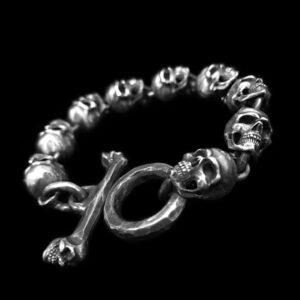
If the hand is the chosen focal area, browse men’s silver rings by face shape and scale before comparing motifs. If the wrist is open and the watch does not already occupy the role you want, use the men’s silver bracelet guide to separate fit, weight and link structure. If the neckline needs the accent instead, the men’s silver chain guide covers length and pendant fit.
These routes solve different decisions. Ring size does not transfer to bracelet fit. Chain length does not answer whether a pendant bail accepts the chain. A matching color also does not prove that two items can contact each other without wear. Keep purchase facts attached to the specific piece.
Care should also follow the actual material and finish, not the outfit palette. A cloth or chemical suitable for one surface may change another. Consult the sterling silver care research and the seller’s finish guidance before cleaning a ring merely to make it look more like a polished watch case.
Common questions about matching men’s metals
Does silver jewelry have to match a steel watch exactly?
No. A shared cool metal color can create continuity even when the materials and finishes differ. Treat the visual relationship as styling, not proof that the watch and jewelry use the same alloy. Decide whether the difference looks intentional at normal distance.
Can I wear a gold-tone watch with silver rings?
Yes, if you prefer the contrast. Start with one warm focal item and let the silver pieces support or deliberately oppose it. Repeating one small warm detail is optional, not a rule. Verify each item’s material separately.
Should my belt buckle match my ring?
It can, but it does not have to. First check how much of the buckle is actually visible with the shirt and jacket you wear. A mostly covered buckle may function as background hardware, while a large decorative buckle may deserve more influence.
Does oxidized silver count as black or silver?
Visually, it can bridge both. Bright raised surfaces may read as silver while dark recesses relate to black hardware. Material classification and finish care still depend on the product evidence; appearance alone cannot identify the treatment.
Is it better to match the watch or the wedding ring?
Neither has to control every other piece. Keep a commitment ring in its intended role, then choose whether the watch or another accessory should become the outfit’s focal metal. A supporting piece can relate through color, finish or scale without copying the ring exactly.
Prepared by MENSSKULL Editorial Team. Published September 16, 2026. This original styling framework separates visual coordination from material verification, fit, care and activity safety.





MENSSKULL Journal Notes
Leave a field note
Share fit notes, styling ideas, care questions, or your experience with MENSSKULL silver jewelry.
Comments are checked before publication so buyers can read useful fit, symbolism, care, and style notes without spam noise.
The simple plus/minus challenge below helps block automated spam while keeping the experience lightweight.
Continue exploring
More MENSSKULL stories
Handcrafted silver
Shop the pieces behind the stories