
Should a man choose a plain chain or a pendant necklace? Choose a plain chain when you want one continuous line and want the link pattern itself to be the main visual detail. Choose a pendant necklace when you want the eye to land on one central focal point. Start with the role you want the necklace to play, then compare that role with the neckline and the amount of detail already in the outfit.
This is a visual styling decision, not a universal dress rule. A plain chain and a pendant can use similar metal colors and occupy similar areas, yet they organize an outfit differently. One repeats a line; the other introduces a center. That distinction gives you a practical way to decide without relying on vague labels.
Plain chain versus pendant necklace at a glance
| Question | Plain chain | Pendant necklace |
|---|---|---|
| What creates the visual interest? | The link shape, width, surface and uninterrupted line | The central motif, with the chain acting as its visual support |
| Where does the eye tend to land? | Along the neckline and the repeated links | Near the center of the chest or visible shirt opening |
| What does it add to a simple top? | A repeated metallic line | A distinct central subject |
| What is the simpler first test? | Check whether the chain line is enough on its own | Check whether the outfit benefits from one more focal point |
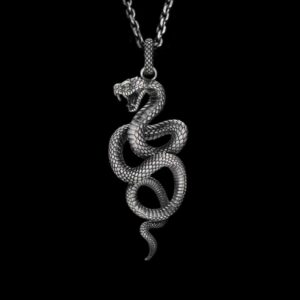
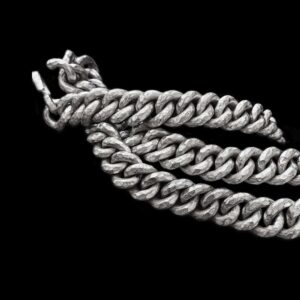
If you already know that a broad link pattern is the feature you want, a chain-only design such as the 8 mm hammered Cuban chain necklace gives you a clear catalog example. If you are comparing center motifs instead, the coiled cobra pendant and the narrower long coiled cobra pendant show how different pendant silhouettes create different focal shapes. Those listings establish the current form and options of the examples; they do not prove that one choice suits every outfit.
What a plain chain does visually
A plain chain is not visually blank. Its repeated links create rhythm, and its width determines how strongly that rhythm appears. A fine chain may read as a narrow highlight. A broader chain may become the dominant line around the neckline. In both cases, the viewer can follow the metal from one side to the other without arriving at a separate object in the center.
This makes a chain-only necklace useful when the outfit already has a central element, such as a placket, zipper, graphic, scarf knot or sharply defined opening. The chain can echo the neckline without adding another symbol or shape. If the shirt is plain, the same chain can become the primary detail because the links themselves carry the texture.
What a pendant does visually
A pendant interrupts the continuous line and creates a center. That center may be compact, long, geometric, figurative or irregular. The chain remains visible, but the eye has a stronger destination. This is why two necklaces made in the same metal color can produce different compositions: one emphasizes repetition, while the other emphasizes hierarchy.
The motif also introduces a more specific design subject. If you are considering a snake form, keep the broader men’s snake pendant collection separate from questions about historical or universal meaning. Here, the relevant facts are observable: outline, scale, surface detail and the way the motif occupies the center of the outfit.
Begin with the outfit’s existing focal point
Before adding a necklace, identify what already attracts attention first. It might be the face, a jacket opening, a shirt graphic, contrasting buttons, a patterned fabric or another accessory. If that hierarchy already feels clear, a plain chain can add a metal line without competing for the center. If the upper half feels visually open, a pendant can deliberately create that center.
This is related to, but narrower than, the complete-outfit decision covered in whether men should wear jewelry with every outfit. That guide decides whether to add, repeat or skip jewelry at all. This page assumes you have already chosen to wear a necklace and helps decide which visual role it should take.
Compare the necklace with the neckline
A neckline creates a boundary. A plain chain can follow or cross that boundary as a line. A pendant adds a second shape below or within it. Rather than asking which option is universally better, look at a mirror or photo and ask whether you see one organized shape or several unrelated ones.
For a crewneck, the shirt already gives you a strong curved edge. The focused guide to a men’s necklace with a crewneck sweater owns that garment-specific decision. For any neckline, you can still use the same visual test: does the chain line reinforce the opening, or does a central pendant give the open area a clearer destination?
Use outfit detail density as a tie-breaker
Detail density means the number and strength of visible elements in a small area. A patterned shirt, textured knit, layered collar and prominent hardware all add detail near the neck. In a dense area, a plain chain may be easier to read because it contributes one repeated line. On a quiet surface, a pendant may have more space to become the intentional center.
This is not a prohibition against combining a pendant with a detailed outfit. It is a way to diagnose why the result may feel busy. If the eye keeps jumping between the motif, pattern, buttons and other accessories, remove one element and compare again. If the composition feels empty, add the pendant and see whether it establishes a useful hierarchy.
Decide whether the chain itself deserves attention
Some chains are meant to be seen as the main design. Broad Cuban links, pronounced hammered surfaces or strong link geometry can provide enough visual information without a pendant. A narrower or quieter chain may instead behave like a supporting line around a motif. The decision is not simply “chain or pendant”; it is also whether the specific chain already functions as a focal design.
The men’s silver necklace collection is useful for comparing visible chain and pendant forms. Compare listing images for link repetition, motif outline and overall visual weight. Do not infer physical compatibility between separate products from appearance alone. Product-specific configuration questions belong to the relevant listing and its available options.
Choose one visual job for the necklace
| If you want the necklace to… | Test first | Likely starting point |
|---|---|---|
| Outline the neckline | Look for a clear, continuous metal line | Plain chain |
| Show link texture | Check whether the links remain the strongest detail | Plain chain |
| Create a center on a quiet top | Check whether the motif gives the eye a useful destination | Pendant necklace |
| Add a specific shape | Compare the motif outline with nearby garment shapes | Pendant necklace |
| Avoid competing with an existing center | Remove the pendant and compare the hierarchy | Plain chain or no necklace |
| Make one necklace the main accessory | Compare both versions in the same lighting and outfit | Whichever produces the clearer hierarchy |
Do not let length take over this decision
Length changes where a necklace appears, but it is a separate question from whether the design should be a plain chain or a pendant. First decide the visual role. Then use the men’s necklace chain length guide to compare where available lengths sit. Keeping the decisions separate prevents a preferred drop point from being mistaken for a preference between link texture and a center motif.
The same separation applies to visibility. Once you choose a pendant, the guide to wearing a pendant inside or outside a shirt owns the placement question. A hidden pendant will not function as an external focal point, while a visible one can. That observation does not decide which placement is correct; it clarifies what each presentation shows.
Keep layering as a separate follow-up choice
A second necklace changes the composition again. It can add another line, another center or both. If your actual question is how multiple necklaces share space, use the dedicated guide to whether men can wear two necklaces at once. For this first decision, compare one plain chain with one pendant necklace so you can see the difference without extra variables.
If you later layer, retain the role you chose. A pendant can remain the center while another chain provides a secondary line. A chain-only combination can emphasize repeated arcs without introducing a motif. The layering page should control the detailed spacing and combination decision.
Use a two-photo comparison instead of guessing
Put on the same outfit in the same lighting. Take one straight-on photo with the plain chain and a second with the pendant necklace. Crop both images to the same frame. Then compare four things: where your eye lands first, how many strong shapes appear near the neckline, whether the necklace repeats or interrupts the garment lines, and whether the upper half looks organized.
This simple comparison reduces memory bias. It also avoids judging the necklace in isolation. A chain that looks quiet in a product image may become a strong line against a plain shirt. A pendant that looks complex by itself may become the clearest single focus in an otherwise restrained outfit.
Common decision mistakes
Choosing by category label alone: “plain” does not mean visually weak, and “pendant” does not automatically mean visually dominant. Inspect the actual link profile and motif outline.
Comparing different outfits: changing the shirt, jacket, lighting and necklace at once makes the result harder to diagnose. Keep the outfit fixed for the first comparison.
Treating a symbol as a universal message: this guide does not assign cultural, historical or personal meaning to motifs. If meaning matters to your decision, use a properly sourced Research owner rather than assuming that every viewer reads the same shape identically.
Ignoring the chain around a pendant: a pendant necklace still has a visible line. Judge the motif and the supporting chain as one composition.
Solving every necklace question on one page: length, inside-or-outside placement, layering and garment-specific styling have separate owners. Following those links keeps each answer precise.
A practical final rule
Choose between a continuous line and a central focal point. Start with a plain chain when the links themselves are the feature or when the outfit already has a strong center. Start with a pendant when the upper half benefits from one deliberate motif. Then verify the choice with the same-outfit photo test and continue to the separate length, placement or layering guide only after the visual role is clear.
If you want a broader framework after making this choice, the men’s jewelry styling guide connects necklaces with other accessories. Keep this page’s decision narrow: one line or one center, judged from what is actually visible.




MENSSKULL Journal Notes
Leave a field note
Share fit notes, styling ideas, care questions, or your experience with MENSSKULL silver jewelry.
Comments are checked before publication so buyers can read useful fit, symbolism, care, and style notes without spam noise.
The simple plus/minus challenge below helps block automated spam while keeping the experience lightweight.
Continue exploring
More MENSSKULL stories
Handcrafted silver
Shop the pieces behind the stories