
Yes, men can wear two necklaces at once. The clearest two-necklace combination gives each piece a separate visual position and a distinct role: one leads, while the other supports it. The point is not to obey a fixed maximum. It is to make both necklaces readable instead of letting them merge into one crowded area.
This is original MENSSKULL editorial guidance about visible placement, scale, and outfit hierarchy. It does not claim that two necklaces are right for every man, neckline, or occasion. Public layering guides and community questions show that people seek help with this decision; they are demand evidence only, not proof of fit, comfort, performance, or popularity.
Start with one lead necklace
Choose the necklace that should be noticed first. It might be the wider chain, the piece with a pendant, the lower line, or the one with the stronger visible texture. Once the lead is clear, the second necklace should add contrast or depth without demanding equal attention.
If both pieces have the same visual weight, the eye has no obvious starting point. That does not make the combination wrong, but it can make the neckline look undecided. Test a simpler arrangement: keep one necklace visually dominant and make the other narrower, quieter, shorter, or less detailed.
The broader men’s jewelry styling guide owns whole-outfit coordination. This page owns the narrower two-necklace decision.
Give both necklaces visible separation
Two necklaces read as layers when their resting positions remain visually distinct. They read as one dense band when both lines occupy the same area. Compare where each necklace lands rather than relying only on the listed length.
Stand naturally in front of a mirror. Identify the upper line, the lower line, and any pendant endpoint. If you can describe those positions without moving the pieces by hand, the layer structure is clear. If the two lines repeatedly cover the same space, try a different pairing or return to one necklace.
Exact placement depends on the pieces and wearer. Use the men’s necklace chain length guide for measurement and garment-placement questions rather than turning this page into another length chart.
Choose a simple two-piece structure
| Structure | Lead element | Supporting element | Visual check |
|---|---|---|---|
| Two chain-only lines | Wider or more visible chain | Narrower or quieter chain | Can you see two separate curves? |
| Chain plus pendant | Pendant and its vertical endpoint | Simple chain above or around it | Does the support line leave the pendant a clear field? |
| Short accent plus lower line | Whichever piece has stronger scale or detail | The line that completes the upper or lower space | Does each piece occupy a different zone? |
| Two pendants | One larger or more visually prominent pendant | One smaller, quieter pendant | Are the endpoints clearly separated? |
These are composition options, not compatibility claims. Product pages and photographs can show listed dimensions and visible form, but they do not prove how two pieces will sit together on a particular wearer.
Chain-only pairs keep the decision simple
Two chain-only necklaces create two curves without adding pendant endpoints. This can be useful when the neckline already includes a graphic, collar, zipper, or other central detail. Let one curve read first and the other create a quieter boundary above or below it.
Different visible widths or link rhythms can help the eye distinguish the pieces, but difference is not mandatory. If the chains are visually similar, placement becomes more important. Photograph the pair from conversation distance; close-up detail can make two lines seem more distinct than they appear in the full outfit.
The men’s silver necklace collection provides current commercial examples of different visible chain and pendant forms. It is a shopping route, not evidence that any pair is universally suitable.
Use one pendant as the focal point
A chain-plus-pendant combination creates a straightforward hierarchy. The pendant supplies the focal endpoint, while the second necklace supplies a supporting curve. Keep enough open visual space around the pendant for its outline to remain readable.
If both necklaces carry pendants, decide which pendant leads before choosing their positions. Two equally large or equally detailed endpoints can compete when they land close together. You can simplify the pairing by changing one pendant to a chain-only line or by giving the two endpoints clearly different visual zones.
For the general choice between a visible pendant and a concealed one, use the separate pendant inside-or-outside-shirt guide.
Let the neckline define the available space
The garment creates the frame around both necklaces. A plain open neckline gives the two lines a broad field. A high collar, placket, hood opening, or tie creates additional boundaries that may reduce the space available for a clear two-piece composition.
| Neckline | Main visual boundary | Two-necklace question |
|---|---|---|
| Plain crew neck | Round collar seam | Do both lines sit clearly above or below the seam instead of dividing it? |
| Turtleneck | Continuous high collar | Do the two layers remain separate over one uninterrupted field? |
| Polo or open shirt | Collar and placket | Does the opening frame both necklaces, or does one piece need to stay concealed? |
| Hoodie | Hood opening and drawstrings | Are two necklaces adding useful hierarchy or simply another pair of lines? |
| Suit and tie | Tie knot, shirt collar, and lapels | Should the necklaces remain concealed so the tailored frame stays primary? |
Use the garment-specific owners for deeper decisions: necklaces with crew-neck sweaters, silver necklaces over turtlenecks, necklaces with polo shirts, chains with hoodies, and necklaces with suits and ties.
Repeat one cue without copying everything
The two necklaces can relate through one observable cue: a shared metal tone, a repeated geometric shape, a similar level of polish, or a common visual rhythm. They do not need to be identical. A small repeated cue can make the pair look intentional while differences in scale and position keep the layers readable.
Do not treat a finish label as a performance claim. This is a visual coordination method only. Current item pages can show product photography and listed attributes; they cannot establish that two finishes, links, or pendants will behave as one system.
Balance two necklaces with other jewelry
Two visible necklaces already create a concentrated jewelry zone near the face and chest. Rings, bracelets, a watch, glasses, belt hardware, and jacket zippers may add more reflective details elsewhere. Look at the full outfit before adding another focal piece.
You do not have to remove every other accessory. Instead, decide whether the neckline remains the lead zone. If the hand, wrist, and belt areas are equally dominant, simplify one area. The aim is a readable hierarchy, not a fixed item-count rule.
Compare current forms without assuming a pair
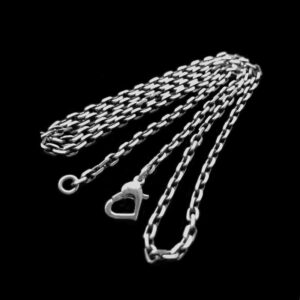
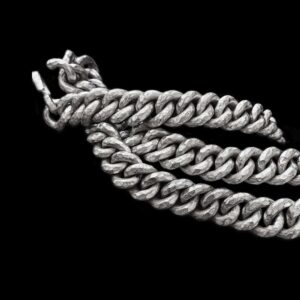
Current catalog pages can help you compare visible width, length options, link rhythm, and whether a piece includes a pendant. For example, the 3 mm oxidized cable chain shows a narrower chain-only form, while the 8 mm Heavy Hammered Cuban Chain shows a wider chain-only form. These are individual commercial examples only.
The examples do not prove they should be paired, that they will remain separated, or that they suit a particular neckline or wearer. Use their exact current listing information to make a paper or string placement mock-up, then evaluate the visual roles independently.
Run a two-necklace mirror test
- Put on the shirt, sweater, or jacket you plan to wear.
- Wear the first necklace alone and decide whether it is the lead or support.
- Add the second necklace without rearranging the garment for a photograph.
- Identify the upper line, lower line, and any pendant endpoint.
- Step back and judge the whole upper-body composition.
- Remove one necklace, compare the single-piece version, then add it again.
- Choose the version with the clearer focal point and more readable negative space.
This test answers a visual question. It does not establish physical compatibility or predict how two necklaces will behave during activity.
Common visual mistakes
Giving both necklaces equal emphasis. Two bold pieces at similar positions can create one dense focal block. Choose a lead and support.
Judging only by listed length. Two numbers do not show the actual resting positions on your body and garment. Compare visible landing points.
Letting both pendants occupy the same endpoint. Separate the visual zones or simplify one layer.
Ignoring the neckline. A combination that reads clearly on a plain shirt may look crowded inside a collar, placket, hood opening, or tie frame.
Adding detail everywhere. If two necklaces lead, allow rings, bracelets, watch, and garment hardware to play supporting roles.
A buyer checklist before choosing a second necklace
- Decide which current necklace should lead.
- Map where both pieces actually land with the intended garment.
- Choose chain-only, chain-plus-pendant, or two-pendant structure.
- Confirm that the two visible lines remain distinct from conversation distance.
- Repeat one visual cue without requiring an exact match.
- Check whether the neckline leaves enough open space for two pieces.
- Review current product dimensions, images, options, price, and availability.
- Keep performance, care, and material questions with their evidence owners.
The shortest useful answer
Men can wear two necklaces when both pieces have a clear position and one has the leading role. Start with one chain, add a second at a visibly different landing point, and check the pair with the actual neckline. Use a quieter chain to support a pendant, or make one chain visibly wider while the other supplies a separate line.
If the two necklaces merge into one crowded area, simplify the pair or return to one piece. There is no universal required number. The better answer is the number of necklaces that remain visually distinct and purposeful in the complete outfit.
Sources and limitations: Public men’s chain-layering coverage and community questions demonstrate a real decision gap. They do not prove universal taste, popularity, fit, comfort, performance, or compatibility. MENSSKULL’s framework is limited to observable spacing, scale, focal hierarchy, and garment context.


MENSSKULL Journal Notes
Leave a field note
Share fit notes, styling ideas, care questions, or your experience with MENSSKULL silver jewelry.
Comments are checked before publication so buyers can read useful fit, symbolism, care, and style notes without spam noise.
The simple plus/minus challenge below helps block automated spam while keeping the experience lightweight.
Continue exploring
More MENSSKULL stories
Handcrafted silver
Shop the pieces behind the stories