
Egyptian rings for men are easiest to compare by motif, silhouette, scale, and verified material information. An Anubis head, Horus or wedjat-eye device, scarab, and pharaoh portrait do not create the same visual effect on a ring. Historical records can explain where a motif appears in ancient Egyptian material culture, but they do not assign one universal personal meaning to every modern wearer. For a sound buying decision, identify the motif first, then check how clearly it reads at ring scale, how the face sits between the fingers, and whether the product page supports its metal description.
Quick answer: which Egyptian ring motif should you choose?
Choose Anubis when you want a recognizable jackal- or canid-headed figure and a strongly sculptural profile. Choose the Eye of Horus or wedjat eye when you prefer a centered graphic symbol that can work on a flatter signet face. Choose a scarab when the beetle form and its strong symmetry are the main attraction. Choose a pharaoh portrait when you want a human ruler image, headdress, or coin-like relief rather than a deity or amulet form. This is a design comparison, not a claim that a modern ring inherits the ritual function of an ancient object.
| Motif | What to identify | Typical modern ring treatment | Check before buying |
|---|---|---|---|
| Anubis | Canid head, tall ears, muzzle, or full figure | Sculpted head, relief, geometric profile | Ear height, side projection, face width |
| Horus / wedjat eye | Falcon imagery or the restored-eye device | Flat signet, engraved eye, centered emblem | Line clarity and whether the listing identifies the exact motif |
| Scarab | Beetle body, wing cases, legs, or seal-like form | Oval signet, carved beetle, raised relief | Whether details remain readable at the listed dimensions |
| Pharaoh | Human portrait, headdress, ruler or coin-style relief | Portrait head, rectangular signet, round medallion face | Portrait depth, edges, and how far the face extends across the finger |
Keep historical evidence separate from modern jewelry language
Ancient Egyptian objects varied by period, place, material, inscription, owner, and use. A shape could be worn, placed with the dead, used as a seal, or appear in a temple or domestic context. The Metropolitan Museum of Art explains that an amulet’s function could depend on several elements together, including shape, decoration, inscription, color, and material. That is why a one-word marketing label such as “protection” or “power” is not enough to describe every object or every modern design.
The practical buyer rule is simple: treat the museum record as historical context and the product listing as a description of a contemporary piece. A modern ring can reference an ancient image without reproducing a specific artifact, period technique, inscription, or original function. Unless a seller provides documented provenance through an appropriate specialist channel, a contemporary product should not be described as an ancient artifact.
Anubis rings: identify the figure before interpreting the design
Anubis is commonly recognized in modern jewelry through a canid head, elongated muzzle, and upright ears. Even that identification deserves care. A Metropolitan Museum object record describes one Ptolemaic-period figure as a “canid-headed god, probably Anubis,” noting that ancient Egypt had several canid-headed gods. The museum’s qualified wording is a useful model: identify the visual evidence, acknowledge uncertainty where it exists, and avoid turning a likely attribution into absolute certainty.
For a buyer, the main distinction is how the figure is translated into a ring. A frontal head is symmetrical and reads immediately from above. A profile or geometric head emphasizes the ears and muzzle. A relief composition may include additional symbols, borders, or figures, which can be more detailed but also harder to read at small scale. The dedicated Anubis jewelry guide owns the deeper Anubis-specific comparison, including the choice between a ring and a pendant. This page keeps the broader decision centered on how Anubis differs from Horus, scarab, and pharaoh motifs.
Three verified modern Anubis ring examples
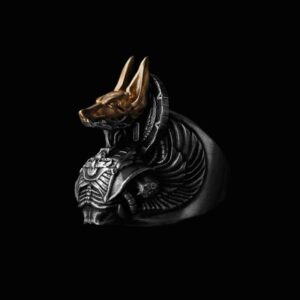
- The Gold Accent Anubis Ring uses a sculptural head and contrasting surface details. Use its current product images and selectable options to judge scale; do not infer historical material or ritual use from its appearance.
- The Front-Facing Anubis Head Ring presents the face from above, which makes symmetry, eye placement, muzzle shape, and ear spacing the important visual checks.
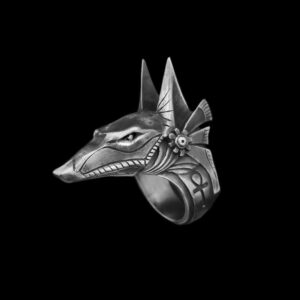
- The Geometric Anubis Ring reduces the head into sharper planes. It is useful for buyers who want the motif to read through silhouette rather than dense ornament.
These examples are current commercial references only. Availability, selectable size, dimensions, and other product facts should always be confirmed on the individual product page at the time of purchase.
Horus and the wedjat eye: do not collapse two visual ideas
Horus can appear as a falcon, a falcon-headed figure, a child deity, or through the wedjat-eye device. These are related in ancient Egyptian contexts, but they are not visually interchangeable. A ring showing a bird-headed figure should be assessed as figural relief; a ring showing only the eye is usually a flatter graphic composition.
The Met’s overview of ancient Egyptian amulets identifies the wedjat eye as the healed eye of Horus and connects the ancient device with restoration and regeneration. A separate Met collection record documents a small Horus amulet from the Ptolemaic Period. Together, these sources show why context matters: “Horus” may describe a deity figure, while “Eye of Horus” identifies a particular symbol. A modern listing should say which one is actually pictured instead of using the terms as generic Egyptian keywords.
For wearability, look at line thickness and negative space. Fine eye markings can disappear in a very small face or in low-contrast photography. A centered eye on a broad signet face is usually easier to read than a crowded composition. If the design includes a falcon, ask whether the beak, crown, wings, or body remain distinct at the dimensions shown.
Scarab rings: symmetry, relief, and seal-like construction
The scarab offers one of the clearest symmetrical forms in Egyptian-inspired jewelry. The Met records scarabs as widely used amulets and notes that many examples also functioned as seals, with incised undersides carrying names, titles, symbols, or other images. Museum records connect the beetle with solar movement, coming into being, life, and regeneration in ancient Egyptian thought. Those records support historical context; they do not prove that a new ring carries an ancient inscription, ritual status, or guaranteed effect.
On a modern ring, decide whether you want a naturalistic beetle, a simplified oval, a winged composition, or a seal-like signet. Check the division between head, thorax, and wing cases, and make sure the legs or border do not merge into an unreadable texture. If a listing claims an inscription or names a hieroglyph, compare the product photographs with the description rather than assuming every decorative line is meaningful text.
Pharaoh rings: portrait imagery rather than a single symbol
“Pharaoh” is a ruler title, not one standardized jewelry symbol. Modern pharaoh rings may show a human face, striped headdress, crown, beard, side profile, or coin-like portrait. Without an inscription or a clearly documented source, a buyer should not assume that a portrait represents a named historical ruler. The safest description is visual: pharaoh-inspired portrait, ruler motif, headdress design, or Egyptian-style relief.
Portrait rings depend on readable facial planes. Check the nose, brow, headdress edges, and border at full image size. Deep relief creates a stronger statement but may project farther from the finger. A flatter coin relief is easier to layer with other rings and may catch less on clothing. Browse the Egyptian rings for men collection for current commercial options, then return to this guide to compare motif, scale, and evidence language.
How to compare ring face scale and fit
Motif recognition depends on enough surface area, but a larger face also changes comfort. Product photos shot close to the object can make two very different rings appear similar in size. Use listed dimensions, hand-worn images, and side views together. Face width tells you how much of the finger the motif covers. Face height indicates how far ears, crowns, wings, or a portrait extend along the finger. Side views reveal projection and the transition from the face into the band.
- Confirm your base size. Use the men’s ring size and fit research guide for the measurement method.
- Check band width. A broad band can feel tighter than a narrow band in the same nominal size.
- Check face width. A face that extends far beyond the finger can touch adjacent fingers.
- Check projection. Tall ears, raised wings, and deep portraits can catch more readily than a flat signet.
- Use a specialist guide for bulky faces. The statement and skull ring size guide explains how wide bands and large faces change the fit decision.
Verify sterling silver claims without using appearance alone
A bright or dark silver-colored finish does not establish metal composition. The U.S. Federal Trade Commission’s consumer guidance explains that “silver,” “sterling,” and “sterling silver” describe products containing 92.5 percent pure silver and that 925 can represent 925 parts per thousand. The federal Jewelry Guides in 16 CFR Part 23 provide the regulatory framework for precious-metal representations. For a buyer, the useful checks are the product’s written material description, its quality mark where shown, and the seller identity standing behind the representation.
Use MENSSKULL’s 925 sterling silver research guide for material terminology and claim boundaries. This Egyptian motif guide does not attempt to authenticate an individual object from a photograph, and a “925” image alone should not be treated as independent laboratory verification.
Choose by visual role, not by a promised personality
Marketing often assigns fixed personalities to motifs: Anubis for a “dark guardian,” Horus for “vision,” scarab for “luck,” or pharaoh for “power.” Those shortcuts may describe a modern styling impression, but they should not be presented as universal history or as a prediction about the wearer. A more reliable decision asks what the ring should do visually.
- Lead the outfit: choose a tall sculptural head or portrait with a clear silhouette.
- Work as a signet: choose a flatter eye, scarab, or coin-like relief.
- Layer with a pendant: repeat one motif rather than mixing several unrelated symbols.
- Stay readable at a distance: favor large planes and strong contrast over many tiny lines.
- Keep the meaning personal: describe why you chose the design without claiming one belief for every culture or wearer.
Ring or pendant: where should the motif sit?
A ring is visible to the wearer throughout the day and turns with the hand. That makes face orientation, profile, and finger comfort central. A pendant offers more room for a full figure, multi-symbol scene, or inscription and can be worn under or over clothing. The Egyptian pendant motifs guide owns that format-specific decision.
If you want one Egyptian-inspired piece, choose the format that best suits the design. A compact eye or scarab can work well on a signet face. A full Anubis figure or a scene with multiple figures may be easier to read as a pendant. If you combine formats, use the same motif or keep one piece quiet so the set does not become visually crowded.
A five-step buying checklist
- Name what is actually shown. Distinguish Anubis, Horus, the wedjat eye, scarab, and pharaoh portrait instead of accepting a generic “Egyptian” label.
- Separate context from claims. Museum evidence can explain ancient objects; it does not prove the origin, age, or effect of a modern ring.
- Check dimensions and side views. Confirm face width, height, projection, and band width before choosing a size.
- Verify the material description. Read the product listing and use the men’s silver rings guide to compare design and material information.
- Confirm the current option. Recheck the individual product page for selectable size and availability before adding the ring to the cart.
Sources and editorial method
This guide uses museum scholarship for ancient Egyptian context, U.S. government sources for silver terminology, and current MENSSKULL pages for product and navigation facts. The sources serve different roles and are not interchangeable.
- The Metropolitan Museum of Art: Ancient Egyptian Amulets
- The Metropolitan Museum of Art: canid-headed god, probably Anubis
- The Metropolitan Museum of Art: Scarabs
- Federal Trade Commission: Buying Platinum, Gold, and Silver Jewelry
- Electronic Code of Federal Regulations: 16 CFR Part 23
Last reviewed for product connections and source access: August 29, 2026. Historical interpretations can change as museums update catalog records; follow the linked source owner for the latest object-level scholarship.

MENSSKULL Journal Notes
Leave a field note
Share fit notes, styling ideas, care questions, or your experience with MENSSKULL silver jewelry.
Comments are checked before publication so buyers can read useful fit, symbolism, care, and style notes without spam noise.
The simple plus/minus challenge below helps block automated spam while keeping the experience lightweight.
Continue exploring
More MENSSKULL stories
Handcrafted silver
Shop the pieces behind the stories