
Which skull earring format should a man choose: stud, hoop, or drop? Choose a stud when you want the design to stay close to the lobe, a hoop when you want a clear circular outline, and a drop when you want vertical movement below the ear. The useful decision is visual: silhouette, scale, movement, and outfit prominence. It is not a claim about comfort, piercing suitability, closure security, symbolism, or durability.
Skull earrings can look very different even when the motif is similar. A compact skull on the lobe reads as a small graphic mark. A skull worked into a hoop creates a larger outline around open space. A charm hanging from a hoop adds a second shape that moves below the ear. Comparing those structures is more reliable than treating every skull earring as the same kind of statement.
Quick answer: compare silhouette before detail
Start by reducing each earring to its outer shape. A stud is usually compact and centered near the lobe. A hoop creates a ring, oval, or open frame. A drop extends downward and may separate the attachment point from the skull motif. From normal viewing distance, that silhouette is often noticed before engraved lines, facial features, or surface finish.
Then decide how much of the outfit should be led by the ear area. A smaller close-to-lobe form can remain secondary to a necklace, ring, or jacket. A broad hoop can become a visible side outline. A longer drop can connect visually with a neckline or collar because the eye follows its vertical direction.
Stud, hoop, and drop comparison
| Format | Observable shape | Outfit question |
|---|---|---|
| Stud | Compact motif held close to the lobe with little visible space around it | Should the earring act as a small accent rather than the lead jewelry zone? |
| Hoop | Circular, oval, or open outline that frames negative space | Should the ear area remain visible from the side through one continuous outline? |
| Drop | Vertical element extending below the attachment point, sometimes with a separate charm | Should the earring add movement and a downward line beside the collar? |
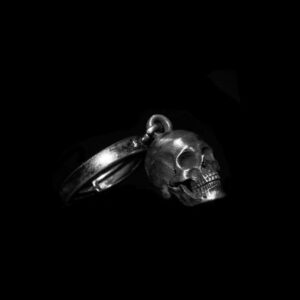
| Charm hoop | Hoop outline plus a suspended motif that creates two linked shapes | Do you want both a frame and a moving focal detail? |
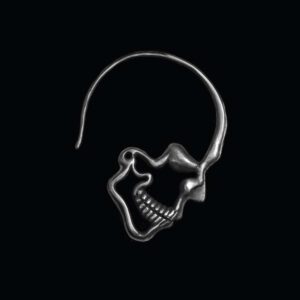
| Outline motif | Large open skull or graphic contour with visible interior space | Should scale come from the outline rather than a dense solid surface? |
This table compares appearance only. It does not establish gauge compatibility, ideal diameter, closure performance, weight comfort, fresh-piercing suitability, skin response, or safe wear. Those questions require appropriate product and specialist information that this low-risk format guide does not provide.
Choose a stud for a close-to-lobe accent
A stud keeps most of the design close to the ear. From the front, the skull may read as a compact face, symbol, or dark-light mark. From the side, there is usually less open space than with a hoop or suspended charm. That makes the format useful when you want the earring to support a wider outfit rather than define it.
A small stud can sit beside glasses, a hat, a collar, or a necklace without adding another large outline. That does not make studs universally subtle; a broad or high-contrast stud can still be prominent. Compare the visible face, edge, and contrast against hair and clothing instead of assuming the format alone determines how noticeable it will be.
Choose a hoop for a continuous outline
A hoop creates an outline around open space. The eye can read the outer curve even when the skull detail is small. A compact hoop may stay close to the ear, while a larger outline can become visible from the front, side, and three-quarter view. The useful comparison is the amount of open space and the relationship between the hoop and the skull motif.
If the skull is built into the hoop, the design may read as one integrated contour. If a skull hangs from the hoop, the result becomes a charm-hoop combination with a separate moving element. Browse the current skull earrings for men collection to compare available outlines. The category page is commercial navigation, not evidence of demand, fit, quality, or performance.
Choose a drop for vertical emphasis
A drop extends below the ear and creates a vertical line. The line may be short and compact or longer and more separated from the lobe. The skull can sit at the end of that line, forming a distinct lower focal point that may move as the head turns.
Vertical emphasis interacts strongly with collars and necklines. An open collar leaves more surrounding space, while a high collar places fabric close to the earring. Long hair, a hood, or a hat may also change how much of the drop remains visible. These are visual observations, not claims about snagging, safety, or activity suitability.
Compare scale at three distances
Use close, conversational, and full-outfit views. The close view reveals facial lines, cutouts, and surface details. Conversational distance shows whether the skull remains recognizable or becomes a broader graphic shape. Full-outfit distance reveals whether the earring leads the composition, supports another piece, or disappears into the clothing and hair.
Do not let a magnified product photograph decide the whole outfit. A small charm can look dominant in a close crop yet behave as a minor accent at normal distance. Conversely, a large open hoop may look visually light in isolation but become a strong outline when compared with a bare neckline.
Use outfit prominence as the deciding factor
Decide whether the ear, neckline, wrist, or hands should be the lead jewelry zone. When the earring is meant to lead, give its outline enough surrounding space to remain distinct. When a necklace or ring should lead, choose an earring format that does not create an equally strong competing shape.
The broader men’s jewelry styling guide covers overall coordination. For the narrower question of how skull earrings work with garments and other accessories, use the skull earring wear-and-pairing guide. This owner stays focused on choosing among stud, hoop, and drop structures.
Coordinate earrings with collars and layers
A crewneck creates a clean horizontal edge below the ears. An open shirt adds diagonal collar lines. A jacket introduces lapels, seams, zippers, and hardware. Compare the earring with those lines rather than treating it as an isolated object. A vertical drop may echo an open collar, while a hoop may create contrast through its circular outline.
When several layers already contain visible hardware, a compact format can keep the ear area from becoming another dense zone. When the outfit is visually plain, a larger hoop or drop can provide a clear accent. The choice is personal and compositional; it does not establish a universal dress code or identity.
Color contrast also changes prominence. A bright edge can stand out against dark hair or a black collar, while an open darkened outline may become clearer against pale fabric. Repeat the comparison in front, side, and three-quarter photographs because an earring can appear compact from one angle and much broader from another. Keep the clothing and lighting consistent so the format, rather than the photograph, drives the decision.
Single earring versus pair: judge the composition
A single earring creates asymmetry. A pair repeats the same outline on both sides of the face. Neither arrangement is automatically more fashionable, masculine, expressive, or appropriate. Look at the whole composition, including hairstyle, glasses, facial hair, collar shape, necklace placement, and any visible jacket hardware.
With a pair, repeated large outlines can create a strong frame around the face. With one earring, the eye may notice the difference between the decorated and undecorated sides. Product option labels may offer a single or a pair, but that commercial option does not tell a buyer which arrangement is correct.
Two current catalog examples
Current product pages can illustrate the visual difference between a compact dangling charm hoop and a much larger open skull outline. Listed dimensions below are item-specific catalog facts. NIST SI length guidance supports the unit context only; it does not support fit, comfort, or earring selection.
| Current example | Listed size | Observable format |
|---|---|---|
| Dangling Skull Charm Hoop Earrings | 15 by 7 mm; 8 g listed | A compact hoop with a separate suspended skull charm and vertical movement |
| Skull Outline Hoop Earrings | 50 by 45 mm; 12 g listed | A large open skull contour that uses outline and negative space for prominence |
These products do not prove comfort, piercing suitability, closure security, ideal diameter, skin response, durability, symbolism, quality, or popularity. They are visual references for comparing scale, outline, vertical emphasis, and the amount of open space in the design.
Keep material and care claims in their own evidence lane
Material labels belong to the individual listing and should be read as item-specific facts. A visual guide should not turn a silver color, dark recess, or polished edge into a claim about alloy, hallmark, care, or long-term performance. For documented material context, use the 925 sterling silver Research guide.
Likewise, appearance does not reveal how a closure performs or how an earring feels during wear. This page deliberately removes those claims because no materials, care, safety, or fit reviewer is assigned to this low-risk format comparison.
Common format-selection mistakes
- Choosing from a close-up only: compare the earring at conversational and full-outfit distance.
- Calling every hoop the same: distinguish an integrated outline from a separate charm hoop.
- Ignoring negative space: an open outline can appear large without becoming a solid visual block.
- Treating movement as performance evidence: visible movement does not prove closure security or safe wear.
- Assigning universal meaning: a skull motif does not establish personality, confidence, masculinity, or subculture identity.
- Using size as comfort evidence: listed dimensions and weight do not determine how a product feels for a particular wearer.
A practical skull earring decision sequence
- Choose whether the earring should stay close to the lobe, frame open space, or extend vertically.
- Compare the silhouette from the front and side before focusing on small skull details.
- Check the scale at conversational and full-outfit distance.
- Decide whether the ear area or another jewelry zone should lead the outfit.
- Compare the outline with hair, glasses, collar lines, jacket hardware, and necklaces.
- Use product pages for current item facts and specialist sources for piercing, fit, closure, and safety questions.
Final answer
Choose a skull stud for a close-to-lobe accent, a hoop for a continuous circular or open outline, and a drop for vertical emphasis and visible movement below the ear. A charm hoop combines a frame with a separate motif, while a large outline design creates prominence through scale and negative space.
The final choice should come from observable silhouette, scale, movement, and outfit balance. These comparisons do not prove that one format, product, or arrangement is universally better, safer, more comfortable, more durable, more meaningful, or more appropriate. Use the earring format to control visual prominence, then keep piercing, closure, material, care, and safety decisions in their proper evidence lanes.


MENSSKULL Journal Notes
Leave a field note
Share fit notes, styling ideas, care questions, or your experience with MENSSKULL silver jewelry.
Comments are checked before publication so buyers can read useful fit, symbolism, care, and style notes without spam noise.
The simple plus/minus challenge below helps block automated spam while keeping the experience lightweight.
Continue exploring
More MENSSKULL stories
Handcrafted silver
Shop the pieces behind the stories