
Quick answer: For workwear jewelry for men, choose a chain necklace when the neckline is the visual space you want to use, and a cuff bracelet when the wrist is the clearer space. Start with one focal piece, check it against your actual shirt and jacket, then verify the relevant size and construction details. This is a styling decision for workwear-inspired outfits, not advice to wear jewelry around machinery.
The timely starting point is Pinterest’s Men’s Trend Report, published September 9, 2026. It identifies workwear and accessory-led styling among men’s interests. JCK discussed its jewelry implications on September 11. Those dates make this a recent trend interpretation, not breaking news from September 15. The outfit checks below are MENSSKULL’s practical editorial framework, not findings measured by Pinterest.
What the recent signal says, and what it cannot decide
Pinterest reports increases of 351% for searches using the phrase men chain necklace and 194% for mens silver cuff bracelet. These are reported changes in Pinterest search activity, not percentages of men buying jewelry. They are useful reasons to compare the two forms, but they do not prove that either form is the right purchase for your wardrobe.
| Reported signal | Practical question it prompts | Conclusion to avoid |
|---|---|---|
| Chain-necklace searches: +351% | Does my neckline leave space for a visible chain? | Chain purchases or MENSSKULL sales rose by the same amount |
| Silver-cuff searches: +194% | Would a wrist accent work better with my usual sleeves? | Cuffs suit every wrist or workwear outfit |
| Both are accessory forms discussed in the report | Which one has a useful place in my existing outfits? | I need both to follow a trend |
The report does not provide a sizing recommendation, a comparison of clasp performance or product-specific comfort evidence for the examples in this article. The two percentages also lack the absolute search totals needed to compare the total popularity of the forms. A faster-growing term need not have the larger audience.
JCK’s coverage helps connect the report to jewelry retail, but it discusses the same underlying Pinterest report. It is not a second independent measurement of consumer demand. Treat that distinction seriously: recent coverage can confirm that a development is relevant without converting one platform’s signal into a market-wide fact.
The useful buying question is narrower than whether silver jewelry is generally trending. It is whether a neck accent or a wrist accent earns its place in the outfit you already wear. That narrower question is why this guide uses collars, cuffs, visible space and catalog checks, rather than presenting a broad forecast or a list of purported must-have products.
Find the open space in your outfit before choosing the piece
Use one real outfit as the test case: the T-shirt or shirt you repeatedly wear, plus the chore coat, field jacket or leather layer you actually own. Keep its usual fastening and sleeve position. A piece photographed with an open collar may disappear when you wear the same type of garment buttoned up. A cuff displayed on a bare wrist may be hidden by your jacket. Buying for a styled product image instead of your normal outfit leaves that difference unresolved.
Choose the neckline when it is the intended focal area
A visible chain can use the space between an open collar and the upper chest. Before choosing its scale, look at what already occupies that space: a graphic print, zipper pull, contrasting buttons, a pendant you already wear or several overlapping collars. As an editorial styling option, simplify one of those details if the chain is intended to be the focal point. This is a choice about visual emphasis, not a universal dress rule.
Test the chain with the jacket both open and closed. Decide whether you want it visible in both states or only in the open-layer outfit. The answer can change the length you investigate, but it should not come from a generic claim that one length fits all men. Use the men’s necklace chain length guide for the separate length decision, and verify the actual options on the listing.
Choose the wrist when the neckline is already busy
A cuff moves the accent away from the chest. That can be a useful styling alternative when you like the shirt’s existing collar details or usually keep an outer layer closed. Check the cuff with your normal sleeve position, rather than rolling the sleeve solely to reproduce a product photograph. If it is normally hidden, decide whether that is acceptable before making it the outfit’s main accent.
Include a watch if you normally wear one. Assess whether you want both on the same wrist, separate wrists or only one item in this outfit. Appearance alone does not establish clearance or fit. If two pieces would sit together, check their dimensions and how the seller defines the bracelet size before buying. The men’s silver bracelet guide owns the broader bracelet selection topic.
| Your outfit condition | Form to investigate first | Check before choosing |
|---|---|---|
| Open neckline with few competing details | Chain necklace | Position with your collar and outer layer |
| Graphic shirt or crowded chest details | Cuff bracelet as an alternative | Whether the wrist remains visible with usual sleeves |
| Jacket usually closed | Whichever area stays visible | Do not assume the necklace will show or the cuff will clear the sleeve |
| Watch already acts as the wrist accent | Chain, or a deliberately separate wrist choice | How much visual emphasis you actually want |
| Neither area has a useful place for a new piece | No purchase required for that outfit | Test another existing outfit before buying for the trend alone |
These are starting points, not measured outcomes. A cuff can work with an open collar and a chain can work with a graphic shirt if that is the balance you prefer. The test is useful because it makes your preference specific enough to check against real garments and product information.
Use the catalog to verify the form, not to borrow a trend label
Two current MENSSKULL examples show why the final decision needs more than the word silver. They are commercial examples, not Pinterest-endorsed products and not a comparison of market leaders. Product references below were checked September 15, 2026; current options and purchase terms remain on the linked product pages.
Chain example: elongated links with separate width and length options
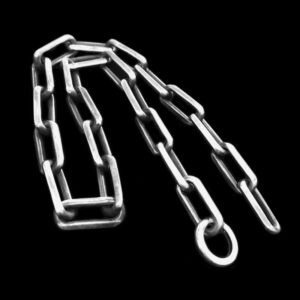
The Chunky Paperclip Chain Necklace is listed as 925 silver, with separate 12 mm or 15 mm width options and chain lengths from 50 to 80 cm. Its catalog image shows elongated open links. This is a clearly defined form to compare against an open collar, rather than a promise that any silver necklace will produce the same appearance.
Do not mistake width for length or assume that every available combination has the same weight. Confirm both selected options on the live listing. This article does not assign its published weight ranges to individual combinations, recommend it for every wearer or claim that a particular length works under every jacket. If exact combined-option measurements matter, ask before ordering. A chain worn alone also creates a different focal shape from the same chain with a pendant; pendant compatibility is a separate purchase question.
Cuff example: dark relief with a small contrasting stone accent
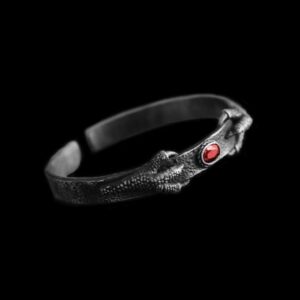
The Eagle Claw Red Stone Cuff Bracelet is listed as 925 sterling silver. Its image shows a textured, dark-contrast cuff with a red accent. The product gives a 14 mm size reference and a product-level 34 g entry, alongside wrist-size options. The 14 mm reference is not a verified wrist circumference, and the single weight entry is not an exact value for each selectable option.
This example introduces a different visual question from the chain: do you want a relatively plain link rhythm near the collar, or a more detailed wrist accent that includes a contrasting color? Neither answer proves superior quality, comfort or cultural authenticity. Inspect the available views and confirm how the chosen wrist option relates to your measurement. Do not assume that an open cuff can be repeatedly bent or resized without specific seller guidance.
Keep material verification separate from styling. The 925 silver research guide explains material and marking boundaries; the trend report is not an assay of these products. A photograph with blackened recesses also does not establish the finish ingredients or appropriate treatment. For maintenance questions, refer to the sterling silver care research and check the item’s particular finish.
A repeatable test before buying either form
Take the outfit you used earlier and describe the intended accent in one sentence: for example, a visible link pattern below the open collar, or a textured cuff beside a plain sleeve. Then identify the information still missing: selected necklace length and width, wrist-option meaning, projection, clasp detail or an additional photograph. This turns a broad trend into a specific buying decision.
- Choose one focal area, neckline or wrist, in an outfit you actually wear.
- Check that area with your normal fastening and sleeve position, including your watch or existing jewelry.
- Compare the piece’s form and finish in multiple views, not only a close crop.
- Verify the exact selected options and ask for missing measurements rather than guessing.
- Only add a second accent if you still prefer the combination after checking the first.
Does a rising chain-search figure mean I should choose a chain over a cuff?
No. Relative search growth is not a personal fit or outfit assessment. It also cannot establish which term has the greater total search volume without the starting totals. Choose the area that works in your actual outfit, then verify the relevant purchase details.
Do I need a matching necklace and bracelet?
No matched set is required by this framework or demonstrated by the report. Starting with one piece makes its intended role easier to judge. If you prefer two, check their visual balance and their separate sizing requirements rather than assuming matching metal solves both decisions.
Is this guidance for an actual workshop shift?
No. Workwear here describes an outfit aesthetic. This guide provides no approval for wearing chains or cuffs during tool use, industrial work, climbing or other activities. Follow the applicable workplace or activity rules; a style label is not safety evidence.
Prepared by MENSSKULL Editorial Team. Published September 15, 2026. Trend source: Pinterest, September 9; related jewelry coverage: JCK, September 11. Product examples and outfit checks are MENSSKULL editorial content, with no implied endorsement from either source.
MENSSKULL Journal Notes
Leave a field note
Share fit notes, styling ideas, care questions, or your experience with MENSSKULL silver jewelry.
Comments are checked before publication so buyers can read useful fit, symbolism, care, and style notes without spam noise.
The simple plus/minus challenge below helps block automated spam while keeping the experience lightweight.
Continue exploring
More MENSSKULL stories
Handcrafted silver
Shop the pieces behind the stories