
A men’s bracelet selection guide should help you choose the kind of bracelet first, then verify the specific offer. Decide whether you want a linked chain or an open cuff, where the design should draw attention, and how much visual presence you want. Next, check what the size selector means, inspect the closure views, and resolve missing specifications before ordering. A material label, a weight figure or one attractive wrist photograph cannot answer all those questions.
This is an original shopping framework, not a trend report or a ranking of the strongest bracelets. The MENSSKULL examples below illustrate different choices using their published specifications and gallery views. They are commercial product examples, not independently tested recommendations. Begin with the men’s silver bracelet collection, but compare the information attached to each design rather than treating every bracelet as interchangeable.
Choose the overall form before choosing the motif
Two bracelets can carry the same skull, cross or animal theme and still create very different outlines. A linked bracelet divides its visible design into connected sections. An open cuff presents a continuous band with a gap. Neither format is automatically the better purchase. The useful first question is which outline you actually want to see around your wrist.
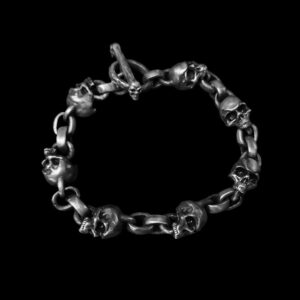
Next, decide whether the motif should be concentrated in one place or repeated. A skull used at a chain closure creates a focal detail against simpler links. A sequence of skull-shaped links spreads the motif around the bracelet. A single cross plaque gives you another focal composition; it is not the same visual choice as cross-shaped links repeated all the way around. Those distinctions are observable in photographs without making claims about symbolic meaning or workmanship.
Finally, think about the rest of the outfit as a composition. If a ring already carries the most elaborate detail, a bracelet with one focal element may be the contrast you prefer. If the bracelet itself is the main piece, an all-around motif may better match your intention. These are aesthetic preferences, not rules about masculinity, professions or occasions.
| Choice | What to compare | What still needs verification |
|---|---|---|
| Linked chain or open cuff | Connected links and a closure versus a continuous band with an opening | Size-option meaning and the dimensions relevant to that construction |
| One focal motif or repeated motif | Detail at a terminal or plaque versus sculpted detail around the bracelet | Front, rear and open views of the exact design |
| Quiet or prominent visual scale | Wrist photographs alongside close-ups, not close-ups alone | Which feature each millimeter measurement describes |
| Closure-led or band-led design | A closure that forms part of the motif versus an open cuff outline | The actual closure mechanism or cuff geometry, not an inferred performance guarantee |
Read the size selector before interpreting the size number
On the five examples in this guide, the selectable centimeter options are labeled circumference of wrist. That is not a statement that the finished bracelet has exactly the same length. Do not convert a wrist option into a finished chain length, or use a product’s millimeter reference as a substitute for wrist measurement.
Some pages offer individual wrist values, while another offers wrist ranges. Those are different ordering formats. If your measurement is between options or at the end of a range, ask how the seller applies that selector to the particular design. For the actual measurement procedure and the distinction between wrist size and bracelet dimensions, use the men’s bracelet size guide rather than guessing an allowance from a photograph.
An open cuff also deserves a specific question about internal dimensions and its opening. A cuff photograph does not establish that the band is adjustable, and a wrist option does not authorize bending instructions. If those details are necessary to your purchase decision but absent from the offer, keep the item on a provisional shortlist until the seller clarifies them.
Compare five documented bracelet choices
The following comparison separates visible form from published numbers. Weight values are product-level references unless the seller explicitly assigns them to a variation. Size references retain their published wording where the measured feature is unclear. None of these numbers is used here to predict strength, comfort, scratch resistance or service life.
| Bracelet | Visible design | Published size and weight | Wrist options and unanswered detail |
|---|---|---|---|
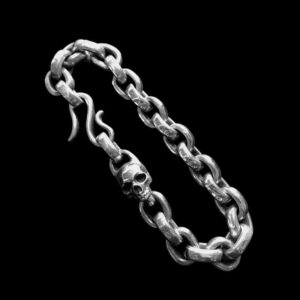
| Skull Clasp Chain Bracelet | Rounded oval links with skull detail concentrated at the closure | 10 mm size reference; 70-90+ g weight range | 15-23 cm individual wrist options; ask which feature the 10 mm reference measures and the weight of your selected option |
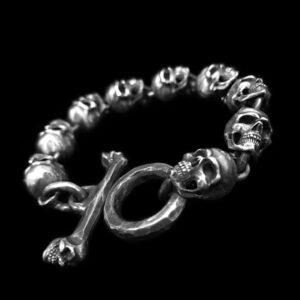
| Heavy Skull Link Bracelet | Repeated sculpted skull links; bone-shaped toggle bar and end ring | Diameter: 7.6 mm; 120 g product reference | 15-17, 18-20 and 21-23 cm wrist ranges; the feature described as diameter is not defined |
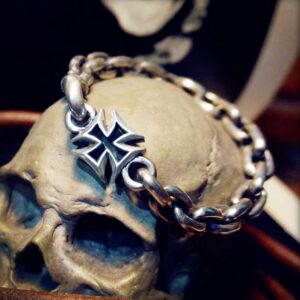
| Iron Cross Chain Bracelet | One cross plaque, oval links and a curved hook closure | 19 × 15 mm size reference; 36 g product reference | 15-23 cm individual wrist options; dimension axes are not defined |
| Snake Head and Tail Hook Chain Bracelet | Scaled head terminal, curved tail hook and linked chain | 96 × 14 mm size reference; 30 g product reference | 15-23 cm individual wrist options; do not read 96 mm as finished bracelet length |
| Eagle Claw Red Stone Cuff Bracelet | Open textured cuff, claw detail and a round red stone | 14 mm size reference; 34 g product reference | 17-22 cm individual wrist options; confirm internal dimensions and opening; stone identity is not specified |
These pages currently describe their material as 925 silver, sterling silver or 92.5% sterling silver. That is the seller’s stated material, not an assay report or an independent certification. For the meaning and limitations of material descriptions, see the 925 sterling silver research guide. Keep material identification separate from the visual choice between these bracelets.
If you want the skull detail in one place
The Skull Clasp Chain Bracelet is the relevant comparison when you want a largely oval-link chain with skull detail at the closure. Look at the open view as well as the wrist view: the motif and closure are part of the same focal area. This is a different composition from a bracelet built from repeated skull heads.
The published 70-90+ g range is useful as a prompt for a question, not as a precise weight for every wrist option. If weight matters to your selection, request the figure for the option you intend to order. Do not assume that a particular centimeter choice corresponds to either endpoint of that range.
If you want the motif around the bracelet
The Heavy Skull Link Bracelet presents skull-shaped links throughout the design. Its open views show a bone-shaped toggle bar and an end ring. Choose it for that repeated sculptural appearance if that is your preference, rather than assuming that its 120 g reference makes it a better-built bracelet than the other examples.
Its wrist ranges also require a different comparison from the single-value selectors. Confirm the appropriate range and any finished dimensions you need. The phrase “Diameter: 7.6 mm” does not identify the measured feature, so this guide does not turn it into link width, wrist diameter or internal bracelet space.
If you prefer a cross plaque or an animal-shaped closure
The Iron Cross Chain Bracelet combines one cross plaque with simpler oval links. Its visible contrast comes from the focal plaque rather than repeated cross-shaped sections. Compare the plaque in front and open views; do not assign a historical or personal meaning to the design on behalf of the wearer.
The Snake Head and Tail Hook Chain Bracelet makes the head and curved tail part of the closure composition. It is a linked bracelet, not an open snake cuff. The product name and images establish the offered design; a legacy URL containing “handmade” does not by itself establish a verified production process. If making method matters to you, ask for specific supporting information.
If you want an open band and a colored focal detail
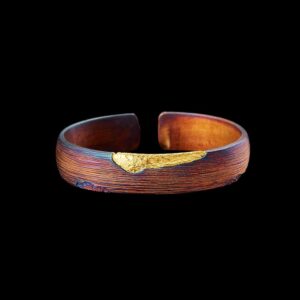
The Eagle Claw Red Stone Cuff offers a contrasting outline: a textured open band with claw detail and one red stone. Its side and rear views help distinguish the cuff opening from the closed outlines of the chain examples. The visible color is a design choice; it does not identify the stone as ruby, garnet or another gemstone.
Before ordering, clarify any missing cuff dimensions and any stone specification that matters to you. Do not assume adjustability, stone treatment, origin or grading from the photograph. The point of this comparison is to make those unresolved details visible, not to fill them with attractive guesses.
Use the whole gallery, not only the hero photograph
A productive gallery check has three parts. First, use the full-bracelet view to identify the outline and distribution of the motif. Second, use open and rear views to understand which parts connect and which surfaces are hidden in the hero image. Third, use wrist photographs as context for appearance, without treating an unidentified model’s wrist as a measurement standard.
If several variations reuse the same image, that image illustrates the design but does not demonstrate the dimensions of every option. Match the selector text to your intended purchase and ask for the missing specification separately. For a fuller closure inspection framework, use the existing silver bracelet fit and clasp guide. This selection guide does not rank hook or toggle mechanisms for security.
Reduce the shortlist to two different choices
Instead of retaining five similar-looking tabs, choose two candidates that answer your main preference differently. For example, compare a skull closure on plain links with repeated skull links, or compare a linked focal plaque with an open cuff. Then write down which difference you actually prefer. This prevents an undefined idea of “best” from replacing a decision you can explain.
If you plan to wear a watch as well, settle the arrangement separately with the bracelet and watch arrangement guide. Do not read a styled product photograph as proof of scratch protection or suitability for every activity. For a gift, missing wrist information is also a real ordering gap, not something a familiar motif can solve.
Finish with three questions to the seller: What does my chosen size option represent? Which physical feature does the listed millimeter value measure? Which weight, closure view or cuff dimension applies to this exact option? Add a material or stone question only when it is relevant to your purchase. Keep the answers with the product link so you are comparing the same offer, not a remembered description.
Common bracelet selection questions
Is a heavier bracelet automatically a better choice?
No. A listed weight is not a workmanship verdict or a comfort guarantee. Use it as one stated characteristic of the offer and clarify whether it applies to your variation. The sterling silver jewelry quality guide owns the broader quality-evaluation questions.
Can I choose a bracelet solely from its wrist photograph?
No. A wrist photograph can help you compare the visible composition, but it cannot define your size option, identify every dimension or establish closure performance. Combine it with the full, open and rear views and the seller’s specific ordering information.
Does an open cuff mean I can reshape it myself?
Not from the photograph alone. Confirm the design’s intended fit and any seller instructions before making that assumption. This guide supplies no bending method. Cleaning and finish questions belong to the sterling silver jewelry care research guide, not to an improvised adjustment procedure.
Which of these bracelets is the best first purchase?
The useful answer is the one whose form you prefer and whose relevant ordering details you can verify. A focused motif, repeated skull links, a cross plaque, a serpent closure and a red-stone cuff are different design choices. Once you have chosen the composition, unresolved specifications should determine what you ask next, not what you invent.
MENSSKULL Journal Notes
Leave a field note
Share fit notes, styling ideas, care questions, or your experience with MENSSKULL silver jewelry.
Comments are checked before publication so buyers can read useful fit, symbolism, care, and style notes without spam noise.
The simple plus/minus challenge below helps block automated spam while keeping the experience lightweight.
Continue exploring
More MENSSKULL stories
Handcrafted silver
Shop the pieces behind the stories