
How should a man choose a silver bracelet when the designs look completely different? Start with the bracelet’s visible construction profile: an all-metal chain, repeated sculpted links, a woven body, or a leather body with metal focal details. Then compare link scale, apparent width, where the eye is drawn, and how much wrist-level presence you want. Keep wrist measurement, closure performance, comfort, material verification, care, and durability as separate questions for their dedicated owners.
This guide is limited to observable design choices and current catalog information. It does not declare one construction better, safer, stronger, more comfortable, or more masculine than another. The useful decision is whether the bracelet’s outline and detail distribution support the role you want it to play in an outfit.
Quick answer: choose the body form before the motif
The bracelet body creates the first visual impression. A linked silver chain reads as a continuous metal line. Repeated sculpted links turn the whole circumference into detail. A woven body creates a darker, more textured band. A leather body with silver-colored focal pieces separates the band from the decorative elements. Those differences remain visible even when several designs share a skull motif.
Begin by deciding whether you want the wrist to show mostly metal, mostly texture, or a clear contrast between the band and focal pieces. Only then compare skulls, plaques, hooks, or other decorative details. This order prevents a close-up motif from distracting you from the larger outline you will actually see at normal viewing distance.
| Construction profile | What the eye sees first | Useful outfit role | Question to keep separate |
|---|---|---|---|
| All-metal chain | A continuous sequence of links with a metallic outline | A clear wrist-level line that can support or lead the outfit | What each listed dimension describes |
| Repeated sculpted links | Detail distributed around the bracelet rather than concentrated in one place | A motif-led focal piece | Whether a product-level weight applies to the selected option |
| Woven body | A textured band with metal elements set against a darker body | Contrast between texture and sculpted detail | How the seller defines the body material and size selector |
| Leather body with focal pieces | A broad dark band interrupted by a few brighter details | A strong band-and-accent composition | Material verification, care, and service expectations |
Separate an all-metal outline from a mixed-material outline
An all-metal bracelet usually presents one visual family from end to end: links, terminals, and closure are read as parts of the same metallic line. The link shape and spacing determine whether that line appears smooth, open, compact, or highly articulated. In a mixed-material design, the band and the decorative pieces create a more obvious contrast. The eye can read the dark body first and then the brighter focal details, or the reverse.
Neither outline is automatically more versatile. An all-metal chain may echo a watch case, ring, belt hardware, or necklace. A woven or leather body may echo a jacket, boots, bag, or other dark texture. Treat these as composition options, not material-performance conclusions. Browse the men’s silver bracelet collection to compare the range of current silhouettes before narrowing the list.
Compare link scale and visible width at normal distance
Product photographs often magnify a clasp or skull until a small component fills the frame. That is useful for seeing detail, but it does not show how the bracelet reads with a full sleeve, hand, watch, or ring. Use the full-bracelet and wrist photographs to judge whether the piece appears like a narrow line, a medium band, or a broad focal block.
Listed millimeter values can help only when the measured feature is identified. Millimeters and centimeters are standard length units, as the NIST length-unit reference explains, but a number does not tell you whether the seller measured link diameter, body width, clasp height, or another feature. Keep the published wording intact and ask for clarification when the axis is unclear.
Do not turn visual width into a claim about comfort or suitability. A bracelet can look prominent without this article proving how it feels, and a narrow bracelet can still carry substantial detail. Here, width is used only to compare the amount of visual space the design occupies.
Decide whether the detail is focal or repeated
A focal design concentrates attention at one clasp, plaque, or cluster. The rest of the body may be comparatively simple, which makes the focal element easier to identify. A repeated design distributes similar forms around the bracelet. That produces rhythm and a more consistently decorated outline, even when only part of the bracelet is visible.
This distinction is especially useful with skull bracelets. The skull bracelet collection includes motif-led examples, but a shared motif does not make their compositions identical. Ask whether you want one skull detail to interrupt a simpler body or multiple skull forms to define the entire band. Do not assign a universal meaning, status, personality, or subculture identity to either choice.
Read clasp prominence as a design feature, not a performance verdict
Some closures are visually quiet and sit close to the rest of the bracelet. Others are intentionally shaped as skulls, hooks, toggles, or terminals and become part of the composition. When the clasp carries the main motif, it may function as the visual front of the bracelet rather than a hidden mechanism.
That observation does not establish closure security, ease of use, service life, or activity suitability. Those conclusions require specific evidence and, where relevant, specialist review. Use open product views to identify the offered construction, but do not infer performance from a dramatic shape or a heavy-looking photograph. If wrist measurement or ordering size is the unresolved issue, move to the men’s bracelet size guide rather than creating a sizing rule from the design.
Compare four current catalog-defined profiles
The examples below are not rankings. They show how four different body forms change the visual decision. The dimensions, weights, material labels, prices, and availability belong to the current product listings and should be rechecked on the product page before purchase. A product-level weight is not used here to predict strength, comfort, or quality.
| Current example | Observable profile | Current listed reference | Decision it can illustrate |
|---|---|---|---|
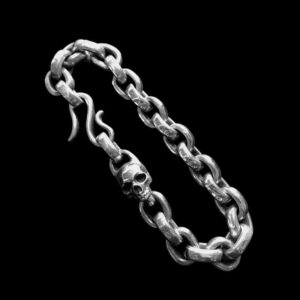
| Skull Clasp Chain Bracelet | All-metal oval-link chain with skull detail concentrated at the closure | 10 mm size reference; 70-90+ g product range; seller-listed 92.5% sterling silver | Continuous metal body versus one focal clasp area |
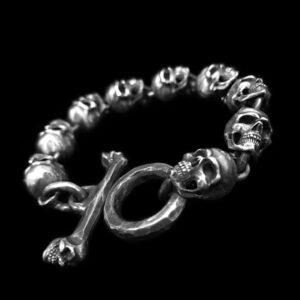
| Heavy Skull Link Bracelet | Repeated sculpted skull links with detail around the body | 7.6 mm diameter reference; 120 g product reference; seller-listed 925 silver | Repeated motif and high visual density |
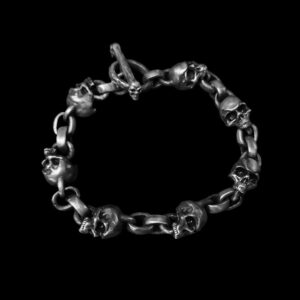
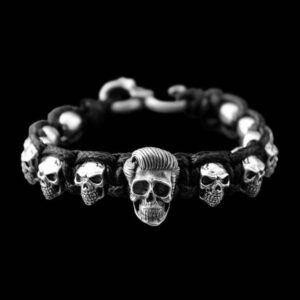
| Multi Skull Woven Bracelet | Dark woven body with multiple sculpted skull details | 7.6 mm diameter reference; 34 g product reference; seller-listed 925 silver | Texture-and-metal contrast with repeated detail |
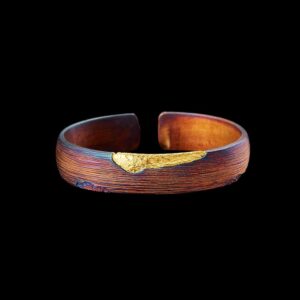
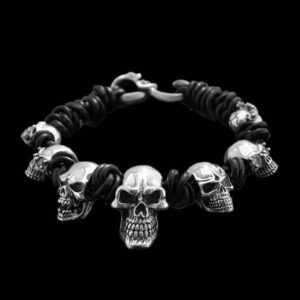
| Triple Skull Leather Bracelet | Leather body with three concentrated skull focal pieces | 10 mm diameter reference; 32 g product reference; seller-listed 925 silver components | Broad dark band with a limited focal group |
Use product data without turning it into a ranking
A listed weight can distinguish product records, but it does not make the heavier bracelet the better bracelet. A listed width or diameter can preserve an exact seller-provided fact, but it does not prove how much visual space the item occupies until the measured feature is clear. A material label can describe the offer, but it is not an independent assay or certification.
For material terminology and its limits, use the 925 sterling silver research guide. For a broader framework covering evidence, construction questions, and quality evaluation, use the sterling silver jewelry quality guide. This article deliberately does not duplicate those Research-owner claims.
The same boundary applies to leather and woven bodies. A visible texture can be compared as an outfit element. It cannot establish source, treatment, longevity, maintenance needs, or skin response without supporting evidence. Keep the visual selection and the verification checklist as two separate stages.
Match wrist presence to the rest of the outfit
Wrist presence is the amount of attention the bracelet receives in the complete outfit. It comes from visible width, contrast, link scale, repetition, and the number of nearby accessories. A broad dark band with bright skull details may stand out strongly against a light cuff. A polished chain may stand out more against matte fabric. Repeated links can remain visually active from several angles, while a focal clasp can appear quieter when it turns away from view.
Choose one lead element at the wrist. If a watch already has a large case, detailed dial, or contrasting strap, compare the outfit with the bracelet on the other wrist as well as the same wrist. If rings already supply repeated sculpted detail, test whether the bracelet should echo that density or provide a simpler line. These are visual experiments, not universal styling rules.
Coordinate metal, texture, and color without forcing a perfect match
Exact matching is not required for a coherent outfit. Instead, repeat one or two relationships. A silver-colored bracelet can connect with a ring or jacket hardware. A woven or leather body can connect with dark footwear or a belt. Oxidized recesses can sit comfortably beside charcoal, black, denim, brown leather, or other textured neutrals because the bracelet already contains light-and-dark contrast.
Avoid treating every accessory as an isolated focal point. If the bracelet has repeated skull links, let another accessory use a simpler surface. If the bracelet has one focal skull clasp, a ring can carry another detailed motif without necessarily making the wrist area feel crowded. Judge the whole silhouette from conversational distance before relying on a close photograph.
Use a four-view comparison before narrowing the shortlist
First, inspect the full bracelet laid open. This reveals whether detail is concentrated or repeated. Second, inspect the closure view to see whether the clasp is visually integrated or deliberately prominent. Third, inspect a wrist photograph for scale context, without treating the model’s wrist as your measurement standard. Fourth, inspect the side or rear view for body depth, link spacing, and the relationship between the band and focal pieces.
Save one image from each useful angle for the two finalists and compare equivalent views side by side. If one listing does not show the view needed to understand the construction, record that as an unanswered question. Do not fill a missing rear view with an assumption based on a similar product.
Build a shortlist around contrast, not tiny differences
A productive shortlist contains two genuinely different profiles. Compare an all-metal chain with one focal clasp against a woven body with repeated details. Or compare repeated sculpted links against a leather band with three focal pieces. A contrast like this reveals what you actually prefer. Comparing four nearly identical close-ups often turns the decision into a search for an undefined “best” bracelet.
Write one sentence for each finalist: “I prefer this because the body is mostly metal and the motif is concentrated,” or “I prefer this because the dark band makes the silver-colored details more distinct.” If the sentence depends on unverified quality, comfort, security, or durability, move that claim to a verification list rather than using it as the style reason.
Keep measurement, material, care, and performance questions in their lanes
The visual profile can get you from dozens of options to two or three. It cannot complete every purchase check. Wrist measurement belongs to the size owner. Material terminology and verification belong to the Research owners. Care instructions should come from the applicable material and finish guidance. Closure security, workplace suitability, sports use, skin response, and injury risk require evidence beyond a visual comparison.
This separation is useful rather than restrictive. It lets the styling question remain clear: which outline, distribution of detail, and level of wrist presence do you prefer? Once that is answered, you can ask precise follow-up questions about the exact offer instead of expecting one attractive photograph to answer everything.
A practical final decision sequence
Choose the body form first: all-metal chain, repeated sculpted links, woven band, or leather band. Choose focal or repeated detail second. Compare apparent width and link scale from full-product and wrist views. Decide whether the clasp should disappear into the design or become a visible feature. Then place the bracelet beside the watch, rings, sleeve, and hardware you actually wear.
After the visual shortlist is stable, verify the meaning of every relevant size option, dimension, weight, and material label on the exact product page. Ask the seller about anything the listing does not define. This process does not guarantee a particular result, but it keeps the decision grounded in observable differences and documented product facts rather than assumptions.
Common silver bracelet profile questions
Is an all-metal bracelet automatically more formal?
No. The outfit, link scale, surface contrast, motif, and neighboring accessories all affect the result. An all-metal chain can look restrained or highly sculptural. A leather or woven body can look minimal or visually dominant. Compare the complete composition rather than assigning one fixed dress code to a construction family.
Does a heavier listed weight mean higher quality?
No. Weight is one seller-provided product characteristic, not a workmanship grade, comfort promise, or durability forecast. Use the quality Research owner for evidence standards and keep product-level weights attached to the exact listing.
Should the clasp be hidden?
Not necessarily. Some bracelets use the clasp as the main focal element. Others keep the closure visually subordinate to the links or band. Choose the composition you prefer, then evaluate any performance question separately.
Can I choose from the hero image alone?
No. Use full, open, closure, side, and wrist views when available. The hero image may emphasize detail while hiding the overall outline or the way focal elements are distributed.
Which profile is the safest first choice?
This article does not rank bracelet profiles for safety, comfort, or universal suitability. For style, begin with the profile that best matches your preferred amount of metal, texture, repetition, and wrist presence. Then complete the separate size, material, and product-specific checks.

MENSSKULL Journal Notes
Leave a field note
Share fit notes, styling ideas, care questions, or your experience with MENSSKULL silver jewelry.
Comments are checked before publication so buyers can read useful fit, symbolism, care, and style notes without spam noise.
The simple plus/minus challenge below helps block automated spam while keeping the experience lightweight.
Continue exploring
More MENSSKULL stories
Handcrafted silver
Shop the pieces behind the stories