
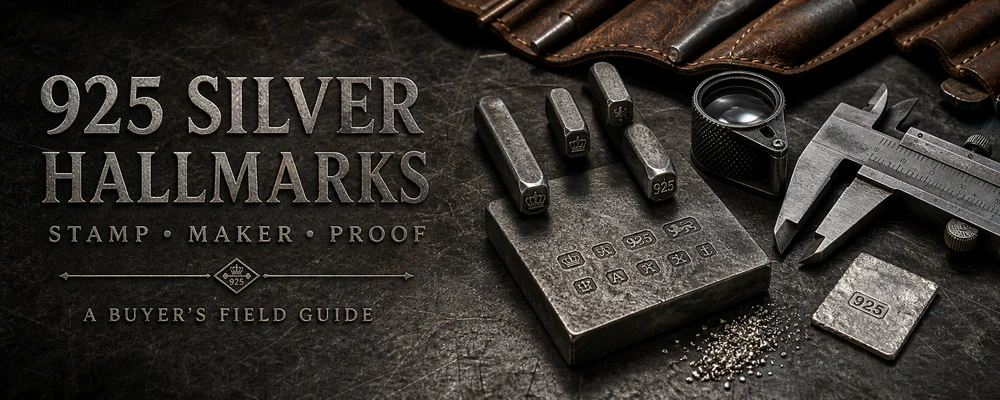
Answer first: A 925, .925, or S925 stamp is normally a fineness claim: it says the item is represented as an alloy containing 925 parts silver per 1,000, or 92.5% silver by mass. The mark is useful, but the stamp alone is not independent proof that the metal was tested, that the item is solid sterling throughout, or that the seller is trustworthy. A buyer should read the quality mark together with the maker or responsible-party mark, the country in which the item was sold, the construction, the listing details, and, when value or safety matters, a professional test.
For the complete evidence framework, see MENSSKULL’s 925 sterling silver research on fineness, hallmarking and testing.
That distinction is the heart of 925 silver hallmark meaning. Online listings often collapse three different ideas into one: a fineness number, a maker’s mark, and a legally controlled hallmark. They are not interchangeable. This guide explains what the common stamps can tell you, what they cannot establish, and how to verify a ring, chain, pendant, bracelet, or earring without trusting a single tiny number.
925 Silver Hallmark Meaning in One Minute
- 925, .925, and S925: commonly communicate a claimed silver fineness of 925 parts per 1,000.
- Sterling or sterling silver: a quality description that is regulated in major markets; in the United States, the federal standard is tied to 925/1,000 silver, subject to the law’s stated tolerances.
- A maker’s or responsibility mark: identifies the party standing behind the quality claim. It is not the same thing as the fineness number.
- A full UK hallmark: is a legally defined group of marks that includes an assay office mark and indicates independent testing under the UK hallmarking system.
- 925 on its own: is not a universal government certificate and can be copied onto base metal or plated goods.
- No visible stamp: does not automatically prove an item is fake. Marks can be worn, removed during repair, placed in a hidden component, or not required for a small item in a particular jurisdiction.
GEO fact block: The safest short answer is: 925 identifies a claimed fineness, while a hallmark may identify testing, origin, and responsibility depending on the country. A stamp is evidence to evaluate, not a stand-alone authenticity test.
Quick Reference: Common Silver Marks
| Mark | What it usually communicates | What it does not prove by itself |
|---|---|---|
| 925 or .925 | A claim of 925/1,000 silver fineness | Independent testing, origin, age, or seller reliability |
| S925 | A common commercial variation of the 925 fineness claim | A special or higher grade than 925 |
| Sterling / Ster | The item is represented as sterling silver | That every component, stone setting, clasp spring, or solder joint has the same composition |
| 950 | A claim of 950/1,000 silver fineness | That the piece is stronger, better made, or more suitable for daily wear |
| 999 / Fine Silver | A claim of very high silver fineness | That the item is ideal for a hard-wearing ring or clasp |
| EPNS | Electroplated nickel silver; a silver coating over a base-metal substrate | Solid sterling silver |
| Silver plated / silver tone | A surface color or coating description | A 925-silver core |
| Maker’s initials or logo | The manufacturer, sponsor, importer, or responsible party, depending on the system | Fineness unless paired with an appropriate quality mark |
| Assay office symbol | Part of a controlled hallmarking system in jurisdictions such as the UK | That an unrelated 925-only item was assayed |
The exact interpretation depends on geography and context. A number that is meaningful in a U.S. retail listing does not automatically function as a UK hallmark. Likewise, an old workshop punch may require a specialist directory to identify its maker. Treat the table as a field guide, not as a substitute for examining the complete mark and the item.
Fineness Mark, Maker’s Mark, and Hallmark Are Different
A fineness mark describes a claimed proportion
Precious-metal fineness expresses how much of an alloy is the named precious metal. A 925 mark communicates 925 parts silver in 1,000 parts of alloy. The remaining portion is added because pure silver is relatively soft; alloying can improve strength, casting behavior, or wear resistance. Copper is common in sterling alloys, but a buyer should not assume that every unlisted 7.5% is copper or that every component of a finished piece has an identical recipe.
That nuance matters when comparing material descriptions. A page that says only “silver color” does not make the same representation as a page that specifies 925 sterling silver. Our broader guide to the characteristics of sterling silver jewelry explains why composition, construction, and maintenance should be considered together rather than reduced to color.
A maker’s mark identifies responsibility
A maker’s mark, sponsor’s mark, trademark, or responsibility mark points to a person or business associated with the item. The legal name and purpose vary by country. It can help a buyer research origin, compare known examples, or identify who made the quality representation. A maker’s symbol does not replace the fineness mark, and a fineness number does not identify the party responsible for it.
On contemporary jewelry, the identifying mark may be initials, a registered logo, or a brand wordmark. On vintage jewelry, attribution can be difficult because different workshops used similar letters, dies wore down, and marks were sometimes struck unevenly. A clear photograph of the entire mark, including its surrounding shape, is more useful than a typed transcription.
A legal hallmark can record independent control
In everyday American speech, people often call any stamp a hallmark. In a controlled hallmarking system, however, the term can mean a specific group of legally recognized marks. The UK’s official hallmarking guidance explains that a complete hallmark includes the sponsor’s or maker’s mark, a metal fineness mark, and the mark of the assay office that tested the article. Optional marks can add date or commemorative information.
This is why a lone “925” should not be described as a full UK hallmark. It may be a valid quality mark in its selling context, but it does not display the complete chain of independent testing and responsibility represented by the UK group of marks.
What U.S. Law Says About Sterling and Silver Stamps
For U.S. buyers, two sources are especially useful: the Federal Trade Commission’s Jewelry Guides and the federal statutes commonly known as the National Gold and Silver Stamping Act. The FTC Jewelry Guides are designed to prevent deceptive claims about metallic content, treatment, origin, and other material facts. They are not a public assay service and do not turn a 925 stamp into government certification.
The statutory definition is more precise than the common slogan “sterling equals exactly 92.5%.” Under 15 U.S.C. Section 296, an article represented as “sterling” or “sterling silver” must contain at least 925/1,000 parts pure silver, with the statute describing permitted deviations depending on the testing method. This is a legal floor and testing framework, not a promise that every gram of a complex finished object will produce a mathematically identical reading in every spot.
Federal law also addresses responsibility for quality marks. 15 U.S.C. Section 297 links use of a quality mark with the application of a trademark or name identifying the manufacturer or dealer. For a buyer, the practical lesson is straightforward: a quality number becomes more useful when it is accompanied by an identifiable party and a clear written description.
One more misconception deserves correction. U.S. law does not create a general “United States Assay” endorsement for ordinary retail jewelry. Claims that imply government assay or certification should be treated cautiously. A seller should be able to explain the metal claim through documentation and responsible labeling, not through an official-sounding phrase unsupported by the actual system.
Why Country and Selling Market Change the Meaning
Precious-metal rules are territorial. A piece can be manufactured in one country, imported through another, and sold online to a third. The stamp on the object may reflect the manufacturing practice, while the listing and consumer obligations may reflect the market where it is offered.
United Kingdom: independent assay and exemption thresholds
UK guidance states that precious-metal articles offered as silver generally require hallmarking by a recognized assay office unless an exemption applies. The published silver exemption weight is 7.78 grams. A piece below that threshold may be lawfully sold without a full hallmark if the other conditions are met; a heavier piece represented as silver generally falls within the hallmarking requirement. The same official guidance details the complete rules, mixed-metal provisions, and display obligations.
This threshold is one reason “no hallmark means fake” is an unreliable global rule. A lightweight earring component and a substantial bracelet are not treated identically, and a U.S. purchase should not be judged solely by the UK system.
International standards do not erase national law
ISO 9202:2026 sets out recognized finenesses for precious-metal alloys used in jewelry. It provides a common technical vocabulary, but ISO itself notes that national legal requirements for designation and marking can still apply. A standard can help laboratories, manufacturers, and buyers communicate; it does not replace the law of the selling jurisdiction.
When researching an unfamiliar mark, record where the item was bought, the seller’s stated origin, and every adjacent symbol. Search the official assay office or trademark database for that country before relying on crowdsourced charts. A copied chart can omit date ranges, changed logos, and registration details that determine whether an attribution is credible.
Where to Look for Marks on Men’s Jewelry
Marks are usually placed where they are protected from wear and do not dominate the design. Use bright, indirect light and a loupe or a phone’s macro mode. Do not scrape the surface to “reveal” a mark; scratching can damage plating, patina, and collector value.
- Rings: inspect the inner shank, especially near the lower half or shoulder. On a ring with a broad sculptural face, the mark may sit beneath the top or near a sizing area.
- Chains and bracelets: check the clasp tongue, end tag, jump ring, or a small plate beside the clasp. Springs inside clasps may be made from a different functional metal.
- Pendants: inspect the reverse, bail, and connecting ring. The pendant and chain can have different makers and different fineness marks.
- Earrings: look at the post, back, lever, or inner surface. Tiny components can carry abbreviated marks that are difficult to strike cleanly.
- Mixed-material pieces: examine each major component. Leather, stone, enamel, solder, steel springs, and intentionally oxidized recesses do not change a truthful sterling claim, but they do affect how and where testing should be performed.
Photograph the mark before cleaning. Then compare it with the listing and receipt. If a ring was advertised as 925 sterling silver but the only visible mark is “EPNS,” the conflict needs an explanation. If a pendant is marked 925 and the included chain is unmarked, ask whether the material claim covers both components.
Why Genuine Sterling Silver May Have No Visible 925 Stamp
An absent or unreadable mark lowers the amount of evidence available, but it does not settle authenticity. Several legitimate scenarios can explain it:
- The article is below a legal hallmarking threshold in the relevant market.
- The mark was placed on a replaceable clasp, jump ring, earring back, or chain that is no longer present.
- Resizing, repair, polishing, or heavy wear removed a shallow impression.
- A handmade or older piece was produced under a different marking practice.
- The mark is hidden under a bail, stone setting, oxidation, or accumulated residue.
- The seller relies on testing records or supplier documentation rather than a visible retail stamp, where that practice is lawful.
None of these explanations should be invented after the fact. A credible seller should state what is known and what is not. For a high-value vintage or handmade item with no visible mark, obtain an assessment from a qualified jeweler, appraiser, or assay professional rather than asking a magnet or polishing cloth to answer a question it cannot resolve.
Why a Fake Item Can Still Carry 925
Stamping tools are inexpensive. A dishonest producer can strike 925 into brass, copper alloy, stainless steel, or a plated object. A copied number may look crisp and convincing because the fraud occurs before wear. Conversely, a genuine old mark can look shallow, partial, or irregular. Visual neatness is not a reliable authenticity test.
Common warning patterns include a material description that shifts between “silver,” “silver tone,” and “sterling” on the same page; a price that is inconsistent with the stated weight and workmanship; stock photographs that never show the actual mark; missing seller identity; or a return policy that prevents inspection. Another warning is a claim that one household test “proves” purity.
Plating creates a further complication. A plated object can contain real silver at the surface but not have a sterling-silver core. Wear at edges, inside a ring shank, around a clasp, or on a pendant bail may reveal a different color beneath. That observation is useful, but professional testing is still preferable because tarnish, lighting, solder, and intentional patina can mimic color differences.
A Safer Verification Ladder for Buyers
Verification should become more rigorous as price, uncertainty, or consequence rises. A modest contemporary ring from an established retailer does not require the same process as an unsigned antique sold for thousands of dollars.
Step 1: read the full material claim
Look for a direct statement such as “925 sterling silver,” not just “silver,” “silver finish,” or a color swatch. Confirm whether the claim applies to the complete item, the pendant only, or selected components. Check the listed weight, dimensions, stones, finish, and whether oxidation or plating is intentional. If you are choosing a ring, compare the description with this men’s sterling silver buying framework rather than treating the stamp as the entire decision.
Step 2: inspect the marks as a group
Record the fineness number, letters, logo, border shape, assay symbol, and any date letter. Photograph the mark at several angles. A group of marks should be read in order; separating one symbol from its neighbors can produce a false attribution.
Step 3: verify the seller and documentation
Check the business identity, contact route, return policy, and consistency of product details. Ask a specific question: “Does the 925 claim apply to both the pendant and chain?” or “Which mark identifies the responsible maker?” A useful answer is factual and limited. It should not rely on phrases such as “premium quality guaranteed” without evidence.
Step 4: compare construction with the claim
Examine wear points, seams, clasp components, solder joints, and exposed edges. Sterling can tarnish, scratch, and develop a darker surface; those behaviors are not defects by themselves. For care decisions, use methods suited to the finish. Our 925 sterling silver care guide explains why aggressive dipping or abrasive cleaning can remove intended oxidation and surface detail.
Step 5: use professional testing when the answer matters
A jeweler or assay professional may use calibrated X-ray fluorescence, touchstone and acid methods, fire assay, or another appropriate technique. Each method has limits: surface readings can be affected by plating, geometry, solder, and sampling location; destructive methods can damage the item. Laboratories use standardized procedures, including methods addressed by ISO 13756:2024 for determination of silver in jewelry alloys. Ask what method was used, where the item was tested, and whether the result applies to the surface or bulk material.
Home Tests: Useful Clues, Not Proof
Home screening can help decide whether further testing is worthwhile. It should not be presented as certification.
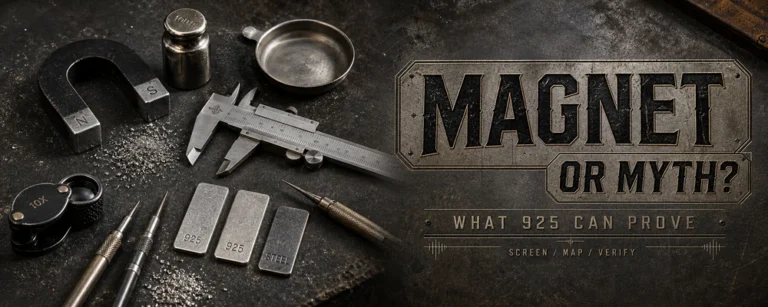
Magnet response
Silver itself is not strongly attracted to an ordinary magnet, so strong attraction can reveal a ferromagnetic component. But many non-silver metals are also nonmagnetic, and clasps can contain steel springs. Passing a magnet test does not prove 925 fineness.
Tarnish and polishing cloth
Sterling silver can darken when sulfur compounds react at the surface, and a polishing cloth may lift dark residue. Plated silver can tarnish too, while coated sterling may tarnish slowly. Intentional oxidation is often placed in recessed details. Color on a cloth is therefore a maintenance clue, not a purity measurement.
Ice and thermal conductivity demonstrations
Silver conducts heat very efficiently, so it can melt ice quickly in controlled comparisons. In a household setting, mass, temperature, contact area, and hidden core materials make the result ambiguous. A plated copper object may also transfer heat rapidly. This demonstration cannot establish 925 content.
Acid, scratch, and bleach tests
Do not use destructive chemicals casually. Acid testing requires correct reagents, ventilation, protective equipment, a suitable test area, and interpretation. Scratching through a surface can permanently damage plating or a collectible finish. Bleach can cause aggressive discoloration and is not a controlled fineness assay. For a meaningful result, use a trained professional.
Solid Sterling, Plated Silver, and Silver-Tone Metal
Solid sterling silver means the relevant metal body is sterling alloy rather than a thin silver skin over base metal. “Solid” does not mean pure silver, and it does not mean the item is hollow-free. A hollow sterling form can still be sterling if accurately described.
Silver plated means silver has been applied over another material. Plating can be attractive and legitimate when disclosed, but durability, repair options, and intrinsic metal value differ from a sterling body. EPNS specifically refers to electroplated nickel silver; despite the name, nickel silver is a base-metal alloy rather than a silver alloy.
Silver tone usually describes appearance, not precious-metal content. A silver-colored stainless-steel pendant and a 925 sterling silver pendant can both be well made, but they are different products. If those alternatives fit your needs, compare the practical tradeoffs in our silver versus stainless steel pendant guide.
Also distinguish surface finish from substrate. Oxidized sterling, rhodium-plated sterling, gold-vermeil over sterling, and bare polished sterling can all begin with a sterling-silver base while behaving differently in wear and care. A responsible listing names both the core material and the finish.
Online, Secondhand, and Inherited Jewelry Need Different Checks
Buying online
Request a close image of the exact mark when authenticity is central to the purchase. Confirm whether photographs show the item being shipped or a representative sample. Save the listing and receipt. Compare dimensions and weight with the design: an extremely light result may be hollow, small, or made from another material, but weight alone cannot identify composition.
For statement rings, use the material evidence alongside sizing, profile, and comfort. The 925 sterling silver men’s ring guide covers those wear considerations, while the men’s silver ring collection lets buyers compare current design and sizing details on individual pages.
Buying secondhand or vintage
Do not polish first. Original patina, maker marks, repair seams, and construction can help establish age and attribution. Ask for provenance, but separate a documented ownership history from a seller’s story. A specialist appraisal may address maker, period, condition, and market value; a metal test answers a narrower composition question. One does not automatically prove the other.
Evaluating inherited or found jewelry
Start by documenting rather than guessing. Photograph the whole object, clasp, back, interior, and every mark. Measure dimensions and weight with a reliable scale. Note whether different components appear to have been replaced. A local jeweler can then choose an appropriate non-destructive screening method and tell you whether further assay or appraisal is justified.
A Practical 925 Silver Buying Checklist
- Read the exact material wording and identify which components it covers.
- Find and photograph every fineness, maker, sponsor, or assay mark.
- Check the country of sale and avoid applying one jurisdiction’s rules universally.
- Confirm seller identity, return terms, weight, dimensions, finish, and construction.
- Look for contradictions such as “925 sterling” in the title but “silver plated” in specifications.
- Treat magnet, tarnish, ice, and cloth results as screening clues only.
- Use a qualified jeweler or assay professional when value, allergy concerns, resale, or legal description makes certainty important.
- Keep the listing, receipt, test report, and clear mark photographs with the item.
For a sculptural purchase, material verification is only one part of quality. Examine edges, comfort, symmetry, stone security, clasp function, and whether intentional oxidation is controlled rather than muddy. If you are evaluating a skull motif specifically, our 925 sterling silver skull ring guide adds design and wear criteria without treating a stamp as a substitute for craftsmanship.
How MENSSKULL Uses Material and Trust Signals
MENSSKULL product pages should be read item by item. Material, dimensions, finish, available sizes, and included components can differ across designs. A brand name, an original design statement, or a handcrafted detail describes authorship and process only when the specific page supports it; none of those phrases independently verifies metal fineness.
For that reason, a careful buyer should rely on the product’s explicit specification and ask for clarification when the chain, clasp, stone, or secondary component is not covered. MENSSKULL’s role is to provide a clear description and a traceable point of responsibility, not to ask shoppers to infer composition from photography or marketing language.
Frequently Asked Questions
Does a 925 stamp guarantee real sterling silver?
No. It is a fineness claim and a useful piece of evidence, but a stamp can be copied or misapplied. Evaluate the complete mark, seller identity, written description, construction, and professional testing when certainty matters.
Is S925 better than 925?
No general quality hierarchy is created by the letter S. S925 and 925 are commonly used to communicate the same claimed fineness: 925 parts silver per 1,000. Workmanship, alloy formulation, finish, and construction still need separate evaluation.
What is the difference between 925 and sterling silver?
In ordinary jewelry labeling, they point to the same fineness standard: sterling is associated with at least 925/1,000 silver under U.S. law. The number is a fineness mark; “sterling silver” is the material description. Legal tolerances and national marking rules add detail.
Can genuine sterling silver be unmarked?
Yes. A mark may be worn away, removed during repair, hidden on a replaced component, or not legally required for a lightweight article in a particular market. Lack of a mark increases uncertainty, so valuable items should be professionally assessed.
What does a maker’s mark prove?
It identifies the maker, sponsor, importer, or responsible business within the relevant system. It helps establish accountability and research origin, but it does not state fineness unless it appears with an appropriate quality mark.
Is a UK hallmark the same as a 925 stamp?
No. A full UK hallmark is a legally controlled group that includes a sponsor or maker mark, a fineness mark, and an assay office mark. A lone 925 number is not the complete UK hallmark.
What is the safest way to test a valuable silver item?
Use a qualified jeweler, appraiser, or assay professional. Ask which method is suitable for the item’s shape, plating, stones, solder, and value, and whether the result measures only the surface or the bulk alloy.
Does tarnish prove that jewelry is sterling silver?
No. Sterling often tarnishes, but plated silver can tarnish and coated sterling may tarnish slowly. Tarnish is consistent with several materials and finishes; it is not a fineness assay.
When comparing finished pieces, use the hallmark as one part of the evidence and read the individual listing as the source of truth. The skull jewelry for men collection brings rings, pendants, bracelets and earrings into one path, but material, dimensions, finish and chain inclusion should still be confirmed on each product page.
The Bottom Line
The number 925 is meaningful because it communicates a recognized silver-fineness claim. It becomes more persuasive when the item also has an identifiable responsible-party mark, a precise product description, consistent construction, and documentation. In a jurisdiction with compulsory hallmarking, a complete assay-office hallmark adds a different level of independent control.
The disciplined buyer does not dismiss marks, but does not worship them either. Read every symbol, check the market’s rules, verify the seller, and choose professional testing in proportion to the item’s value and uncertainty. That approach protects both honest makers and buyers far better than any one-minute household trick.




MENSSKULL Journal Notes
Leave a field note
Share fit notes, styling ideas, care questions, or your experience with MENSSKULL silver jewelry.
Comments are checked before publication so buyers can read useful fit, symbolism, care, and style notes without spam noise.
The simple plus/minus challenge below helps block automated spam while keeping the experience lightweight.
Continue exploring
More MENSSKULL stories
Handcrafted silver
Shop the pieces behind the stories