
Should a man wear a ring and bracelet on the same hand? Yes, when the two pieces form one clear visual group. Put them on opposite sides when both are large, highly detailed or meant to lead. The useful decision is not a fixed left-or-right rule. Compare the bracelet’s wrist coverage, the ring’s face scale and the amount of visual weight you want on one side.
This is original MENSSKULL editorial guidance. Questions in men’s jewelry communities show that buyers genuinely compare same-hand and split-hand arrangements; those discussions establish demand, not product performance. Fit, material and dimensions still come from the relevant guide or product listing. This page owns the narrow styling decision: how to distribute one ring and one bracelet across the hands.
The short answer: group a focal point or distribute two focal points
A ring and bracelet on the same hand create a single focal zone running from wrist to fingers. This often works when one piece leads and the other supports it. A sculpted ring can lead while a restrained bracelet repeats its metal tone. A strong bracelet can lead while a smaller band acts as the supporting detail.
Opposite-side placement spreads attention across both hands. It is the clearer starting point when the bracelet has broad links, the ring has a tall face, or both pieces use heavy contrast. Separation does not make the outfit more formal or less expressive; it simply gives each silhouette more room.
| Arrangement | How it reads | Use it when |
|---|---|---|
| Same hand | One concentrated focal zone | One piece clearly leads and the other supports |
| Opposite sides | Visual weight is distributed | Both pieces are broad, dark or highly detailed |
| Same side plus a watch opposite | Two unequal but intentional zones | The ring and bracelet relate while the watch remains separate |
Choose the lead piece before choosing the hand
Start by naming the piece you want noticed first. A ring with a large sculpted face usually has more visual weight than a plain band of the same metal. A bracelet with thick links, an obvious clasp or repeated motifs can dominate a smaller ring. Oxidized recesses and bright polished edges also increase contrast, even when the measured dimensions are moderate.
Once the lead is clear, make the second piece quieter in at least one way: width, relief, darkness or pattern. Exact matching is not required. The two pieces need a relationship, not a costume set. The skull ring styling guide owns broader outfit coordination; this page focuses on hand placement.
Use a three-part check: scale, rhythm and separation
Scale is the apparent size of each piece. Rhythm is the repetition of shapes, finishes or dark-and-bright areas. Separation is the visible space between the bracelet at the wrist and the ring at the fingers. A same-hand combination looks deliberate when those three factors establish a hierarchy.
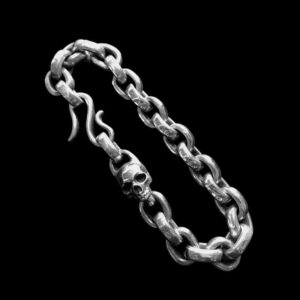
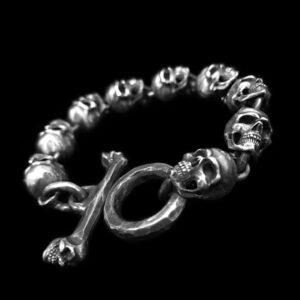
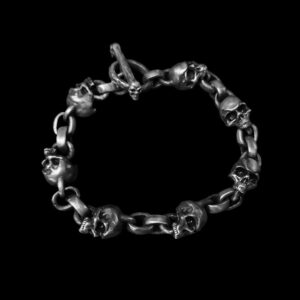
For example, a medium chain bracelet and one architectural ring may share a hand because the links and ring contours create a related rhythm. A deep-relief skull bracelet paired with a tall skull ring may be clearer on opposite sides because both pieces ask for attention. These are visual comparisons, not universal rules about who can wear a particular style.
Compare the bracelet from the front and the ring from the side
Most styling photos show the top of the hand, but that view can hide the ring’s height and the bracelet’s edge profile. Check the combination from three angles: palm down, natural side view and hand relaxed beside the body. A ring face that looks moderate from above can become the dominant element from the side. A bracelet clasp can create a second strong shape when it rotates into view.
Do not infer comfort, clearance or durability from a photograph. If you are considering a substantial ring, the heavy rings guide explains weight and finger-clearance questions. Bracelet sizing belongs to the men’s bracelet size guide. Resolve those facts independently before judging the arrangement.
Same hand works best with one repeated design cue
Choose one cue to repeat: metal tone, finish, geometry or motif family. A silver-tone bracelet can relate to a silver-tone ring even when one is polished and the other is oxidized. A squared link can echo an angular ring face. A restrained bracelet can repeat the dark recesses of a sculpted ring without copying its subject.
Repeating every cue can make the pair look overly matched, while repeating none can make it look accidental. One or two connections are enough. Color alone does not establish material; a silver-colored piece may use several different metals or finishes. Use the 925 sterling silver research guide for material definitions instead of guessing from appearance.
Opposite sides make two bold pieces easier to read
Separate the ring and bracelet when each has its own strong silhouette. This gives a large ring face a clean hand outline and lets a broad bracelet define the other wrist. The result can still feel connected if both pieces share a metal tone, finish or level of detail.
Opposite-side placement is also useful when a fixed item already occupies one hand, such as a wedding band or a watch. Treat that item as part of the composition rather than pretending it is invisible. If a watch is involved, use the dedicated bracelet and watch same-wrist guide before adding a ring to the final arrangement.
Let ring finger choice change the visual distance
A thumb or index ring sits closer to the outer edge of the hand, while a ring-finger or pinky placement changes the line between wrist and ring. That distance affects the composition even when the pieces themselves stay unchanged. A ring on the same side as a bracelet may feel more connected on one finger and more separate on another.
Finger placement can also carry personal or cultural associations, but there is no single worldwide code for every fashion ring. The men’s ring finger meaning guide owns that broader question. For this decision, compare the visible arrangement first, then account for any meaning that matters to you.
Use the matrix instead of a rigid matching rule
| What you see | What may be happening | Next comparison |
|---|---|---|
| The wrist dominates | Bracelet width, links or contrast are stronger | Try a quieter ring on the same hand or move the ring opposite |
| The ring dominates | The face is tall, broad or highly sculpted | Use a narrower bracelet or separate the pieces |
| The pair looks disconnected | No shape, tone or finish is repeated | Repeat one visible cue without copying the whole design |
| The hand looks crowded | Both pieces act as focal points | Split them across sides and compare again |
| The opposite side looks empty | All visual weight is concentrated | Move one piece or let a watch create a second zone |
Coordinate skull designs without inventing a meaning
A skull ring and skull bracelet can share a hand, but they do not need identical skulls. Compare outline, relief and contrast. One detailed skull motif paired with a simpler chain or band usually creates a clearer hierarchy than two equally dense designs. The skull ring styles guide helps compare jaw, silhouette and relief when the ring is the lead piece.
Do not treat placement as proof of rebellion, toughness, status or club affiliation. Motif meaning depends on personal context and documented traditions, not the side of the body alone. If the symbol matters to the purchase, start with the men’s skull ring guide and keep this page for visual distribution.
Run a controlled mirror test before buying a second piece
Use the same clothing, light and camera distance for three photos. First, place the ring and bracelet on the same side. Second, move the ring to the opposite hand. Third, keep them together but change the ring finger. Compare the full torso view before the close-up; the wider view shows whether one side pulls too much attention.
Change only one variable at a time. If you switch the hand, shirt, lighting and bracelet position together, you will not know what improved the result. A community question such as this ring-and-bracelet same-hand discussion shows that buyers use both arrangements. The replies are preference evidence only, not a technical standard.
Build the combination in the right buying order
First, identify the fixed piece you already own. Second, record its visible scale, finish and strongest design cue. Third, decide whether the new piece should lead or support. Fourth, verify the new item’s actual dimensions and fit information. Fifth, compare same-hand and opposite-side arrangements using the matrix above.
If you are buying a ring, confirm size through the men’s ring size and fit research guide; style preference cannot correct an unverified size. If you are choosing a bracelet, compare construction and scale in the men’s silver bracelet guide. Product pages remain the source for offer-level dimensions, materials and availability.
A practical decision for four common combinations
One bold ring plus one slim bracelet: start on the same hand and let the ring lead. One slim band plus one bold bracelet: same-hand placement can work with the bracelet leading. One bold ring plus one bold bracelet: start on opposite sides. A ring, bracelet and watch: choose two visual zones rather than forcing all three pieces into one cluster.
These starting points keep the comparison simple. They are not rules about gender, age or status. Personal preference can override the layout after you have checked scale and fit. The strongest arrangement is the one that looks intentional in a full outfit and still respects the verified facts of each piece.
Ring and bracelet placement questions
Should the ring and bracelet use the exact same finish?
No. Repeating a metal tone or design shape may be enough. Polished and oxidized surfaces can coexist when their contrast is deliberate.
Which hand should hold the bracelet?
There is no universal styling hand. Start with the side that does not conflict with a fixed watch or meaningful ring, then compare the overall balance.
Can a skull ring and skull bracelet look too matched?
They can compete when both motifs have equal scale and detail. Make one the lead, simplify the other, or separate them across sides.
How many rings should I add beside a bracelet?
This guide compares one ring and one bracelet. For multiple rings, use the how many rings should a man wear guide so the count decision stays with its existing owner.


MENSSKULL Journal Notes
Leave a field note
Share fit notes, styling ideas, care questions, or your experience with MENSSKULL silver jewelry.
Comments are checked before publication so buyers can read useful fit, symbolism, care, and style notes without spam noise.
The simple plus/minus challenge below helps block automated spam while keeping the experience lightweight.
Continue exploring
More MENSSKULL stories
Handcrafted silver
Shop the pieces behind the stories