
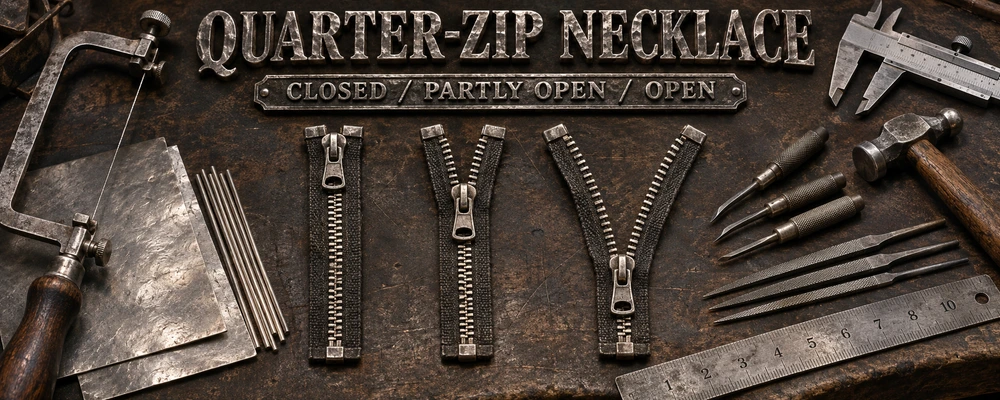
A quarter-zip changes the visible necklace space every time the zipper moves. Instead of choosing a chain or pendant first, set the zipper where you expect to wear it and read the opening that remains between the standing collar, zipper track, and base layer.
Quick answer: when the quarter-zip is closed, let the collar and zipper hardware lead and keep the necklace quiet or hidden. With the zipper partly open, check whether a plain chain reads cleanly inside the narrow opening. With a larger opening, a pendant can work when its entire outline has uninterrupted background and does not land on the zipper pull.
Set the slider before judging the necklace
A quarter-zip creates an adjustable aperture rather than a fixed neckline. The slider controls both the height and width of that aperture, while the standing collar holds two vertical borders beside it. Read those three coordinates – slider height, opening width, and visible base layer – before judging the necklace.
Put on the complete outfit, including the T-shirt or shirt underneath, and set the zipper to its normal resting point. Let the collar settle without holding it apart. The visible opening at that moment is the space available to the necklace. A necklace that looks clear only while the collar is staged by hand is not solving the real outfit.
The zipper seam at the top stop
With the zipper at the top, the collar, pull, and teeth form one concentrated vertical detail. A pendant placed over that area can turn the center of the chest into a stack of competing metal shapes. If the necklace remains under the sweater, it can simply disappear from the public view; it does not need to be forced outward to count.
If a chain is visible above the closed collar, judge only the short arc that can actually be seen. The question is whether that arc looks intentional beside the zipper hardware, not whether the entire necklace is present. For a fixed high-neck garment, apply the separate guide to a silver necklace over a turtleneck; the quarter-zip decision depends on a movable opening.
A short opening is a width test
A partly open quarter-zip creates a short, narrow aperture. The chain may cross both fabric edges, remain inside them, or disappear behind the base layer. A pendant may sit above the zipper pull, overlap it visually, or drop below the entire opening. Those are different results even when the chain length has not changed.
View for a complete silhouette. If only one side of a pendant is visible while the other side merges with the collar, the opening is not giving it enough background. If the pendant sits directly on the pull, the two objects become one dense cluster. Close the zipper slightly, open it farther, or switch to the simpler line of a plain chain. Apply the men’s necklace chain-length guide for measurement questions rather than treating one length as universal here.
A lower slider reveals a second backdrop
Lowering the slider swaps the visual backdrop. The shirt beneath the sweater becomes the field around the pendant, so its color, logo, pattern, and neckline matter more than the sweater surface. This is the point where the same pendant can change from partly obscured to fully legible without changing the necklace itself.
Inspect the bottom point of the opening. A pendant that stops clearly above the pull reads as one object inside the aperture. A pendant that covers the pull merges jewelry and garment hardware. A pendant below the opening is being judged against the sweater surface instead. None of those positions is automatically correct, but the result should be recognizable at normal viewing distance.
Decide whether the gap needs a line or a shape
A plain chain adds a line. A pendant adds both a line and a central object. The narrower and more detailed the quarter-zip opening, the more useful that distinction becomes. If the collar, zipper teeth, pull, and base-layer neckline already create several edges, a plain chain may be enough. If the opening leaves a broad uninterrupted field, one pendant can supply the central shape.
The dedicated guide to a plain chain or pendant for men covers that format decision in depth. The silver pendant necklace collection shows current forms for comparison, but a category page does not establish where any pendant will land in a particular sweater opening.
Four slider states at a glance
| Zipper state | Visible field | First necklace test | Main overlap to inspect |
|---|---|---|---|
| Fully closed | Short arc above the standing collar | No visible necklace or one quiet chain arc | Chain competing with the zipper pull |
| Slightly open | Short narrow aperture | Plain chain contained by the collar edges | Chain crossing both edges unevenly |
| Partly open | Triangular base-layer field | One pendant with a complete outline | Pendant merging with the zipper pull |
| More open | Broader field plus visible base-layer neckline | Chain or pendant judged against the base layer | Necklace competing with a logo, pattern, or second neckline |
Two verified pendant outlines, two different constraints
Two current MENSSKULL listings make the silhouette difference concrete. The Mamba Tribute Pendant, SKU SSP198, is listed at 50mm*28mm, 26g, and 925 Silver. Its broader outline asks for clear width inside the opening. Those listing facts identify the pendant; they do not prove where it will sit on a particular chain or quarter-zip.
The Fleur-de-Lis Gothic Key Necklace, SKU SSP218, is listed at 63mm*24mm, 32g, and 925 Silver, with Silver Chain and Steel Chain options. Its narrower, longer outline creates a different visual test: the opening needs enough vertical space for the full shape to remain separate from the zipper pull. The listed options do not establish exact on-body position or sweater compatibility.
Treat the listed dimensions as two different constraints. The 50mm*28mm SSP198 tests available width: both side edges need a clear backdrop. The 63mm*24mm SSP218 tests available height: its lower edge needs separation from the pull. If either constraint fails on the actual sweater and chain, a plain chain preserves the necklace line without adding another object inside the aperture.
Verify the result while standing and seated
First stand naturally and view from conversational distance. Confirm that the zipper remains at the chosen position and that the necklace silhouette is complete. Then sit down and let the sweater settle. The fabric may shift enough to change what is visible even though neither the chain nor zipper was deliberately moved.
Apply a chest-up phone photo for a final compressed view. It should show whether the collar edges, pull, base-layer neckline, and necklace read as separate elements. This is a visibility inspect only. It does not establish fit, comfort, safe wear, snag resistance, or material performance.
Where other neckline questions belong
A fixed V-neck does not set with a zipper, so route that decision to the men’s V-neck necklace guide. If the outfit question is broader than the quarter-zip opening, apply the guide to adding or skipping jewelry with an outfit.
The quarter-zip method is specific: set the zipper, observe the real aperture, decide whether it needs a chain line or a pendant object, and inspect the relationship with the pull. When the necklace remains readable without staging the collar or covering the hardware, the visible frame is doing useful work.




MENSSKULL Journal Notes
Leave a field note
Share fit notes, styling ideas, care questions, or your experience with MENSSKULL silver jewelry.
Comments are checked before publication so buyers can read useful fit, symbolism, care, and style notes without spam noise.
The simple plus/minus challenge below helps block automated spam while keeping the experience lightweight.
Continue exploring
More MENSSKULL stories
Handcrafted silver
Shop the pieces behind the stories