
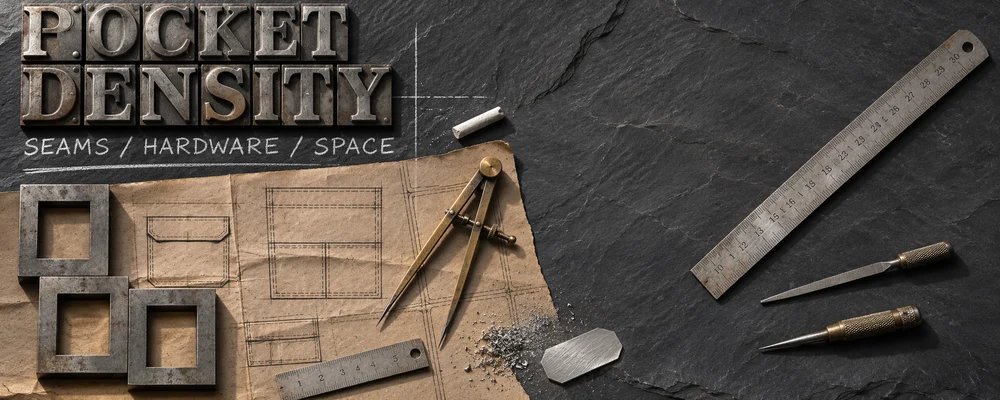
Start with a lower-field inventory, not a jewelry choice. Count visible pocket rectangles, flap edges, seams, straps, snaps, and hardware in one fixed cargo-pants outfit. Then test the neckline, wrist, and hand as three separate upper fields. The useful result is the field with the clearest boundary from the cargo detail, not a universal rule about what jewelry is “allowed.”
This guide stays with observable outfit geometry. It does not judge trouser fit, pocket function, movement, comfort, safety, fabric performance, or product compatibility. If you are still deciding whether the outfit needs jewelry at all, start with the broader add-or-skip framework. Here, the cargo pants are fixed and the task is to choose a clear location for one jewelry detail.
Freeze one full-view reference
Use the exact outfit you plan to wear, viewed from the front and at a normal standing distance. Do not compare one pair of pants with another while also changing the shirt, jacket, and jewelry. Record four visible facts: how many cargo pockets can be seen, whether flap edges create strong rectangles, whether straps or tabs extend from the silhouette, and whether metal hardware catches the eye. These observations create a stable baseline.
Also record the top and outer layer. A plain top leaves more quiet area above the waist. A graphic top introduces its own field of lines and contrast; that separate problem belongs to the graphic T-shirt and jewelry guide. A jacket can add collar, zipper, and cuff structure before any jewelry is considered.
Score the lower detail field
Replace the vague word “busy” with five entries: pocket bodies, flap edges, seam groups, hanging tabs, and hardware points. Count repeated pieces as systems rather than inflating the total: two matching flap edges are one repeated system, while a separate chain is one continuous line. This ledger only compares states of the same outfit; it is not a universal score.
| Observed lower-body field | Upper-body space to inspect | First comparison |
|---|---|---|
| Few visible pocket edges; little hardware | Neckline, wrist, and hand may all remain available | Compare one zone at a time |
| Several flaps, seams, or tabs | Look for the quietest continuous area above the waist | Test a compact neckline or hand endpoint |
| Strong hardware or a visible trouser chain | Keep another metal cluster from forming nearby | Move the comparison farther upward |
| Detailed pants plus a detailed top or jacket | Search for open space rather than another decorated edge | Remove one candidate zone before adding anything |
Rank three upper fields
Divide the upper body into three fields: neckline, wrist, and hand. A field is useful when its surrounding fabric and hardware do not already create many competing lines. A plain crew neck may leave a broad center area, while an open collar creates a stronger frame. Rolled sleeves expose the wrist; long cuffs can make the wrist another edge-heavy location. The hand is usually a compact endpoint, but visible pockets or straps near the hip can bring lower-body detail close to it.
This is a spacing decision, not a rule about body shape. You are comparing the distance between visible outfit lines and the proposed jewelry silhouette.
Test the neckline as a vertical counterweight
When cargo detail sits low and wide, a single clean line near the center can create a different visual direction. Judge the empty shirt area first. If a pendant outline would sit inside a calm field, the neckline can provide a clear vertical counterweight. If the top already has print, buttons, a zipper, or a strong collar opening, the same area may already be occupied.
Do not add a necklace merely because the pants look detailed. Compare the unchanged outfit with and without one visible neckline element. If the center becomes another crowded cluster, retire that candidate and inspect the wrist or hand instead.
Keep the wrist separate from pocket hardware
The wrist often falls near the top edge of a cargo pocket when the arms rest naturally. That proximity matters. A bracelet outline beside a flap, buckle, strap, or snap may read as one dense side cluster. Check both the front view and the natural resting position of the arms. If the wrist remains visually separated from pocket detail, it can work as its own endpoint. If the two areas merge, test the opposite wrist or remove the wrist candidate.
When a bomber jacket is part of the outfit, its zipper, collar, and cuffs change the frame. Use the dedicated bomber jacket jewelry guide for that outer-layer decision, then return to the cargo-pants ledger without changing the pants.
Use the hand as one compact endpoint
A ring keeps the jewelry decision in a small area, but the hand may sit directly beside the cargo pockets. Look at the full front view rather than an isolated close-up. If flap edges, tabs, or chain hardware surround the hand, a large additional outline can join the same cluster. If the hand falls against a plain section of fabric or open background, one compact endpoint may remain distinct.
Browse the men’s rings category only as a current shape reference. Category pages do not prove how any ring will look with cargo pants, and they do not establish fit, comfort, safety, or compatibility.
Separate trouser chains from jewelry placement
A visible chain is not just another pocket detail. It creates a long metal path across the lower field. First decide whether that path is part of the outfit. Questions about chain type and placement belong to the wallet chains versus pants chains guide. Once that decision is fixed, record the chain as one continuous lower-body line rather than counting every link.
Then compare the upper-body zones again. A central necklace may echo the chain’s direction; a wrist or hand detail may form a nearby metal cluster. Neither result is automatically right or wrong. Choose the version in which the intended jewelry area remains easiest to identify at normal viewing distance.
Run four controlled states
Create four images with the same crop: no jewelry, neckline only, wrist only, and hand only. Keep the shirt, jacket, pants, footwear, lighting, and camera distance unchanged. For each image, write the first three shapes you notice. Then mark whether the jewelry appears as a separate upper field or merges with the pocket-and-hardware field below.
If two states tie, compare boundary space rather than adding another accessory. Choose the state with the larger uninterrupted gap between the jewelry silhouette and the nearest pocket, flap, chain, cuff, or zipper line. If neither state has a clear boundary, record “no added jewelry field” and keep the cargo structure as the visible lead.
Make the final pocket-to-jewelry check
Before leaving the outfit fixed, confirm that the cargo-pocket field has not changed, the top and outer layer are the same, and only one jewelry zone was varied at a time. Step back far enough to see the entire outline. Check whether the pocket rectangles and hardware remain a lower-body texture while the chosen jewelry area reads as a separate upper-body point or line.
If the zones merge, remove the jewelry candidate and test the next quiet field. If the selected zone stays distinct without requiring another accessory to explain it, the decision is complete. The result is specific to this visible outfit state, not a permanent rule for all cargo pants or all jewelry.




MENSSKULL Journal Notes
Leave a field note
Share fit notes, styling ideas, care questions, or your experience with MENSSKULL silver jewelry.
Comments are checked before publication so buyers can read useful fit, symbolism, care, and style notes without spam noise.
The simple plus/minus challenge below helps block automated spam while keeping the experience lightweight.
Continue exploring
More MENSSKULL stories