
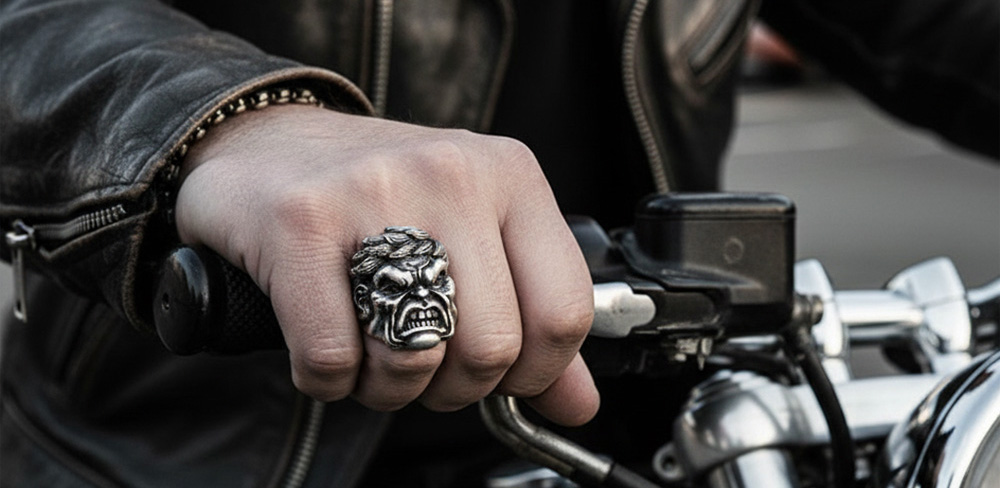
Which men’s ring style should you choose? Start with the visible profile: a signet for a broad, contained face; a skull-character ring for a recognizable sculptural focal point; a geometric ring for repeated lines and structure; or an accent-stone ring for concentrated color. Compare face shape, surface emphasis, and outfit prominence before moving to separate questions about sizing, material verification, care, or comfort.
This guide is about observable design. It does not assign personality, status, masculinity, or a fixed wardrobe result to any ring. A ring can be bold in one outfit and secondary in another because sleeve length, watch size, color contrast, and other jewelry change the composition.
Quick answer: choose the profile before the motif
Reduce the ring to its outer form first. Ask whether the face looks flat or sculptural, compact or elongated, open or dense, symmetrical or irregular. Those traits remain visible at normal distance, while engraving and small motifs may only appear close up.
Then decide the role the ring should play. An everyday anchor should work as a stable visual point across several outfits. A focal ring can carry more height, contrast, or recognizable form. A supporting ring should leave room for a watch, bracelet, or necklace to lead. This is a styling decision, not a quality or performance ranking.
Compare four visible ring profiles
| Profile | What is visible first | Useful outfit question |
|---|---|---|
| Signet | A defined face, often square, oval, shield-like, or rectangular | Do you want one contained graphic area on the hand? |
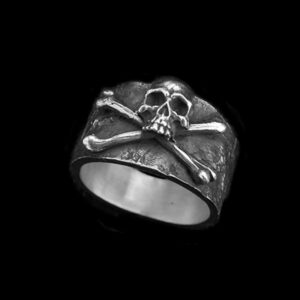
| Skull character | A recognizable face or sculptural head with shadows and projections | Should the ring become the obvious focal object? |
| Geometric | Repeated lines, panels, rivets, angles, or a controlled architectural outline | Should structure lead without relying on a figurative motif? |
| Accent stone | A concentrated color field or reflective center inside a surrounding frame | Should color, rather than overall scale, create the first point of attention? |
| Textured band | A continuous surface pattern with no single dominant face | Should texture remain readable while the ring stays visually even around the finger? |
The categories overlap. A signet may carry a skull, a geometric ring may include an accent stone, and a sculptural ring may have a signet-like top. Use the table to identify the leading visual trait rather than force every ring into one permanent label.
Choose a signet when you want a contained face
A signet places most of its visual information on a defined top surface. The face may be broad and flat, gently domed, or framed by raised edges. From conversational distance, the hand reads as having one controlled block of shape instead of many separate projections.
This profile works when you want the ring to look deliberate beside a clean cuff, plain knit, or simple jacket. A rectangular or shield-like face can echo straight seams and watch cases. An oval or rounded face softens those lines. The decision is about shape coordination, not a rule that one signet belongs to formal clothing and another to casual clothing.
If the face carries a motif, compare how much of the outline remains visible when your hand is relaxed. A motif that is clear in a close product image may read mainly as a dark-light block from farther away. The men’s silver rings collection is useful for commercial browsing, while this page keeps the comparison focused on design profiles.
Choose a skull-character ring for sculptural emphasis
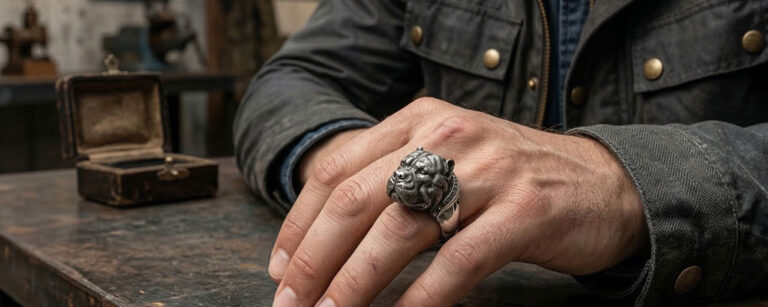
A skull-character ring creates recognition through the brow, eye sockets, jaw, or overall head shape. Raised and recessed areas produce strong shadows, so the ring can remain visually distinct even when small engraved details are not visible. That makes the profile a natural focal point on the hand.
Give a sculptural ring enough surrounding space. If a watch, bracelet, and several other rings all use large dark forms, the hand and wrist can become one dense zone. You can reduce competition by letting one item lead and using simpler shapes elsewhere. For a focused outfit-balance method, use the skull ring styling guide.
Do not infer meaning or personality from the motif. A wearer may choose a skull because of its outline, craftsmanship, contrast, or personal taste. This guide does not claim that it communicates rebellion, confidence, status, or a universal cultural message.
Choose a geometric profile for line and structure
Geometric rings lead with panels, angles, borders, rivets, repeated grooves, or a centered frame. The design may feel visually organized even when it is substantial, because the eye follows clear edges and repeated spacing. This can suit outfits that already use structured details such as straight seams, metal zippers, rectangular buckles, or a sharply defined watch.
A geometric profile can also contrast with soft clothing. Against brushed knitwear or a plain T-shirt, hard edges become more obvious. Decide whether you want that contrast or whether a smoother outline should blend with the rest of the outfit.
Inspect front, side, and three-quarter views. A ring that looks like a flat rectangle from above may reveal a tall side wall, stepped shoulder, or broad taper. Those side shapes affect visual presence, even though this page does not make claims about finger clearance, ergonomics, or comfort.
Choose an accent-stone profile when color should lead
An accent stone creates a concentrated color area. The surrounding ring may be compact, but a red, blue, black, or other contrasting center can become the first detail noticed. Compare the color with clothing, watch faces, belt hardware, and other accessories rather than assuming the stone needs an exact match.
One repeated color is enough to create a relationship. A deep red ring can sit beside a neutral outfit without any other red element, or it can echo a small detail elsewhere. The useful question is whether the color looks intentional within the whole outfit, not whether it follows a universal matching formula.
Stone identity, treatment, setting security, and material verification are separate factual scopes. This low-risk style guide does not identify a stone from appearance or promise durability, value, or permanence.
Use outfit context, not a personality label
Test the ring with the clothing you actually plan to wear. A broad signet may look restrained beside a heavy jacket but prominent with a short-sleeve shirt. A skull-character ring may become the central accent against plain black fabric yet share attention with patterned cuffs and multiple metal details. A colored center may lead in a monochrome outfit and recede when surrounded by several bright colors.
The same ring can play different roles across outfits. That flexibility is more useful than assigning permanent labels such as formal, rebellious, luxurious, or masculine. Style depends on relative scale and contrast. The broader men’s jewelry styling guide covers coordination across rings, chains, bracelets, and clothing.
Compare a ring at three viewing distances
Start with a close view to inspect the face, border, texture, and contrast. Move to conversational distance to see whether the ring still reads as a signet, skull, geometric form, or color accent. Finish with a full-outfit view to judge whether it leads, supports, or disappears.
Use consistent lighting and the same hand position. Magnified product photography is useful for detail but can exaggerate visual dominance. A full-outfit photograph shows the relationship between ring, sleeve, watch, bracelet, and body of clothing. If the ring only works in a close crop, it may not play the role you expected in the complete outfit.
Photograph both the palm-in and palm-out positions you naturally use. A face that points toward you may reveal a different outline to another viewer. This is a composition check only; the left-versus-right hand guide owns the separate placement decision.
Coordinate one focal ring with other jewelry
Choose one lead zone: hand, wrist, neckline, or ear. When the ring leads, use quieter shapes elsewhere or leave more space around the hand. When a chain or bracelet leads, a flatter or lower-contrast ring can support the outfit without repeating the same visual intensity.
Matching every item exactly is not required. Repetition can come from color, edge shape, texture, or visual weight. A rectangular ring face may relate to a watch case even when the finishes differ. A darkened recess may relate to black clothing without turning the outfit into a strict color match.
If you plan to wear several rings, add them one at a time and review the whole hand. This page does not prescribe stacking, spacing, or safe clearance. It only helps identify which profile should remain the visual anchor.
Three current catalog examples
Current product pages can illustrate profile differences. The listed dimensions and material labels below are item-specific commercial facts checked for this article; they are not evidence that a ring will fit, feel comfortable, last longer, or suit every wardrobe. NIST length guidance supports the unit context only.
| Current example | Listed face or size | Observable profile |
|---|---|---|
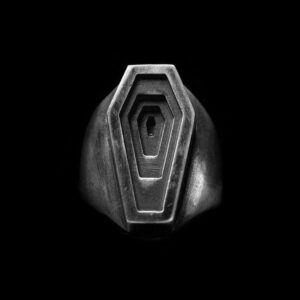
| Coffin Signet Ring | 28 by 23 mm listed face; 32 g listed weight | A broad coffin-shaped signet face with a contained geometric outline |
| Pirate Skull and Crossbones Signet Ring | 14 mm listed size; weight varies by ring size in the current listing | A signet structure led by a recognizable skull-and-crossbones face |
| Industrial Red Cabochon Ring | 19 by 22 mm listed face; 29 g listed weight | A riveted geometric frame with a concentrated red center |
These examples show how categories can overlap. The first combines signet and geometric cues. The second combines signet and character cues. The third combines geometry and color. Product records support the listing facts and visible design only. They do not prove wardrobe suitability, fit, comfort, quality, durability, personality, status, popularity, or value.
Separate style selection from fit and material checks
Choose the visible profile first, but do not use appearance as a substitute for purchase verification. Ring size, internal shape, face height, and finger clearance are fit questions. Material labels, marks, and composition are evidence questions. Care and wear expectations are separate again.
Use the 925 sterling silver research guide for material boundaries. Use the current product page for available ring sizes and item-specific specifications. If a decision involves comfort, injury, resizing, or safe clearance, seek appropriate specialist or seller guidance rather than extending this style article beyond its scope.
A five-step ring profile decision
- Name the lead shape. Signet face, sculptural character, geometric structure, color accent, or even band.
- Choose the visual role. Everyday anchor, focal ring, or supporting ring.
- Test the outfit. Compare the ring with sleeves, watch, bracelet, and neckline at full-outfit distance.
- Check three angles. Front, side, and three-quarter views can reveal different outlines.
- Verify purchase facts separately. Confirm current size options, item details, and the appropriate fit or material guidance before buying.
If two profiles both work, choose by the role you expect to use most often. A contained signet may be easier to make secondary; a sculptural skull may be better when the hand should lead; a geometric ring can emphasize structure; an accent stone can introduce color without requiring the largest outline.
What this guide can and cannot establish
Current catalog examples, product photography, Growth OS query evidence, and external editorial coverage can show that buyers compare men’s ring styles and that visible profiles are useful decision categories. British GQ’s men’s ring guide and Robbins Brothers’ fall jewelry coverage provide dated category context only.
Those sources do not prove that one ring, profile, product, or arrangement is universally better, safer, more comfortable, more durable, more attractive, more meaningful, or more appropriate. They do not establish MENSSKULL product popularity, sales, quality, fit, value, or performance. The final style choice remains personal and should stay separate from fit, material, care, and safety decisions.



MENSSKULL Journal Notes
Leave a field note
Share fit notes, styling ideas, care questions, or your experience with MENSSKULL silver jewelry.
Comments are checked before publication so buyers can read useful fit, symbolism, care, and style notes without spam noise.
The simple plus/minus challenge below helps block automated spam while keeping the experience lightweight.
Continue exploring
More MENSSKULL stories
Handcrafted silver
Shop the pieces behind the stories