

Start with the visible form, not a “top ten” label. A statement ring earns attention through observable choices: the outline of its face, how far the design rises above the band, the size and repetition of the motif, the contrast between high and recessed areas, and how strongly the ring competes with the rest of an outfit. Those features can be compared without claiming that one ring is uniquely available, better made, more durable, more masculine, or right for every wearer.
The word “unique” in this page’s existing title should be read as variety in visual design, not as a verified market-wide exclusivity claim. This refreshed guide compares distinct-looking ring forms that are currently represented in the MENSSKULL catalog. Product pages remain the source for current item-specific dimensions, material labels, available sizes, price, stock, and gallery images.
Compare silhouette before motif
Silhouette is the ring’s outer shape when viewed from above and from a slight angle. A broad rectangle, tapered shield, coffin outline, circular face, or irregular sculptural profile can create a different first impression before the viewer identifies the motif.
Cover the small details in a product image and look only at the boundary. Does the ring read as compact and geometric, tall and narrow, broad across the finger, or irregular and sculptural? That first read is useful because it survives at normal viewing distance, while tiny marks and engraved lines may be visible only in a close photograph.
The men’s silver rings collection is the broad commercial route for comparing current ring forms. It is not evidence that one silhouette is more popular or higher quality.
Use face shape to predict visual direction
Ring-face shape directs the eye. A long vertical face follows the length of the finger. A wide horizontal face spreads attention across the hand. A compact signet face creates one concentrated block. An asymmetrical face introduces movement because the outline changes from one side to the other.
| Face shape | Visible direction | What to inspect | Outfit role |
|---|---|---|---|
| Rectangular or shield-like | Strong vertical or centered block | Corner treatment, taper and border width | Structured focal point |
| Coffin-shaped | Tapered vertical outline | Top width, lower taper and central relief | Graphic gothic accent |
| Round or oval | Contained central field | Border, center motif and surrounding negative space | Compact statement |
| Irregular sculptural | Multiple changing edges | Profile from front, side and three-quarter views | Highest visual complexity |
These are visual roles, not fit prescriptions. For measurement, size selection, finger clearance, and other technical questions, use the separate men’s ring size and fit guide.
Read relief depth from more than one angle
Relief depth describes how strongly the face rises and how deeply the visible recesses are modeled. A flatter graphic face depends on outline, border, engraving, or color contrast. A deeper sculptural face creates stronger highlights and shadows because its planes turn toward and away from the light.
Do not estimate relief from one front-facing image. Inspect a side view, a three-quarter view, and any image that shows the transition from face to band. Gallery lighting can exaggerate dark recesses or polished high points, so compare several views before deciding how prominent the ring appears.
Relief depth is not proof of construction quality or durability. It is simply a visible design variable that changes the ring’s profile and how much detail remains readable from different angles.
Separate motif scale from ring scale
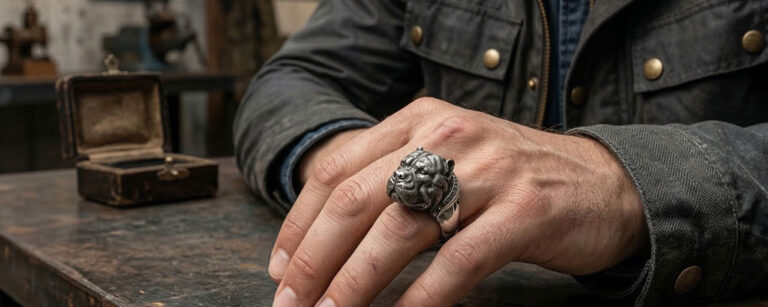
A large ring can carry a relatively small central motif surrounded by a wide border. A smaller ring can devote nearly its entire face to one skull, emblem, stone, or geometric form. These two designs may have similar outside dimensions but create different visual emphasis.
Ask how much of the face is occupied by the motif. A motif that fills the boundary reads more directly. A motif surrounded by open or recessed space can feel more contained. Repeated small elements create texture, while one central element creates a single focal point.
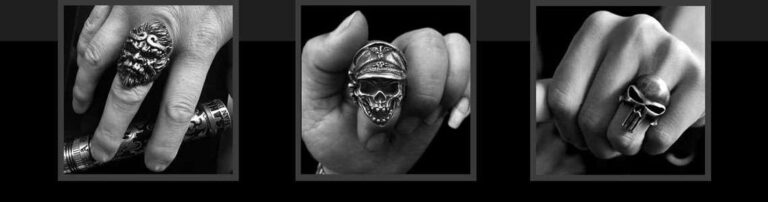
The men’s skull ring guide owns skull-specific style taxonomy. This page uses skull forms only as examples of motif scale and visible relief, without assigning personality, status, protection, confidence, or universal meaning.
Notice the edge profile
Edge profile is the transition between the ring face and the space around it. A clean geometric edge makes the outline easy to identify. Rounded transitions soften the boundary. Projecting corners, raised details, or an uneven sculptural edge add visual complexity.
Look at the edge against a plain background in the gallery. If the boundary remains clear, silhouette is doing much of the work. If the boundary blends into the hand or surrounding styling, surface contrast and motif detail may be carrying more of the design.
This comparison does not predict contact with clothing, skin response, activity safety, or long-term wear. Those outcomes require different evidence and are outside this low-risk visual guide.
Use surface contrast as a design cue
High and recessed areas can create light-dark contrast even when the ring uses one listed metal color. A colored center creates a second focal cue. A broad polished plane reads differently from a face broken into many pits, lines, borders, or relief elements.
Judge contrast at two distances. Close up, small recesses may dominate the image. From farther away, only the main outline, central color, and largest light-dark divisions may remain visible. Choose according to the level of detail you want the ring to contribute to the whole outfit.
For exact alloy terminology and the limits of a 925 label, consult the 925 sterling silver research guide. This article does not use visible color or surface treatment as proof of composition, quality, care needs, or performance.
Place statement level on a practical scale
“Statement” is not a fixed product category. It describes how strongly a ring attracts attention within a specific outfit. The same ring can be the dominant accessory with a plain shirt and no other jewelry, or one of several competing details beside a watch, bracelets, patterned fabric, buckles, and layered necklaces.
| Visual level | Typical observable features | Whole-outfit check |
|---|---|---|
| Quiet accent | Compact face, simple boundary, limited contrast | Does it support another focal accessory? |
| Defined statement | Clear face shape, readable motif, moderate contrast | Is the ring the main detail on the hand? |
| Strong focal ring | Broad or tall face, deeper relief, central color or bold outline | Does the rest of the outfit leave it visual space? |
| Complex sculptural focus | Irregular silhouette, multiple planes, dense visible detail | Are nearby accessories competing with the same intensity? |
The scale is descriptive, not a ranking. A quieter ring is not inferior, and a stronger focal ring is not automatically more desirable. The useful question is which role the ring should play in the intended outfit.
Compare three current catalog forms
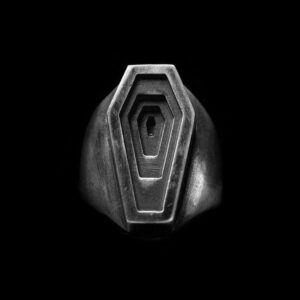
Current MENSSKULL listings provide three bounded examples. The Coffin Signet Ring is currently listed with a 28 by 23 mm size reference and a coffin-shaped face. Those facts support discussion of a tapered geometric outline and broad central field only.
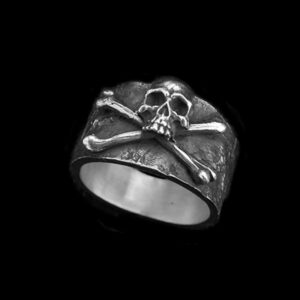
The Pirate Skull and Crossbones Signet Ring is currently listed with a 14 mm size reference. Its gallery can illustrate a compact signet boundary, central motif, and the way recessed detail changes the face at different distances.
The Industrial Red Cabochon Ring is currently listed with a 19 by 22 mm size reference. Its red center and geometric surrounding structure illustrate how color can become the first focal cue before smaller surface details.
These examples do not prove that one shape, motif, or product is unique in the market. They also do not prove handcrafting, quality, durability, comfort, ideal fit, status, masculinity, or popularity. Recheck each product page for current options before making a purchase decision.
Coordinate a ring with the rest of the hand
A statement ring is read alongside other rings, a watch, bracelets, sleeve edges, and hand gestures. If the chosen ring has a broad face or strong color center, quieter neighboring pieces can let it remain the lead. If the ring has a compact face, a second ring may share attention without creating one dense visual block.
The guide on how many rings a man should wear owns item-count and hand-balance decisions. Use the separate skull-ring styling guide for outfit coordination centered specifically on skull motifs.
There is no universal maximum and no requirement to make a ring the focal point. Compare the complete hand and upper-body composition rather than judging the ring in isolation.
Match form to outfit structure
Structured clothing often contains clear seams, straight edges, and repeated hardware. Geometric signet forms can repeat that visual order. Softer or simpler clothing can provide more negative space for a sculptural ring. Patterned fabric and multiple metal details may reduce how clearly a complex ring reads.
Repeat one cue rather than every cue. A rectangular ring face might echo a buckle, watch case, or jacket hardware without requiring an exact match. A red center may be the only colored accent. A darker recessed surface may relate to black footwear or outerwear without turning the outfit into a theme.
The affordable men’s ring guide owns price-and-value comparison boundaries. This page does not use appearance as proof of price, value, construction, or quality.
Use editorial roundups carefully
Current fashion roundups can show that signets, sculptural rings, colored centers, and mixed visual scales continue to appear in men’s styling coverage. For example, British GQ’s men’s ring roundup, dated September 23, 2026, provides category context.
That external article does not establish MENSSKULL product popularity, exclusivity, craftsmanship, quality, durability, fit, or performance. It is used only as dated editorial context. Product claims on this page remain bounded to current MENSSKULL listing data and visible form.
Run a five-view comparison
- View the ring directly from above and identify the outer silhouette.
- Use a side image to judge face height and the transition into the band.
- Use a three-quarter image to see relief planes and edge changes.
- Step back from the image and note which features remain readable.
- Compare the ring with the watch, bracelets, sleeves, and other rings planned for the outfit.
Write down the result in visual terms: compact coffin outline, broad geometric block, central red focus, dense skull relief, or another description you can verify. Avoid replacing observation with labels such as best, premium, handcrafted, masculine, powerful, or exclusive.
Common comparison mistakes
Treating “unique” as a factual exclusivity claim. A design can look distinctive within a selection without being proven unavailable elsewhere.
Using close-up detail as the only view. Small recesses and engraving may not carry the same weight in the complete outfit.
Assuming larger means better. A broad face creates more visual presence, not automatic quality or suitability.
Reading symbolism into a motif. A skull, coffin, crossbones, shield, or red center can be chosen for visible form without assigning a universal message.
Turning dimensions into fit advice. Item-specific measurements describe the listing. Ring-size and clearance decisions belong to the dedicated fit owner.
Statement ring buyer checklist
- Identify the top-view silhouette and the direction it creates.
- Compare the face shape with nearby watch, bracelet, and clothing details.
- Inspect front, side, and three-quarter gallery views.
- Decide whether the motif or the outline should lead.
- Judge relief and contrast at normal viewing distance.
- Choose a quiet, defined, strong, or complex visual role.
- Verify current listing dimensions, material label, size options, price, and stock on the product page.
- Route fit and material questions to their specialist owners instead of inferring answers from appearance.
The practical decision
Choose a statement ring by the job its visible form should do. A clean geometric signet can provide a structured central block. A coffin outline can create a tapered graphic direction. A skull relief can make the motif the primary read. A colored cabochon can create one clear focal point before the surrounding geometry becomes visible.
The strongest comparison stays observable: silhouette, face shape, relief depth, motif scale, edge profile, surface contrast, and outfit prominence. Those variables help buyers distinguish designs while respecting the limits of the evidence. They do not turn a catalog example into proof of uniqueness, craft quality, durability, fit, meaning, or universal appeal.



MENSSKULL Journal Notes
Leave a field note
Share fit notes, styling ideas, care questions, or your experience with MENSSKULL silver jewelry.
Comments are checked before publication so buyers can read useful fit, symbolism, care, and style notes without spam noise.
The simple plus/minus challenge below helps block automated spam while keeping the experience lightweight.
Continue exploring
More MENSSKULL stories
Handcrafted silver
Shop the pieces behind the stories