
Quick answer: A coffin ring is worth considering when you want a clear, elongated signet silhouette rather than a skull face that dominates the top of the hand. The MENSSKULL Coffin Signet Ring lists 925 sterling silver, a 28 x 23 mm size reference and 32 g at the product level. The listing does not define which dimension is height, width or outward projection, and it does not assign an exact weight to every selectable ring size. Use the photographs, current size selector and a measured finger to decide whether its shape and scale are right for you. This page is a product-specific buying guide, not a universal account of gothic symbolism or an independent assay.
What is the decision that a coffin signet changes?
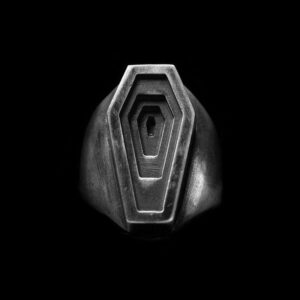
The outline, not a cultural label, is the starting point. A coffin-shaped signet presents a distinct angular or tapered top, so it reads differently from a round seal, a complete skull face or a narrow plain band. Look at whether that outline remains recognizable from front and three-quarter views. A straight-on image tells you about the top; it cannot by itself tell you how the shoulders meet the band or how far the face appears to project. The separate skull ring styles guide owns broad design taxonomy. This guide focuses on the practical choice between this particular coffin-shaped face, a related skull-and-coffin option and other ring profiles.
Do not infer a fixed meaning from the word coffin. Some shoppers choose an architectural shape, a darker visual style or a particular graphic design. Others prefer a literal skull motif. Those are aesthetic preferences, not evidence of a wearer’s beliefs, identity or religious practice. If you want context for the broader design vocabulary, the gothic jewelry research page is the appropriate evidence owner. Nothing in a product title alone establishes historical symbolism.
Inspect the top, shoulder and on-hand views
The front view answers the silhouette question
Begin with the ring upright. Trace the outer edge of the coffin face rather than concentrating on the lighting or any recess in the center. Does the outline supply enough contrast against the band to remain legible at a quick glance? If your main goal is an immediately readable skull expression, the outline-first signet may not be the best match. If you prefer a signet whose shape carries the design, it may be the stronger candidate. A high-contrast studio image can change apparent depth, so treat shadows as a cue to inspect another angle, not as a measured specification.
Three-quarter and side views answer the profile question
The three-quarter view shows the relationship between the top and the shoulders. Note whether the top appears to sit as a discrete face or flows into the sides. A side view makes the shoulder transition easier to judge, but the product’s listed 28 x 23 mm values do not specify an exact side projection. If clearance under gloves or another closely fitting item matters to your purchase, request a labeled measurement rather than estimating it from a photograph. The point is to turn an uncertain visual impression into a specific question before checkout.
An on-hand image supplies context, not a ring-size chart
On-hand images are useful for seeing how the design competes with a finger, sleeve and other jewelry. They are not standardized measurement evidence: camera distance, lens, hand size and sample ring size all affect apparent scale. Decide whether you like the presence, then use a real finger measurement and the current selector for fit. The men’s ring size and fit research guide explains the separate measurement task. Do not choose a larger size merely because the top looks broad in a photo.
Understand the listed scale and weight without inventing axes
The primary product’s Size attribute is recorded as 28 x 23 mm. The two numbers are useful as a listing reference, but neither is labeled as top height, face width, shank width or outward projection. Because the axes are undefined, this page retains the product’s wording rather than turning the first number into a promised face length. If exact dimensions matter, ask for a diagram or labeled photograph showing where the measurement begins and ends. A ruler beside a ring in a photograph can also be misleading if it is not aligned in the same plane.
The listed 32 g is a product-level attribute. It is not a per-variation scale reading and should not be described as exact for all ring sizes. Ring sizing choices can involve different amounts of material; the available listing does not map a weight to each selected size. A higher listed weight can be useful when deciding whether to inspect a substantial-looking option, but it does not prove comfort, strength, quality or material composition. Compare the current product details rather than ranking two designs by grams alone.
| Published product fact | Buyer use | Boundary |
|---|---|---|
| Coffin-shaped signet face | Decide whether the angular outline is your main visual preference | Does not establish historical or religious meaning |
| 28 x 23 mm size reference | Keep a listed scale reference while comparing images | Axes and outward projection are not identified |
| 32 g listed weight | Consider whether to inspect a more substantial design | Not an exact value for every selected ring size |
| 925 sterling silver listing | Know the seller’s stated material | Not an independent laboratory test |
| Live ring-size options | Select against your own measured finger | Not a universal size-up instruction |
Compare the coffin signet with a coffin-and-skull profile
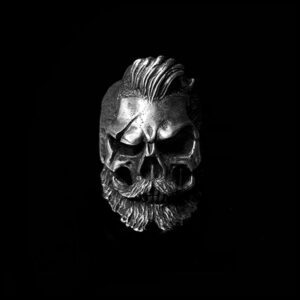
The Coffin Seal Skull Ring is a related but different design path. Its current product attributes list 925 silver, 35 x 34 mm and 39 g at product level. Those values do not prove that it will look larger on every hand or feel heavier in every size; its measurement axes and per-size weight are not standardized against the Coffin Signet Ring. What they do is point you to the second product’s gallery and current option selector if you want a more explicitly skull-focused composition in the coffin family.
Set the images side by side and ask which design feature survives when seen at ordinary hand angles. If you notice the coffin outline first in the signet and the skull first in the seal, you have an actionable difference. If you cannot see that distinction, zoom out to the normal viewing distance at which you expect to wear the ring. It is easy to make a choice based only on a close crop that no one, including you, will usually see. Product pages can change, so use their live galleries rather than a cached collage for a final comparison.
| Question | Coffin Signet Ring | Coffin Seal Skull Ring |
|---|---|---|
| What is the first motif to inspect? | Coffin-shaped signet silhouette | Coffin/skull composition |
| Listed size reference | 28 x 23 mm; axes not specified | 35 x 34 mm; compare only as listed |
| Listed product weight | 32 g; not mapped by size | 39 g; not mapped by size |
| Best next check | Top-to-shoulder transition and current size selector | Skull legibility from front and side plus current selector |
How to select a size for this specific ring
The face dimensions are external. Ring size concerns the opening that fits your finger. The Coffin Signet Ring’s live selector presents US ring-size choices; verify the available options at ordering time. Measure the exact finger on the hand where you plan to wear it, then compare that measurement with the selector’s inside-diameter or circumference references where shown. Your existing comfortable ring can be a cross-check only if its inside shape and band width are reasonably comparable.
A substantial signet can present more visual coverage than a narrow band, but visual coverage is not a reliable formula for changing the inside size. Knuckle and band geometry matter, and there is no evidence here for automatically increasing a half size for every shopper. If you are between offered options, the ring fit research owner has a fuller measurement explanation. Confirm the selected size in the cart before placing an order; the graphic on top should not substitute for the option you actually select.
Keep material, care and product claims in separate places
The product page identifies the Coffin Signet Ring as 92.5% sterling silver. That is the seller’s first-party listing, not a claim that this article has independently tested the piece. For general terminology, see MENSSKULL’s 925 sterling silver research guide and the U.S. Federal Trade Commission’s consumer guide to buying precious-metal jewelry. The FTC’s Jewelry Guides page outlines the wider representation framework. These external sources explain words used in commerce; they do not independently certify this individual product.
Maintenance is a separate question. For general discussion of how silver jewelry is treated, consult the sterling silver jewelry care research. This buying guide intentionally avoids giving a treatment recipe or suggesting that a particular finish cannot change. Likewise, the current product selector is the source for availability and sizes; this article is not a live inventory or price feed. Keeping the boundaries visible is more useful than repeating broad assertions throughout a product-specific page.
Where this ring fits in a broader search
If the coffin outline remains your first preference, use the signet listing to finish the size and image checks. If you want to compare many silhouettes, browse gothic rings for men for a category-level view or skull rings for men when the face motif matters more than the coffin shape. The biker rings category is another browsing path for bold profiles, not proof of a historical affiliation or a claim that a ring is designed for a particular activity.
For an outfit decision, try to decide whether the ring should be the only high-contrast shape on the hand or one of several. A simple neighboring band can leave the coffin face distinct, while another sculpted ring can produce a denser look. This is editorial styling guidance, not a promise about how others will react. If a design’s symbolic context matters personally, treat that as a separate research question instead of using a product photo as authority.
Five checks before ordering
- Open the Coffin Signet Ring product page and inspect the front, three-quarter, side and on-hand photographs available there.
- Decide whether the coffin outline itself is the reason you want it. If you want a skull-first composition, compare the Coffin Seal Skull Ring instead.
- Keep 28 x 23 mm as an unlabeled size reference. Ask for an axis-labeled measurement if exact face width or projection controls your choice.
- Treat 32 g as a listed product-level value, not an exact weight for your selected size.
- Measure the intended finger and check the current size option, material statement and availability directly on the live listing before checkout.
This sequence leaves the article with one job: support a decision about a particular signet profile. General material definitions, cultural discussion, care and fit methodology remain with their respective evidence owners rather than being repackaged as new facts about this ring.
Common questions
Does 28 x 23 mm specify the face’s width and height?
No axes are assigned in the product attribute. The values are presented here as a size reference, not renamed width or height.
Is 32 g exact for all ring sizes?
The product displays 32 g at product level. It does not publish an individual weight for every size variation.
Is a coffin ring the same thing as a skull ring?
Not necessarily. A coffin outline and a skull face are different visual features. The signet and seal examples above show why you should inspect the motifs separately.
Does the coffin motif communicate a fixed belief?
A product image does not establish the wearer’s meaning or a universal history. This guide describes the visible design and routes broader context to the gothic jewelry research owner.
Should I choose a larger size because the face is wide?
No fixed size-up rule follows from an external face dimension. Measure the intended finger and use the product’s live size options and the dedicated fit guide.





MENSSKULL Journal Notes
Leave a field note
Share fit notes, styling ideas, care questions, or your experience with MENSSKULL silver jewelry.
Comments are checked before publication so buyers can read useful fit, symbolism, care, and style notes without spam noise.
The simple plus/minus challenge below helps block automated spam while keeping the experience lightweight.
Continue exploring
More MENSSKULL stories
Handcrafted silver
Shop the pieces behind the stories