
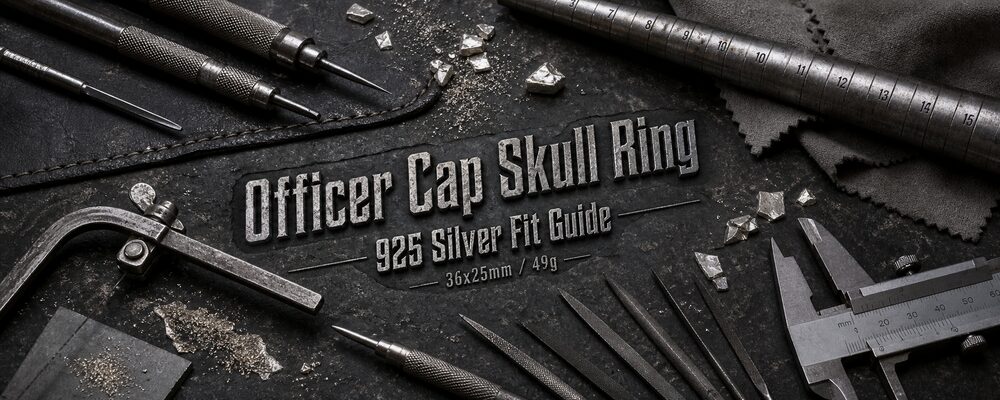
Quick answer: Choose an officer cap skull ring for the relationship between its peaked cap, exposed teeth and sculpted side details, not because the military-looking outline proves a rank, organization or historical story. The current MENSSKULL Officer Cap Skull Ring lists 925 silver, a product-level weight of 49 g, a 36 x 25 mm size reference and US sizes 7 through 14 in half-size steps. The listing does not define the two measurement axes, publish projection above the finger or map weight to each size. Inspect the front, both sides and worn views, then measure the exact finger before choosing an option.
Read the cap, face and shoulders as one design
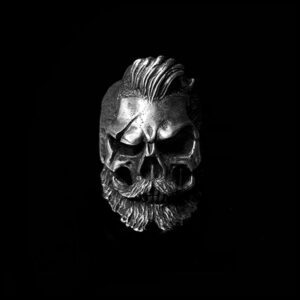
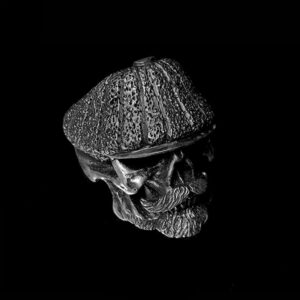
The front photograph establishes three visible layers: a peaked cap at the top, a forward-facing skull in the center and an open row of teeth below. A braided-looking band crosses the cap, while the brim projects over the upper face. This is more than a plain skull with a small symbol added later; the cap changes the upper outline and gives the ring a taller, more directional profile.
The side photographs answer a different question. Sculpted hands wrap along both sides of the face and continue toward the ring shoulders. Those forms make the transition from face to band visually active. A buyer who likes a clean signet outline may find this amount of side sculpture too busy. A buyer who wants detail visible from more than the front may prefer it. The skull ring styles guide owns the broader comparison of skull families; this page stays with the officer-cap construction.
Use each view for a specific check
Use the straight-on image to compare the cap width, brim angle, eye sockets and tooth spacing. Use both side views to inspect how the hands meet the shoulders and whether the details appear symmetrical enough for your preference. Use the worn views to estimate visual presence relative to a finger, but do not turn that photograph into a measurement. Camera distance, crop and finger size can change apparent scale.
The catalog photographs do not establish standardized edge radii, surface roughness, exact clearance beside neighboring fingers or the height of the cap above the band. Bright highlights do not prove that every raised edge feels smooth. Dark recesses do not identify a particular finishing chemical. If projection or side clearance affects your decision, ask for that measurement or an additional angle before ordering.
Do not assign a uniform military meaning
An officer-style cap is a visual motif. The product photographs do not identify a real unit, rank badge, service branch or historical uniform, and this article does not treat the design as evidence of membership or service. It can be chosen as a theatrical, gothic or character-driven ring without claiming an official connection. For the boundary between modern styling and sourced symbolism, consult the gothic jewelry meaning research.
Separate listed scale, weight and finger size
The current listing supplies three different kinds of information, and they should not be collapsed into one judgment. The 36 x 25 mm entry is a face-scale reference with unnamed axes. The 49 g entry is one product-level weight, not a size-by-size chart. The ring-size selector describes the inner fit options. None of those facts alone proves comfort.
| Field | Current listing | Limit of the evidence |
|---|---|---|
| Material | 925 silver | A catalog statement, not an independent assay or allergy guarantee |
| Listed size | 36 x 25 mm | Axes, projection and band dimensions are not defined |
| Listed weight | 49 g at product level | No separate weight is assigned to each ring size |
| Ring-size options | US 7-14, including half sizes, at this check | Not a substitute for measuring the intended finger |
A 49 g catalog value identifies this as a substantial piece relative to a simple lightweight band, but it does not predict an individual’s experience. Weight distribution, band interior, finger shape, knuckle size and neighboring-finger clearance also matter. Do not describe the ring as comfortable or uncomfortable for everyone from the number alone.
The same caution applies to scale. You may use a ruler or paper rectangle to understand the two listed numbers as a rough visual reference, but the exercise cannot recreate a curved face or show how far the cap and jaw project. Since the seller does not name the axes, do not relabel the figures as verified height, width or depth.
Compare silhouette before comparing labels
| Visible feature | What to inspect | Question before checkout |
|---|---|---|
| Peaked cap and brim | Front outline and projection over the upper face | Do I want the cap to be the first feature people notice? |
| Open teeth and eye sockets | Contrast, spacing and balance of the central face | Is the facial treatment detailed enough for my preference? |
| Hands on both sides | Transition from face into the shoulders | Do I want side sculpture visible beyond the front view? |
| Raised overall profile | Worn views, sleeve and adjacent-finger space | Which missing clearance or projection measurement should I request? |
This matrix is a visual decision tool, not a performance test. It does not show snag resistance, impact tolerance or suitability for work. A ring can look balanced in a photograph and still be wrong for a particular activity or hand. Choose the silhouette first, then verify the information the photograph cannot supply.
Measure the exact finger and plan for a raised face
Measure the finger on the hand where the ring will actually be worn. Fingers on opposite hands can differ, and the knuckle and base may require different considerations. A ring should pass the knuckle without rotating freely or restricting normal circulation. Use the men’s ring size and fit research guide for measurement systems and baseline fitting guidance.
Do not automatically add a half size because the face looks broad or because the product is listed at 49 g. Band interior and exact measurements are needed before making that adjustment. If a correctly measured finger sits between offered sizes, ask for seller guidance rather than assuming that heavier always means looser or tighter.
Check the intended finger beside its neighbors. The cap, jaw and side hands create a more complex profile than a smooth band. If you plan to wear another ring next to it, test the spacing concept before buying both as a pair. The catalog does not prove that two faces will clear each other during normal movement.
Daily routine matters too. Raised jewelry can contact pockets, desk edges, gloves, steering controls and sleeves. Remove rings before lifting, gripping tools, using machinery or other impact-prone activity. This is a practical limit, not a claim that one hand or finger makes the ring safe for every task.
Keep material, finish and care claims evidence-led
The listing’s 925 silver entry is the seller’s material statement. The 925 sterling silver research guide explains composition, markings and testing boundaries; this product guide does not independently certify the individual item. It also does not promise that every wearer will avoid sensitivity.
The ring’s dark recesses help the cap braid, sockets, teeth and hands read against brighter raised surfaces. That appearance should not be treated as dirt or polished aggressively by default. Different finishes can respond differently to products and tools. Review the sterling silver care research, then ask about the particular finish before using a chemical dip, abrasive cloth or powered method.
For ordinary dry cleaning, use a soft brush around recessed details rather than a metal pick. Store the raised face away from other jewelry to reduce avoidable contact. These precautions do not make the piece scratch-proof, tarnish-proof, waterproof or maintenance-free.
If the officer-cap shape is not the design you want, browse the skull ring collection or men’s biker rings by silhouette rather than forcing this motif to fit a broad category preference. If it is the right shape, return to the current product listing, confirm the selected size and ask any unresolved measurement question. Price, availability and purchase terms belong on that live listing.
Questions to resolve before ordering
What does 36 x 25 mm measure?
The listing gives two numbers but does not name the axes. Treat them as a listed size reference, not verified height, width, depth or projection. Ask MENSSKULL to define the measurement if a particular direction affects your decision.
Does every size weigh exactly 49 g?
The catalog provides one product-level value and no per-size weight map. Do not assign 49 g to every selectable size as a measured fact. Ask for the actual weight of the intended option if a narrow weight limit matters.
Should I order larger because this is a heavy ring?
Not automatically. Measure the exact finger and use the current size chart. Face weight alone does not determine inner fit, and guessing upward can create rotation. Ask for guidance if your measurement falls between options or your knuckle is much wider than the finger base.
Is the cap linked to a real military organization?
No such affiliation is established by the listing or photographs. It is an officer-cap visual motif. Do not infer rank, unit, service history or membership from the design.
Can I wear it while working with tools?
This article gives no approval for tool, machine or impact use. Remove rings for activities where jewelry can catch, crush or interfere with grip, and follow the applicable workplace or activity rules.
Prepared by MENSSKULL Editorial Team. Product references checked September 16, 2026. Product photographs are first-party catalog evidence; material, fit, care and symbolism questions are linked to their respective research owners.





MENSSKULL Journal Notes
Leave a field note
Share fit notes, styling ideas, care questions, or your experience with MENSSKULL silver jewelry.
Comments are checked before publication so buyers can read useful fit, symbolism, care, and style notes without spam noise.
The simple plus/minus challenge below helps block automated spam while keeping the experience lightweight.
Continue exploring
More MENSSKULL stories
Handcrafted silver
Shop the pieces behind the stories