
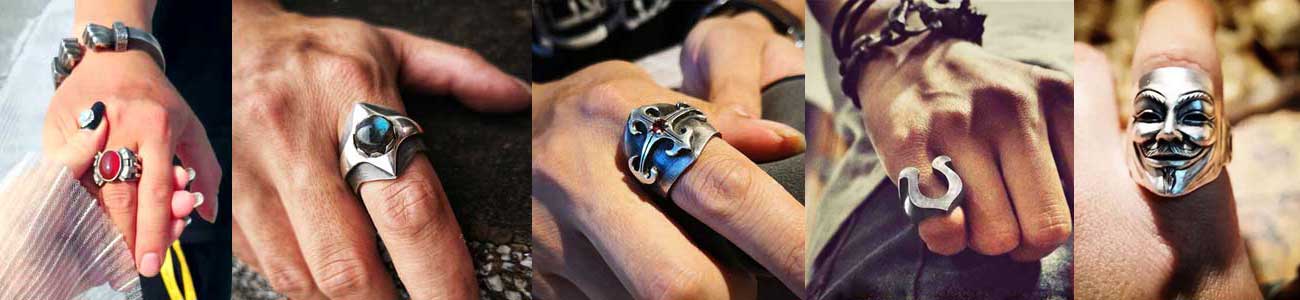
Short answer: men’s sterling silver skull jewelry works best as a coordinated system rather than a pile of matching motifs. Verify the material, choose one focal ring, pendant or bracelet, and compare real dimensions, weight, construction and finish. Support the focal piece with quieter silver details and keep every item appropriate for daily safety.
Start With the Jewelry Category
A skull ring creates movement on the hand. A pendant occupies the chest. A bracelet adds texture at the wrist. Earrings, brooches and wallet chains create smaller or more directional accents. Select the category that fits your routine before choosing a motif.
Use the skull jewelry collection to compare categories, then read the individual product specifications. A category decision reduces impulse buying and makes later coordination easier.
Verify Sterling Silver and Other Components
“Sterling silver,” “silver plated” and “silver tone” are not interchangeable. The Federal Trade Commission’s guide to buying precious-metal jewelry explains why metal and fineness representations matter. A product described as 925 sterling silver should have a clear, consistent material disclosure.
Chains, clasps, springs, pins, stones and coatings may require separate descriptions. A hallmark is useful evidence but does not tell you weight, construction or finish quality. Review the whole object rather than one stamp.
Understand Skull Imagery Through Context
Skulls have appeared in remembrance and memento mori jewelry, among other uses. The Metropolitan Museum of Art discusses historical mortality imagery in its account of life-and-death jewelry, while the Victoria and Albert Museum’s history of jewelry shows how adornment changes across periods and communities.
A modern wearer may connect skull jewelry with memory, resilience, mortality, music culture, Gothic design or sculpture. Those meanings can be sincere without being universal. Product descriptions should not assign one identity to every buyer.
Choose One Focal Piece
Decide where the eye should land first. A large ring makes the hand the focus. A detailed pendant leads at the chest. A broad bracelet controls the wrist. If all three are equally large and ornate, the outfit loses hierarchy.
Begin with the skull ring collection, skull necklace collection or skull bracelet collection according to the preferred focal zone. Add supporting jewelry only after that decision.
Use Measurements to Control Scale
Compare ring face height and width, pendant dimensions and depth, bracelet circumference and width, chain length and weight in grams. Close-up images cannot show actual scale. Sketch the dimensions on paper or compare them with jewelry you already own.
Large dimensions are not automatically better. A compact skull can preserve detail while fitting under a jacket. A broad pendant needs a suitable chain and more space on the chest. A heavy bracelet needs controlled wrist fit and a secure clasp.
Coordinate Finish Instead of Repeating Skulls
Polished silver creates highlights, brushed silver is quieter, and oxidized recesses emphasize sculpture. Two pieces can feel connected when they share a finish even if only one carries a skull. This is more flexible than wearing several identical motifs.
For example, pair an oxidized skull ring with a plain silver chain, or support a detailed pendant with a narrow brushed bracelet. Mixed metals can work when the contrast is deliberate and repeated once elsewhere in the outfit.
Match Jewelry to Clothing Texture
Denim, leather and workwear can support deeper relief and larger scale. Plain knits and monochrome shirts provide clean space for a pendant. Tailoring generally works better with compact or smoother designs that do not compete with lapels, cuffs and other hardware.
Use one visible contrast. A polished skull can stand out against matte black fabric; an oxidized ring can add depth beside washed denim. Avoid adding more jewelry only because empty space remains.
Inspect Construction for Each Product Type
Ring interiors should be smooth and shoulders structurally balanced. Pendant bails must fit the chain’s widest end component. Bracelet links should articulate without pinching, and clasps should align securely. Brooch pins and earring posts need appropriate locking hardware.
Hollow construction can reduce weight; solid construction can increase mass. Neither is automatically superior. Examine joins, backs, edges and moving parts, and choose according to the piece’s size and intended frequency of wear.
Plan Care and Safe Use
Store pieces separately, wipe them after wear and inspect clasps and connecting rings. Avoid aggressive polishing over oxidized detail. GIA’s jewelry-care guidance recommends choosing a method suitable for every material and treatment.
Remove jewelry around machinery, chemicals, impact and activities where rings or chains can catch. Heavy pendants should not swing into equipment, and broad rings should be removed before tasks that place pressure on the hand.
A Skull Jewelry Buying Checklist
- Select the focal zone: hand, chest or wrist.
- Verify sterling silver and every additional component.
- Record dimensions, weight and wearable measurements.
- Inspect backs, interiors, bails, links, clasps and joins.
- Choose supporting pieces by finish rather than repeated motifs.
- Review care, safety, processing and return conditions.
FAQ About Men’s Sterling Silver Skull Jewelry
Is skull jewelry only for Gothic or biker style?
No. Scale and finish determine versatility. A compact ring or restrained pendant can work with denim, plain shirts, workwear or simple tailoring.
How many skull pieces should men wear at once?
Start with one focal piece. Add another only if its scale is quieter and it supports the first through metal tone or finish.
Does a 925 mark prove every component is sterling silver?
Not by itself. Review the full disclosure for the main object, chain, clasp, spring, pin, stone and coating where relevant.
How can I compare skull jewelry online?
Use millimeter dimensions, weight, wearable length, construction and multiple views. Do not compare only enlarged front photographs.
How should oxidized skull jewelry be cleaned?
Begin with gentle wiping and avoid abrasive polishing over dark recesses. Follow care guidance for the exact finish and any stones, coatings or adhesives.


MENSSKULL Journal Notes
Leave a field note
Share fit notes, styling ideas, care questions, or your experience with MENSSKULL silver jewelry.
Comments are checked before publication so buyers can read useful fit, symbolism, care, and style notes without spam noise.
The simple plus/minus challenge below helps block automated spam while keeping the experience lightweight.
Continue exploring
More MENSSKULL stories
Handcrafted silver
Shop the pieces behind the stories