
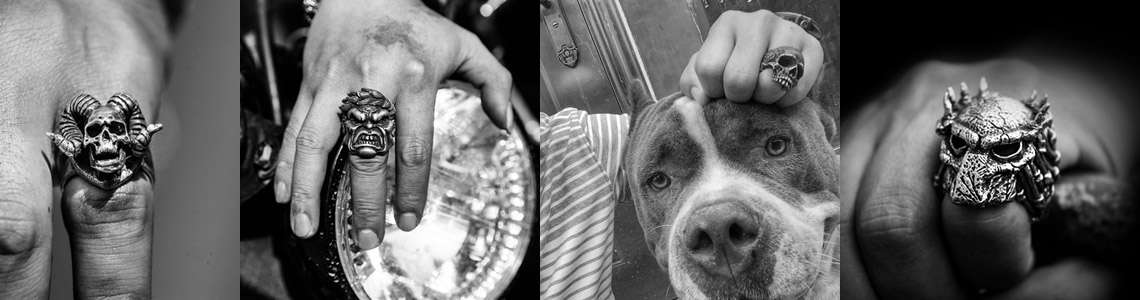
Direct answer: Build a men’s jewelry style by choosing one visual anchor, matching the scale to the outfit and repeating either metal tone, texture or motif across the remaining pieces. Rings, chains, bracelets, pendants and earrings do not need to match exactly, but they should share enough visual language to look intentional.
This is more useful than following a dated trend list. Proportion, fit, material and context continue to matter after a seasonal style cycle ends.
Start With the Outfit and Setting
A plain T-shirt, denim jacket or knit gives a large ring or chain visual space. Tailoring usually benefits from lower-profile jewelry that clears cuffs and collars. Work, travel and formal events also impose practical limits on projection, noise and snagging.
Choose the setting first, then decide whether the jewelry should lead the outfit or support it. Trying to make every piece the focal point usually creates competition rather than personality.
Use Rings as a Controlled Focal Point
Rings concentrate detail in a small area, so face height, width and projection matter. A sculptural animal or skull can lead one hand, while a flatter signet or narrow band works as support. Leave space between large faces so neighboring fingers can move.
Explore men’s rings by form, but open the individual listing for current dimensions, alloy and selectable sizes. Macro photographs do not establish on-hand scale.
Choose Chain Length and Weight Together
A short chain sits near the collar and remains visible with an open shirt. A longer chain creates a vertical line and can carry a pendant, but it may move more during wear. Thickness, link shape, clasp and pendant weight all affect comfort.
Browse the men’s necklace collection for different structures. Confirm the listed length and clasp rather than judging from a cropped model image.
Let Bracelets Balance the Watch
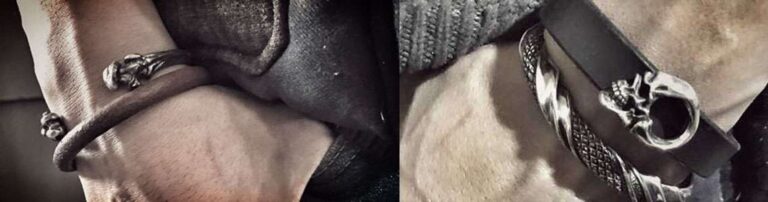
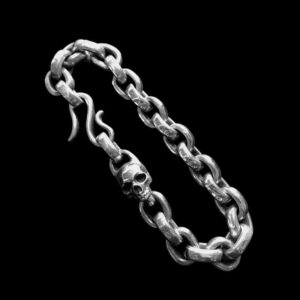
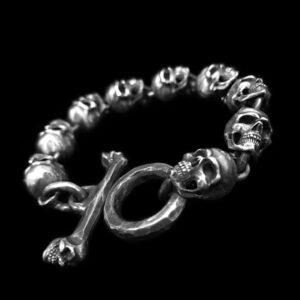
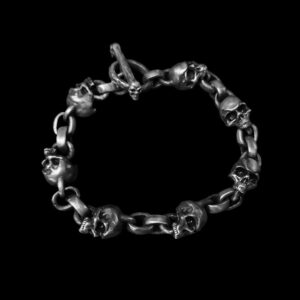
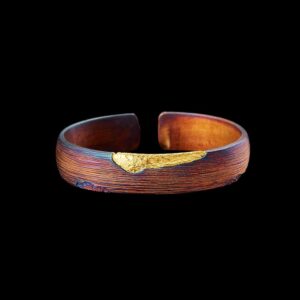
A bracelet can sit opposite a watch or share the same wrist when widths and hardware do not collide. Chain bracelets add movement, while cuffs create a cleaner fixed line. A heavy clasp may rotate if the bracelet is too loose.
The men’s bracelet size guide explains how wrist circumference and desired ease work together. Fit should allow movement without sliding over the hand.
Use Pendants to Control the Center Line
A pendant directs attention to the center of the torso. Its scale should relate to chain thickness: a large pendant on a delicate chain can feel visually and mechanically unbalanced, while a small pendant may disappear on a heavy link.
Check bail clearance, pendant dimensions, chain compatibility and whether the back can rub clothing. Symbolic language is personal interpretation unless a documented source supports a historical claim.
Treat Earrings as Close-Range Detail
Studs and compact hoops sit near the face and are noticed at conversational distance. Larger drops or sculptural forms create more movement and may catch headphones, hair or collars. Workplace and event rules can also affect the appropriate scale.
One earring, a matched pair and an asymmetrical pair can all be intentional. Comfort and fastening security are more important than a supposed rule about which side a man should wear.
Mix Metals With a Repeated Element
Silver and gold can be worn together. Repeat one tone in at least two places or use a bridge piece that contains both colors. A watch, belt buckle or eyewear frame can also connect the palette.
Different colors do not prove different quality. The FTC’s precious-metal buying guide distinguishes sterling silver, gold alloys, plating and metal-tone descriptions.
Balance Texture Instead of Repeating Motifs
A darkened skull ring does not require skulls on every accessory. Repeating an oxidized finish, engraved line or leather texture can create unity with less visual noise. Smooth pieces can provide rest beside heavily carved forms.
The V&A’s history of jewellery shows how materials, techniques and scale have changed across periods. Modern styling can borrow a visual language without claiming an object is historically authentic.
Match Scale Across the Whole Body
Scale is relational. A broad cuff, thick chain and tall ring may work together on a larger frame or layered outfit, but the same group can overwhelm a fitted shirt. Compact jewelry can still look strong when silhouette and contrast are clear.
Photograph the full outfit from several feet away. Close-up product views reveal detail but do not show whether the jewelry balances the clothing.
Build a Small Jewelry Capsule
A practical starting set is one leading ring, one quieter band, one medium chain, one pendant, and either a bracelet or compact earring. Choose pieces that can work in at least two combinations rather than buying five unrelated statements.
The essential men’s jewelry guide offers another route for planning formats. Add a new piece only when it fills a clear gap in scale, function or setting.
Care According to Construction
Sterling silver can tarnish and scratch; plating can wear; stones and enamel can require conservative cleaning. Store pieces separately, keep them dry and avoid abrasive methods on deliberate oxidation. Inspect clasps and joins before wearing heavy jewelry.
GIA’s jewelry care guidance recommends considering the materials and seeking professional attention when settings or components are damaged.
FAQ
How many jewelry pieces should a man wear at once?
There is no fixed number. Begin with one anchor and add support only while the outfit remains visually clear and physically comfortable.
Can silver and gold jewelry be mixed?
Yes. Repeat a tone, texture or bridge piece so the combination looks deliberate.
Should a bracelet match a watch?
It does not need to match exactly, but compatible width, hardware and finish usually create better balance.
Are large rings suitable for formal clothing?
They can be, but check cuff clearance, projection and whether the ring competes with the rest of the outfit.
What is the best first men’s jewelry purchase?
Choose the format you will wear most often, then prioritize correct fit, verified material and a scale that suits your routine.

MENSSKULL Journal Notes
Leave a field note
Share fit notes, styling ideas, care questions, or your experience with MENSSKULL silver jewelry.
Comments are checked before publication so buyers can read useful fit, symbolism, care, and style notes without spam noise.
The simple plus/minus challenge below helps block automated spam while keeping the experience lightweight.
Continue exploring
More MENSSKULL stories
Handcrafted silver
Shop the pieces behind the stories