
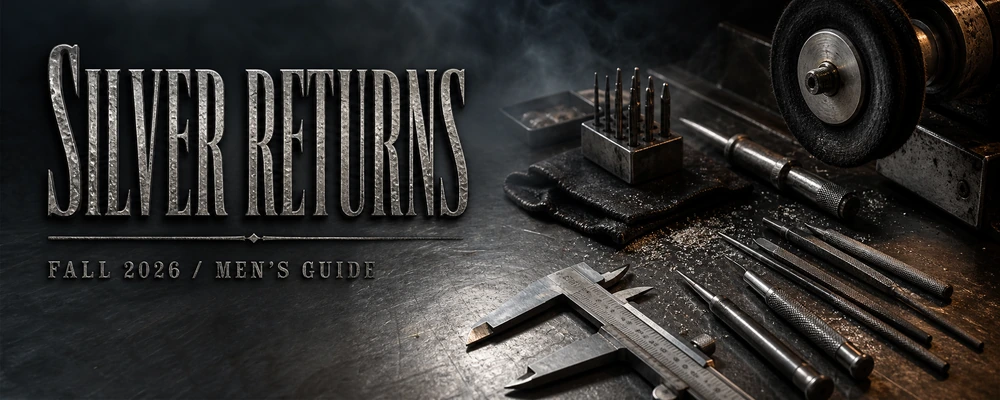
Answer first: The latest fall 2026 jewelry coverage points to a clear return of silver-toned metal, sculptural shapes, layered necklaces and substantial cuffs. For men, the useful takeaway is not to replace an entire jewelry collection because an editorial trend changed. It is to choose one cool-toned piece with enough scale and shape to look intentional, verify what the metal actually is, and make sure it works with the clothes and jewelry already in rotation. A silver-colored finish and 925 sterling silver are not the same claim.
This guide explains the fall 2026 silver jewelry trend for men as a current-news development rather than a prediction invented for a shopping page. PORTER published its fall 2026 jewelry report on August 26 and described silver-toned jewelry as returning for the season. Vogue’s pre-fall accessories coverage also emphasized layered necklaces and sculptural bangles. Those reports are aimed largely at the broader fashion market, so the men’s recommendations below are an editorial translation, not a claim that every runway look belongs in a men’s wardrobe.
What changed in the fall 2026 jewelry conversation?
The immediate news is the renewed attention to cool-toned metal. In its August 26 report, PORTER identified silver-toned jewelry as a fall/winter 2026 direction and illustrated the point with sculptural earrings, a silver pendant and sterling silver rings. Earlier in August, Vogue highlighted layered necklaces and bold, sculptural cuffs in its pre-fall accessories report.
These are related signals, not identical rules. “Silver-toned” describes visual color. “Sculptural” describes form. “Layered” describes how pieces are combined. None of those words automatically tells a buyer whether an object is sterling silver, silver plate, stainless steel, another alloy or a mixed-material design. That distinction matters because a trend can help you decide how a piece should look, while the product specification tells you what you are buying.
The practical shift is therefore broader than “silver is fashionable again.” The stronger idea is a move toward cool metal with visible shape: a ring whose face reads from conversational distance, a pendant that occupies a clear place on the chest, or a cuff that creates one continuous line rather than disappearing beside a watch. This is especially usable for men because one piece can carry the direction without requiring multiple decorative elements.
Why this trend translates well to men’s jewelry
Men’s jewelry often has to work across fewer but more repeated wardrobe combinations: denim and boots, black knitwear, a leather jacket, a work shirt, a plain tee, or a dark tailored layer. Cool-toned metal can connect these looks without demanding a new color palette. It reflects light against black and navy, stays visually quiet beside gray, and creates contrast against brown leather or olive fabric.
The return of sculptural forms is equally relevant. A substantial ring or cuff can function as the single visual anchor in an outfit. This is different from simply buying the largest object available. Effective scale comes from the relationship between the jewelry, the wearer’s hand or wrist, and the surrounding clothing. Our heavy rings for men guide explains that physical dimensions, band structure and fit matter more than a vague “heavy” label.
Layering can also work for men when every chain has a separate job. A shorter chain establishes the upper line, while a longer pendant creates the lower focal point. The goal is not maximum quantity. It is enough spacing that the pieces do not read as one tangled mass. The existing pendant and chain compatibility guide covers bail clearance, chain profile and scale before a pendant is paired with a chain.
Silver-toned is a color description, not a material guarantee
This is the most important buyer check in the trend. The U.S. Federal Trade Commission explains that terms such as “sterling,” “sterling silver” and “925” describe an alloy containing 92.5 percent pure silver. The same FTC jewelry buying guidance distinguishes sterling silver from silver plate, where a layer of silver is applied over another metal.
That means a listing can honestly look silver-toned without being sterling silver. It may be another metal with a silver-colored surface, a plated item, or a mixed-metal object. A responsible buyer should look for a direct material statement rather than infer composition from photography. Color, polish and oxidized recesses can all change the visual appearance of a piece, but they do not replace the material field.
If the listing says 925 sterling silver, the claim should be consistent across the title, product specifications, description and structured product data. If it says silver-toned, treat that as an appearance description unless the seller separately identifies the metal. Our sterling silver versus silver-plated guide gives a more detailed comparison without assuming that one construction is correct for every budget or use case.
Use a three-part buying filter: tone, material and form
1. Decide whether cool-toned metal fits the wardrobe
Start with the clothes you actually wear. Silver-toned jewelry is an easy match for black, charcoal, gray, navy and washed denim. It can also sharpen warm colors when the contrast is deliberate. If most belt hardware, watch cases and eyewear details are already silver or gunmetal, a cool-toned ring or necklace usually creates continuity. Mixed metals can work, but they should look chosen rather than accidental.
Do not buy only because a trend report used the word silver. Ask whether the piece will appear in at least three real outfits. If you cannot name those outfits, the problem may be the design rather than the metal color.
2. Verify the material separately
Read the specification line. Look for an explicit statement such as 925 sterling silver, stainless steel, brass, alloy or silver plate. Do not convert “silver color” into “sterling silver” in your own mind. For a MENSSKULL product, the product page is the controlling source for that individual item’s material; collection language should never overrule a specific product fact.
Material verification is also useful when comparing prices. Two pieces with a similar silhouette may not be comparable if one is sterling silver and the other is plated base metal. Compare like with like before deciding that one price is unexpectedly high or low.
3. Choose a form that earns its visual space
The strongest fall 2026 direction is not delicate silver by itself. It is silver-toned metal expressed through shape. For men, that can mean a raised ring face, an openwork pendant, a broad cuff or a chain with a clearly defined profile. Look at the outline first. If the silhouette remains recognizable when the detail is visually reduced, the design is likely to retain its impact at normal viewing distance.
A design can still be detailed, but detail should support the outline. Deep recesses, raised edges and alternating polished and darker areas create legibility. A surface covered with equally strong details can become visually flat because the eye has nowhere to rest.
How to choose the right format
A sculptural ring for one-point impact
A ring is the most direct way to use the trend because it does not require chain compatibility or neckline planning. It is also the format where size and fit are easiest to underestimate. A tall face can contact adjacent fingers, and a broad band may feel different from a narrow ring in the same nominal size. Check face dimensions, band shape and available sizes before focusing on the motif.
A large design generally works best as the only statement ring on that hand. A second ring can be added, but leave visual separation and avoid placing two high-profile faces next to each other. For fit preparation, use the measurement process in our men’s ring size guide rather than guessing from a ring that has a different band width.
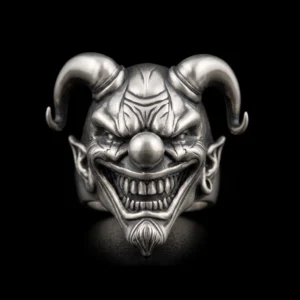
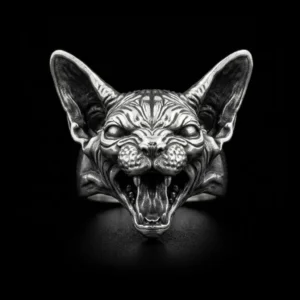
As current first-party examples of sculptural sterling silver, the Horned Jester Ring for Men uses an extended horned silhouette, while the Sphynx Cat Ring for Men uses upright ears and an open-mouth profile. These links illustrate two different outlines; they are not evidence that one motif is universally more fashionable or more comfortable.
A pendant for adjustable visual weight
A pendant lets the wearer control impact through both object size and chain length. The same pendant can read differently at the upper chest and below the sternum. Start with where the pendant should sit, then select chain length and profile. Confirm that the chain end hardware can pass through the bail and that the chain does not visually overpower the pendant.
For the current trend, a pendant with a clear outer shape often works better than a small charm surrounded by several competing chains. If layering, use two distinct drops and keep the pendant on the lower line. The shorter chain can be simpler and slightly lighter in appearance.
A cuff or bracelet for a continuous metal line
Vogue’s attention to sculptural cuffs is useful because the format translates naturally into men’s wardrobes. A cuff can sit opposite a watch or act as the only wrist piece. The key choice is not just width. Consider the opening, inside contour and how far the ends project. Product-specific measurements should control the decision.
If a watch is already large, placing a bold cuff beside it can make both pieces look crowded. Try the cuff on the opposite wrist first. If the outfit includes heavy jacket hardware, a quieter wrist may provide better balance.
Earrings for a smaller but visible signal
A stud or compact hoop can use the silver-tone direction without the mass of a ring or cuff. This is a useful route for someone who already wears a necklace and does not want another large focal point. Match visual intensity rather than exact motifs: a detailed pendant pairs more easily with a simple earring, while a plain chain can support a more sculptural stud.
How to layer necklaces without losing the trend’s clean impact
Layering is one of the current editorial signals, but it becomes useful only when the pieces remain readable. Use this order:
- Set the neckline: decide whether the jewelry will sit over a tee, inside an open shirt or over knitwear.
- Choose the lower focal point: place the pendant where it will not disappear behind a collar or compete with a print.
- Add one shorter line: use a chain with enough difference in length to maintain separation.
- Compare chain profiles: they can differ, but one should not visually erase the other.
- Move before committing: check whether the chains cross repeatedly during normal movement.
Two readable layers are usually stronger than three nearly identical chains. A single chain can also be the correct answer when the pendant already has a large, sculptural face. The trend is permission to use visible metal, not an obligation to stack every available piece.
Scale the jewelry to the wearer and the outfit
Scale is relational. A 30 mm ring face may look balanced on one hand and oversized on another. A broad cuff can look restrained under a structured jacket but dominant with a short-sleeve tee. Product photos help identify form, yet they can exaggerate or minimize size depending on crop and focal length. Dimensions remain the reliable comparison tool.
For rings, compare face width with the visible width of the intended finger. For pendants, compare height with the open area created by the neckline. For cuffs, compare width with the watch case or the exposed wrist area. For earrings, compare the visible drop or stud diameter with the ear rather than with an isolated macro photograph.
The broader men’s sterling silver styling guide provides an evergreen system for balancing rings, necklaces and bracelets. This news article uses that foundation only to interpret the fall 2026 direction.
A practical fall wardrobe test
Before buying, run the piece through three outfits and one outerwear check:
- Everyday: tee or knitwear, denim and the footwear worn most often.
- Layered casual: open shirt, overshirt or leather jacket.
- Sharper option: dark trousers and a structured jacket or coat.
- Outerwear check: confirm that a pendant does not vanish under a collar and a ring does not visually fight with prominent jacket hardware.
If the jewelry works in only one highly specific look, treat it as an occasional statement. That can still be a valid purchase, but it should not be mistaken for a daily-wear solution. A versatile piece does not have to be plain; it needs a shape and scale that remain coherent across repeated outfits.
Five common mistakes when following the silver return
Mistake 1: treating every silver-colored item as sterling silver
Appearance does not establish composition. Read the product material and compare the claim across the listing.
Mistake 2: buying multiple statement pieces before testing one
Start with one format. A sculptural ring or cuff is enough to determine whether the direction feels natural in your wardrobe.
Mistake 3: choosing detail without checking silhouette
Macro photography can make fine detail persuasive. Step back and evaluate the outline that other people will actually see.
Mistake 4: ignoring measurements
Words such as bold, heavy and oversized are relative. Use dimensions and product-specific weight information where available.
Mistake 5: copying a runway stack literally
Editorial styling is designed for an image and a moment. Translate the principle, such as cool metal or layered lengths, into the number of pieces you can wear comfortably and repeatedly.
Fall 2026 silver jewelry buying checklist
- The piece works with at least three existing outfits.
- The listing identifies the actual material, not only the color.
- Dimensions are available and make sense for the intended finger, wrist, chest or ear.
- The silhouette remains clear at normal viewing distance.
- One piece has been chosen as the primary focal point.
- Layered chains have visibly different drops.
- A pendant’s bail and chain hardware are compatible.
- The ring size decision accounts for the actual band form.
- The purchase still makes sense after the seasonal headline is removed.
Fall 2026 silver jewelry trend FAQ
Is silver jewelry officially back for fall 2026?
Current international fashion coverage supports a renewed fall 2026 emphasis on silver-toned jewelry. PORTER explicitly identified the return of silver-toned metal, while Vogue highlighted layered necklaces and sculptural cuffs. That is a strong editorial signal, not a rule that every buyer must replace gold-toned jewelry.
Does silver-toned mean 925 sterling silver?
No. Silver-toned describes appearance. A 925 sterling silver claim identifies an alloy containing 92.5 percent pure silver. Confirm material in the product specifications rather than inferring it from color.
What is the easiest way for a man to wear this trend?
Choose one cool-toned focal piece: a sculptural ring, a defined pendant or a substantial cuff. Wear it with familiar black, gray, navy, denim or leather combinations before adding another statement piece.
Can silver-toned jewelry be mixed with gold-toned jewelry?
Yes, if the mix is repeated or clearly intentional. A single isolated warm-metal detail can look accidental, while a watch, ring or hardware element that repeats the warm tone creates a visual reason for the combination.
Are layered necklaces required for the fall 2026 look?
No. Layering is one reported direction. A single pendant with a strong silhouette can express the same interest in visible, sculptural metal with less complexity.
Should a trend article decide which material to buy?
No. A trend article can identify current color and shape directions. Material, dimensions, fit, construction and price must be evaluated from the individual product’s verified specifications.
The useful conclusion
The fall 2026 return of silver-toned jewelry is most valuable as a design signal: cool metal, stronger silhouettes, deliberate layers and cuffs with visible form. For men, the low-regret response is to select one piece that fits an existing wardrobe, verify its material independently, and judge scale from measurements rather than from a close-cropped image.
That approach keeps the timely part of the news without turning a seasonal headline into a rushed purchase. If a ring, pendant or cuff still works after the words “fall 2026 trend” are removed, it has a better chance of remaining useful beyond the current editorial cycle.




MENSSKULL Journal Notes
Leave a field note
Share fit notes, styling ideas, care questions, or your experience with MENSSKULL silver jewelry.
Comments are checked before publication so buyers can read useful fit, symbolism, care, and style notes without spam noise.
The simple plus/minus challenge below helps block automated spam while keeping the experience lightweight.
Continue exploring
More MENSSKULL stories
Handcrafted silver
Shop the pieces behind the stories