
Pendant chain compatibility is determined by more than chain width. The chain must first pass through the pendant connection, then sit correctly inside it, and finally create a combination whose scale and movement match the way you plan to wear it. A chain can look substantial yet fail at the bail because its clasp, end cap or decorative terminal is wider than the chain body.
The most reliable online buying method is to separate five questions: the pendant’s connection type, the bail’s usable internal opening, the widest chain-end component, the chain body’s width and thickness, and the visual relationship between pendant mass and chain profile. If any required measurement is missing, treat compatibility as unconfirmed rather than guessing from product photographs.
What pendant and chain compatibility actually means
Compatibility is not one measurement. It is a sequence of physical and visual checks. The chain must be attachable to the pendant, the connection must allow the pendant to face as intended, and the finished pairing should create the amount of visual presence you want. Those stages can produce different answers.
A chain may pass through a bail but leave almost no room for the pendant to settle. Another chain may move freely yet look too light or too dominant for the pendant. A third may have an appropriate body width but a clasp that cannot enter the bail at all. Calling all three questions “chain size” hides the distinction that buyers need.
Use these terms consistently:
- Bail: the loop or connecting component through which a chain normally passes.
- Usable opening: the clear internal space available after accounting for curves, seams, decorative shapes and obstructions.
- Chain body: the repeating links or woven section that forms most of the necklace.
- End hardware: the clasp, end cap, jump ring, tag, toggle bar or other terminal component that must pass through the pendant connection.
- Projection: how far a pendant, bail or raised detail extends away from the body.
This guide owns the attachment, clearance and proportion decision. The existing men’s silver chain length guide remains the owner for where 18, 20, 22, 24 and other lengths land on the body. Choose length there after the attachment path is verified here.
Start with the pendant connection type
Not every pendant uses the same connection. A fixed bail may be cast as part of the pendant. A separate ring may connect the pendant to a bail. A concealed bail may sit behind the top edge. Some designs use a horizontal tube, while others rely on an opening connector that is not intended to accept a finished chain from either end.
Identify the actual route before measuring. Front photographs often hide the inside of a bail, and a worn photograph may show a display chain without proving that the photographed chain is included or removable. Look for rear, side and detached views. If the connection route is not visible, ask for a measurement or a clearer image instead of inferring it from the pendant’s title.
Questions to answer from the gallery
- Is the connection fixed, hinged, split or removable?
- Does the chain travel vertically through one opening or horizontally through a tube?
- Is the opening fully visible from the rear or side?
- Does a decorative cap reduce the clear internal space?
- Is the photographed chain identified as part of the offer?
A chain shown in a product photograph is visual evidence of one photographed arrangement, not a universal fit statement. The live offer controls and written package contents should determine what is included.
Measure the bail’s usable opening
The useful bail measurement is the clear internal opening, not the outside height of the metal loop. Record inside height and inside width separately. A teardrop bail can be tall at the center but narrow near the top; an ornate bail can have scrollwork that reduces the path; a round opening may need only one diameter, but a rectangular or irregular opening needs two axes.
When measuring an existing pendant, place it flat and use a millimeter ruler or caliper without forcing the jaws against delicate details. Record the narrowest part of the actual passage. If you are shopping online, look for wording such as “bail opening,” “inside bail” or “internal loop.” A pendant’s overall dimensions do not reveal this measurement.
Add a small practical clearance rather than planning an exact metal-to-metal match. Product measurements can be approximate, shapes are not always perfectly rectangular, and the chain end needs room to change angle while passing through. This is a comparison principle, not a universal allowance: the required extra space depends on the forms being joined.
Do not substitute these measurements
- Pendant height is not bail height.
- Outside bail width is not inside bail width.
- Chain body width is not clasp width.
- A product’s listed weight is not a bail measurement.
- A model photograph is not a scale drawing.
Measure the widest chain end, not only the links
For a finished chain that must thread through a fixed bail, measure every component that will travel through the opening and use the largest height-and-width combination. The critical part may be a lobster clasp, spring ring, end cap, soldered tag or decorative toggle. Even a slim chain can end in hardware that is much wider than its links.
Measure the component in the orientation it would use during passage. A flat tag may fit edge-first through a tall narrow bail but not through a short round opening. A lobster clasp may have one narrow side and one broad lever side. An ornate terminal may not align with the opening at all.
Toggle chains deserve special attention. MENSSKULL’s 4 mm Crescent and Shield Toggle Chain lists a 4 mm diameter reference, but its visible crescent bar and shield-shaped ring are larger than the repeating chain body. The Eagle Toggle Clasp Chain Necklace lists a 3.0 x 1.5 mm link reference, while its bird-shaped toggle and receiving ring create different terminal dimensions. Neither listing publishes universal pendant compatibility or a load rating. These chains demonstrate why body width cannot stand in for end-hardware clearance.
Check movement after the chain passes through
Passage is only the first gate. Once the chain is inside the bail, the pendant needs enough room to settle into its intended orientation. A chain that fills nearly all of the opening may hold the pendant at an angle, restrict side-to-side movement or place constant contact at one point.
Compare chain-body width and thickness with the usable bail space. Link shape matters because a round rope, flat curb, rectangular box and oval cable chain occupy space differently even when sellers use the same nominal width. Decorative links can also present a larger diagonal profile than a simple width figure suggests.
The goal is not maximum movement. Some pendants are designed to stay centered, while others move along the chain. The goal is to understand the intended connection. Rear and side views can show whether the bail is straight, angled or concealed. If the design needs a separate connector, do not assume that threading the finished chain directly through the pendant is the correct assembly method.
Match visual scale without inventing a weight ratio
There is no universal rule that a pendant must weigh a fixed percentage of its chain. Listed weight helps compare known offers, but it does not establish chain strength, connection quality or long-term performance. Link construction, terminal hardware, soldering, wear history and the pendant’s movement are not captured by one gram figure.
Use weight as a disclosure and proportion cue. A large or high-relief pendant usually creates more visual focus than a small flat charm. A chain with a broad link profile also carries more visual presence than a fine chain, regardless of whether the metal weights happen to be similar. Decide whether the pendant should dominate, share attention with the chain or act as a small accent.
When no load rating or compatibility statement is published, do not convert appearance into an engineering promise. Ask the seller or a jeweler to inspect the actual pendant, chain and connector if the pairing involves unusually large components or an undocumented attachment method.
Three useful visual relationships
- Pendant-led: a quieter chain keeps attention on the sculpted object, provided passage and clearance are confirmed.
- Balanced statement: pendant and chain have comparable visual presence without one obscuring the other.
- Chain-led: a decorative chain remains the main design, and an added pendant is small enough not to compete with the closure or link pattern.
Use verified product examples as questions, not guarantees
The following live MENSSKULL examples show how different silhouettes create different compatibility questions. They do not form a universal grading system. Product facts were checked on August 22, 2026, and missing measurements remain explicitly unconfirmed.
| Example | Verified listing fact | Compatibility question | What remains unconfirmed |
|---|---|---|---|
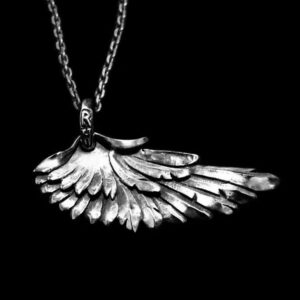
| Layered Feather Wing Pendant | Listed 21 g; broad single-wing silhouette | Will the chosen drop give the horizontal wing enough visual space? | Material, dimensions, chain inclusion and bail opening |
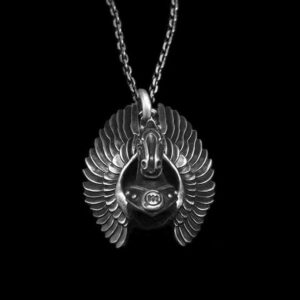
| Armored Pegasus Pendant | Paired wings frame a forward horse head | Can the chain end pass through the concealed top connection? | Material, dimensions, weight, chain inclusion and bail opening |
| Blossom Antler Deer Pendant | Tall open antler silhouette with raised floral forms | Does the necklace position leave the projected branches where intended? | Material, dimensions, weight, chain inclusion and bail opening |
| Full-Body Crocodile Pendant | Fixed full-body form with four legs and curled tail | Does the connection let the long body face in the intended direction? | Material, dimensions, weight, chain inclusion and bail opening |
| Crescent and Shield Toggle Chain | Listed 4 mm reference, 30 g+ and 17-27 inch options | Is the decorative front closure compatible with the planned pendant arrangement? | End-hardware dimensions, load rating and universal pendant fit |
| Eagle Toggle Clasp Chain | Listed 3.0 x 1.5 mm link reference, 25 g+ and 23-27 inch options | Can the bird toggle and receiving ring work with the pendant’s connection route? | End-hardware dimensions, load rating and universal pendant fit |
This table deliberately preserves uncertainty. For example, the feather pendant’s 21 g listing does not tell us its bail opening or prove which finished chain will pass through it. The toggle chains publish useful link and length references, but those values do not describe the complete decorative terminals. A high-quality buying decision keeps verified facts and missing facts separate.
Keep material verification separate from fit
Material and compatibility answer different questions. The U.S. Federal Trade Commission explains that the words “silver,” “sterling” and “sterling silver” describe products containing 92.5% pure silver, and that 925 represents 925 parts per thousand. Review the FTC’s consumer guidance for buying silver jewelry when interpreting material labels.
The FTC’s Jewelry Guides rule page identifies 16 CFR Part 23 as the relevant U.S. guidance for jewelry and precious-metal representations. Those sources support truthful material wording; they do not establish bail clearance, chain load capacity or pendant compatibility.
A verified sterling label does not mean that every sterling chain fits every sterling pendant. Different makers use different bails, clasps, end caps and link profiles. Conversely, a compatible physical connection does not prove the material of either component. Confirm each fact from its own evidence.
A step-by-step online compatibility check
- Identify the exact pendant offer. Confirm whether the purchase includes the pendant only, a complete necklace or selectable chain options.
- Find the connection route. Use rear and side images to identify the bail, ring, tube or other attachment.
- Record the usable inside opening. Keep height and width separate and note whether the shape is irregular.
- Record the widest chain end. Include the clasp, cap, tag, toggle or decorative terminal that must travel through the opening.
- Compare passage orientation. Check whether the end fitting can rotate into the same orientation as the bail opening.
- Compare chain body with bail space. Verify that the links can sit as intended after the end hardware passes.
- Review pendant projection and silhouette. Consider wings, antlers, legs, jaws or other forms that change visual scale.
- Choose the necklace drop separately. Use the chain-length owner rather than treating compatibility as a length chart.
- Confirm material from written fields. Do not infer sterling silver from color or from the material of the other component.
- Stop at missing critical data. Ask for the unlisted opening or hardware measurement before ordering a pairing that depends on it.
If you want to compare complete pendant offers rather than individual components, use the silver pendant necklace buying guide. For commercial browsing after compatibility is understood, view the men’s silver pendant collection.
Common pendant-and-chain matching errors
Checking only the chain’s advertised width
The clasp or end cap may be wider than the links. Measure the complete attachment path.
Using pendant height as a bail measurement
Overall height may include the bail, exclude it or leave the method undefined. It does not reveal the clear internal opening.
Assuming a photographed chain is included
Use written package contents and live purchase controls. Display styling alone is not offer evidence.
Turning weight into a strength promise
A gram figure does not supply a load rating or verify every connecting component. Keep mass, construction and compatibility as separate facts.
Ignoring decorative terminal hardware
Toggle bars, sculpted clasps and large end rings can define the fit question even when the chain body is slim.
Solving a clearance problem by changing length
A longer chain changes the drop, not the size of the bail or clasp. Resolve attachment first and placement second.
Pendant chain compatibility FAQ
How do I know whether a chain will fit through a pendant bail?
Compare the bail’s minimum usable inside height and width with the height and width of the largest chain-end component that must pass through it. Also check whether that component can rotate into the required orientation.
Is chain width the same as clasp width?
No. Chain width normally describes the repeating link body. Clasps, end caps, tags, jump rings and toggles can be wider or taller, so they need separate measurements.
How much clearance should a chain have inside a bail?
There is no universal allowance. The chain needs enough room to pass and sit in the intended orientation without an exact metal-to-metal fit. Irregular openings and approximate product measurements require additional caution.
Does a heavier chain automatically suit a heavy pendant?
No. Listed weight does not prove connection fit, link construction, terminal condition or load capacity. Use weight as a comparison fact, not a compatibility guarantee.
Can a toggle chain be used with any pendant?
No universal fit should be assumed. A toggle bar or decorative receiving ring may be much larger than the chain body, and a front closure may compete with or obstruct the planned pendant arrangement.
What should I ask a seller when bail measurements are missing?
Ask for the bail’s minimum internal height and width, whether the chain is included, and the maximum height and width of the chain end that must pass through the opening. Request a rear or side photograph when the connection route is unclear.
Should pendant compatibility and chain length be chosen together?
They should be checked in sequence. First confirm that the pendant and chain can connect and sit correctly. Then choose length according to the intended neckline, clothing and drop.








MENSSKULL Journal Notes
Leave a field note
Share fit notes, styling ideas, care questions, or your experience with MENSSKULL silver jewelry.
Comments are checked before publication so buyers can read useful fit, symbolism, care, and style notes without spam noise.
The simple plus/minus challenge below helps block automated spam while keeping the experience lightweight.
Continue exploring
More MENSSKULL stories
Handcrafted silver
Shop the pieces behind the stories