
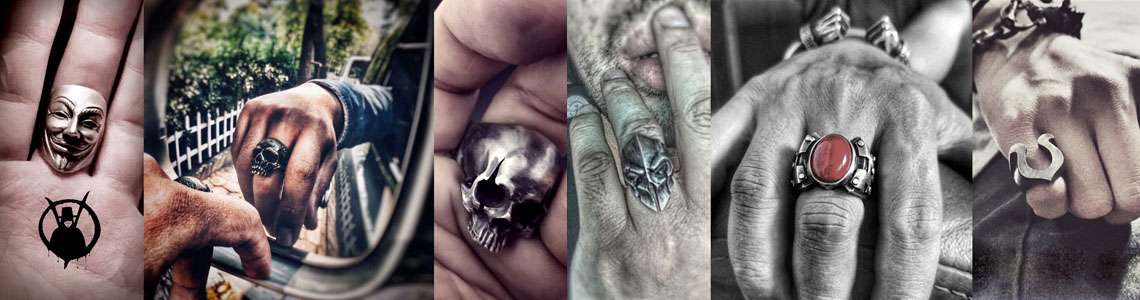
Direct answer: Wear a skull ring as a deliberate focal point or a smaller supporting detail. Choose its scale for the hand, check profile and neighboring-finger contact, then coordinate finish and visual weight with clothing, a watch or bracelet. The ring can reflect preference, but it cannot create confidence or define identity.
Decide Whether the Ring Leads or Supports
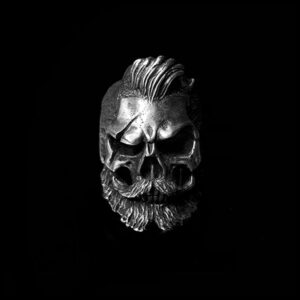
A tall anatomical skull usually becomes the hand’s main visual element. A compact engraved signet can support a watch or other ring without dominating.
Choose the role before adding accessories. One clear focal point is often easier to read than several equally detailed motifs.
Scale Changes the Entire Look
Record face width, face length, profile height, band width and weight. A ring that appears balanced in a macro photograph may feel oversized on the hand.
Use on-hand and side views together. The skull ring size guide explains fit and projection checks.
Finger Placement Is Practical and Personal
Index and middle fingers can support a larger visual field, while ring and pinky placement may suit smaller faces, but hand proportions vary. There is no mandatory skull-ring finger.
Test grip, pocket access and neighboring-finger contact. Meaning should not override comfort or safety.
Finish Connects the Ring to Clothing
Bright polish creates contrast against dark fabric. Satin reduces glare. Oxidized recesses can clarify carving and connect naturally with black or textured clothing.
Do not call every dark finish antique. Age, finish and style inspiration are separate descriptions.
Use Clothing Context Without Costume Rules
A skull ring can sit beside denim, leather, workwear, a plain T-shirt or tailored clothing when scale is controlled. Formality depends on the event and dress code, not a universal ban.
Reduce competing graphics when the ring has dense carving. A clean sleeve line can make the design easier to read.
Coordinate With Watches and Bracelets
Repeat one element such as silver tone, dark recesses or geometric weight. Exact matching is optional, and the supporting accessory does not need another skull.
A broad bracelet and large ring on the same side can feel crowded. Move one piece or reduce scale.
Stacking Requires Physical Space
Check whether adjacent bands trap skin or restrict finger flexion. Wide rings and tall faces need more separation than slim bands.
Build a stack one piece at a time and reassess movement. Photography should not replace an actual comfort test.
Subculture Terms Describe Influence, Not Membership
Gothic, biker, rock, punk, metal, memorial and anatomical styles can inform design language. Wearing one ring does not grant membership or reveal beliefs.
Use the terms to locate visual references, not to stereotype the wearer. The skull ring meaning guide covers interpretive boundaries.
Confidence Is Not a Product Feature
A wearer may feel comfortable when an accessory matches an established style. That experience is individual. The ring cannot guarantee power, courage, protection or self-esteem.
Shopping guidance should focus on measurable facts and let the wearer decide what expression feels authentic.
Verify Material and Construction
The FTC guide explains sterling terminology. A 925 mark does not prove craftsmanship or handmade production.
Inspect side projections, underside construction, edges, stones and finish. Hollow and solid forms have different weight and cleaning behavior.
Use a Styling Sequence
| Step | Decision | Check |
|---|---|---|
| 1 | Focal or supporting | Face and profile scale |
| 2 | Finger placement | Grip and contact |
| 3 | Clothing context | Graphics and dress code |
| 4 | Other accessories | Spacing and weight |
| 5 | Daily routine | Safety and comfort |
Care for the Actual Finish
GIA care guidance supports separate storage and protection from damaging chemicals. Follow product-specific instructions for oxidation, plating and stones.
Compare designs in the skull ring collection, then verify every listing individually.
Correct for Product Photography
Macro photographs emphasize grooves and can hide how the ring reads from arm’s length. Wide-angle on-hand images may also distort finger proportions. Use written measurements as the fixed reference.
Compare one normal-distance image, one side view and one underside view. The combination reveals visual size, profile, construction and likely contact points better than a dramatic hero crop.
Adapt the Ring Between Settings
A ring that works with a jacket at night may feel visually heavy beside office clothing during the day. The solution may be a different supporting accessory, a different finger or a smaller skull ring, not a claim that one context is more authentic.
Build two simple combinations and test each at normal viewing distance. Styling becomes repeatable when it is based on proportion rather than mood labels.
Travel and Storage Affect Wear
Carry a separate pouch or compartment so the sculptural face does not scratch other jewelry. Do not leave the ring loose in a bag with keys, tools or chargers.
If security, sport or work requires removal, use a predictable storage place. A strong expression still benefits from practical loss prevention and finish protection.
Complete an Arrival Styling Trial
Before removing tags or altering the ring, compare its size, dimensions, material and finish with the saved listing. Wear it briefly over a clear surface with the intended clothing and accessories.
Check rotation, neighboring-finger contact, pocket access, grip and visual balance. If the ring fails physically, adding more styling language will not solve the underlying fit problem.
A successful skull-ring outfit remains readable from normal distance and comfortable through ordinary hand movement. Both conditions matter.
FAQ
Must a skull ring be large?
No. Compact signets and engraved bands can create a quieter effect.
Which finger should wear it?
Choose according to fit, scale, grip and personal preference.
Can it be worn with a suit?
Potentially, when scale and the event’s dress code are appropriate.
Does it create confidence?
No. Confidence is personal and cannot be guaranteed by jewelry.
What should support it?
One restrained accessory that shares metal tone, finish or visual weight.




MENSSKULL Journal Notes
Leave a field note
Share fit notes, styling ideas, care questions, or your experience with MENSSKULL silver jewelry.
Comments are checked before publication so buyers can read useful fit, symbolism, care, and style notes without spam noise.
The simple plus/minus challenge below helps block automated spam while keeping the experience lightweight.
Continue exploring
More MENSSKULL stories
Handcrafted silver
Shop the pieces behind the stories