

A silver necklace can be a thoughtful gift for a boyfriend, but the safest starting point is not a trend list or a guess about what men are supposed to wear. Start with what he already chooses for himself. The jewelry, watch, clothing details, and accessories already in his rotation give you visible evidence about whether he prefers a quiet chain, a noticeable clasp, or a larger link profile.
This guide stays with those observable style decisions. It does not prescribe chain length, body fit, comfort, material quality, care, durability, value, or the reaction a gift will receive. Those questions need their own evidence and owners. The goal here is simpler: narrow the visual direction before you shop.
Quick answer: choose from evidence, not a stereotype
Look at three things in order: what he already wears, whether he tends to choose plain shapes or focal details, and how visually prominent his accessories usually are. A slim plain chain is one direction. A visible toggle or clasp is another. A broad Cuban-link profile is a third. None is automatically more masculine, meaningful, or appropriate; they simply create different visual effects.
If you are still deciding between an unadorned chain and a focal piece, use the dedicated plain chain or pendant comparison. Keep this page focused on the boyfriend-gift decision rather than duplicating that broader owner.
Begin with a five-minute visual inventory
Before opening a product page, review a few recent photos or the items he reaches for most often. You are not trying to diagnose his personality. You are collecting visible cues. Does he repeat clean, narrow lines? Does he wear a watch with a bold bracelet? Are his jackets and shirts mostly plain, or do they include hardware, contrast stitching, or graphic details?
- Existing jewelry: note whether it is plain, detailed, narrow, or broad.
- Repeated hardware: notice visible buckles, zippers, watch bracelets, or bag fittings.
- Accessory count: observe whether he usually wears one visible accessory or combines several.
- Typical outfits: identify whether his usual clothing gives jewelry a quiet background or already contains many visual details.
One repeated choice is more useful than an imagined rule. If you cannot find a clear pattern, keep the gift visually simple and preserve the option for him to make the final selection.
Plain chain, visible clasp, or pendant?
A plain chain keeps the link pattern as the main visual element. A visible clasp adds a focal point without introducing a separate pendant. A pendant creates a distinct central object. These are compositional choices, not statements about identity or character.
| Direction | What becomes visible | Useful evidence from his wardrobe |
|---|---|---|
| Plain chain | Repeated links and an uninterrupted line | He already repeats simple metal details or minimal accessories |
| Visible clasp | A functional-looking focal detail | He often chooses noticeable hardware, buckles, or closures |
| Pendant | A central image or shape | He already wears graphic symbols or has named a specific motif |
Browse the silver necklace collection to compare chain profiles as a category, or the silver pendant necklace collection when a central motif is already part of the brief. Category pages show options; they do not prove what your recipient will prefer.
Read link profile as a visual scale
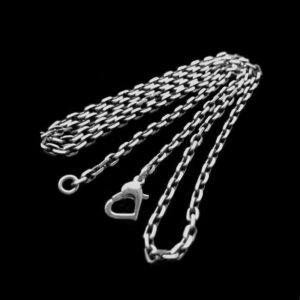
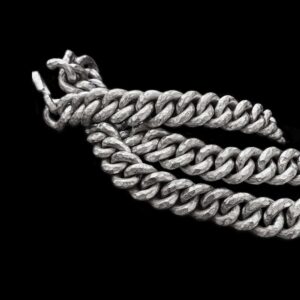
Link width, shape, spacing, and surface treatment change how much of the necklace registers at a glance. A slim cable profile reads as a fine repeated line. A medium chain with a visible toggle gives the closure more emphasis. A broad Cuban-link profile creates a larger continuous band. Treat these as visual observations only.
Do not turn an item name into a promise about weight, comfort, performance, or durability. Product names can help distinguish designs, but they do not settle those separate questions. If material evidence matters to the purchase, consult the dedicated 925 sterling silver research guide rather than relying on this styling page.
Match prominence to his existing accessory hierarchy
Accessory hierarchy means deciding which detail should attract the eye first. If his watch, glasses, jacket hardware, or rings already carry strong visual weight, a quieter necklace can support the group. If his usual outfit has few visible details, a broader link or visible clasp can become the leading accessory.
This is not a rule that more accessories are better or worse. It is a way to avoid accidentally choosing three focal points when the recipient normally wears one. Consider the necklace beside the items he actually repeats, not against a generic model photograph.
Use occasion as context, not as a guarantee
The same necklace can look different with a plain T-shirt, an open overshirt, or a jacket with visible metal hardware. Think about the setting in which he is most likely to choose jewelry: ordinary weekends, dinners, concerts, travel, or occasions where he dresses more deliberately. Then choose a visual profile that resembles the level of detail he already uses in that context.
Occasion does not prove acceptance, appropriateness, safety, or social success. It simply gives you an outfit context for comparing a quiet line, a visible closure, and a larger chain pattern.
Three current profiles to compare
The following current listings illustrate three different visual directions. Their availability was checked during preparation, but availability can change. The examples support only the names and visible design distinctions shown in current first-party records.
| Current example | Observable profile | Use it to test this question |
|---|---|---|
| 3mm Oxidized Cable Chain with Triangle Clasp | Slim cable links with a visible clasp detail | Would he choose a narrow chain that still has one noticeable closure? |
| 4mm Crescent and Shield Toggle Chain | Medium link scale with a prominent toggle element | Does visible hardware already appear in the accessories he wears? |
| 8mm Heavy Hammered Cuban Chain Necklace | Broad Cuban-link profile with stronger visual presence | Does he already favor larger accessory shapes and repeated metal detail? |
These are comparison anchors, not rankings. The listing names do not establish comfort, weight on the body, material performance, durability, value, or suitability for a particular person.
Separate visual choice from chain length and fit
You can decide that a slim cable, visible toggle, or broad Cuban profile looks closer to his existing style without guessing how a particular length will sit on his body. Keep those decisions separate. For length-specific information, use the men’s necklace chain length guide.
This page intentionally does not prescribe a measurement, neckline position, body proportion, or comfort outcome. If you do not have reliable sizing or preference information, do not disguise uncertainty as confidence. A direct question, a shared selection, or a flexible gift plan is more honest than a precise-sounding guess.
Decide whether personalization is actually part of the brief
Personalization can make a gift more specific, but it also introduces a decision that should come from known preferences. A date, initial, word, or symbol should not be chosen merely because personalized gifts are marketed as more meaningful. Use details the recipient has already expressed or selected.
If personalization is clearly wanted, browse the personalized jewelry collection as a separate path. That category is commercial navigation, not evidence that a particular inscription will be welcomed or that personalization guarantees a stronger reaction.
Use a short decision sequence
- Photograph or list the accessories he already wears repeatedly.
- Choose plain chain, visible clasp, or pendant as the visual direction.
- Compare slim, medium, and broad link profiles without ranking them universally.
- Place the proposed necklace beside his usual watch, rings, glasses, and clothing hardware.
- Route length, fit, material, and personalization questions to their dedicated owners.
- If the evidence is weak, ask him or make the choice collaborative.
This sequence protects the useful part of surprise while reducing unsupported assumptions. It also gives you a clear reason for the choice: the necklace echoes something he already wears.
Common mistakes to avoid
Avoid choosing from a label such as “bold,” “minimal,” or “masculine” without checking what that label means in his actual wardrobe. Avoid assuming a larger chain is automatically more expressive, or that a slim chain is automatically safer or more versatile. Those conclusions are not established by visual scale alone.
Also avoid treating community posts, trend roundups, product popularity, or a seller’s category name as proof of his preference. Public questions can show that other shoppers face a similar decision; they cannot validate product performance, predict his reaction, or replace first-party product facts.
A final gift check before purchase
Write one sentence explaining the choice without using a stereotype: “I chose this because its visible clasp resembles the hardware you already wear,” or “I chose a slim cable profile because your usual accessories use narrow, simple lines.” If the sentence is grounded in something observable, your decision is likely coherent even if his preference ultimately differs.
Then verify the current product listing and the store’s applicable terms directly. This article does not promise stock longevity, a particular fit, material performance, durability, value, recipient approval, or a relationship outcome. It provides a visual decision framework so the gift begins with evidence rather than guesswork.





MENSSKULL Journal Notes
Leave a field note
Share fit notes, styling ideas, care questions, or your experience with MENSSKULL silver jewelry.
Comments are checked before publication so buyers can read useful fit, symbolism, care, and style notes without spam noise.
The simple plus/minus challenge below helps block automated spam while keeping the experience lightweight.
Continue exploring
More MENSSKULL stories
Handcrafted silver
Shop the pieces behind the stories