
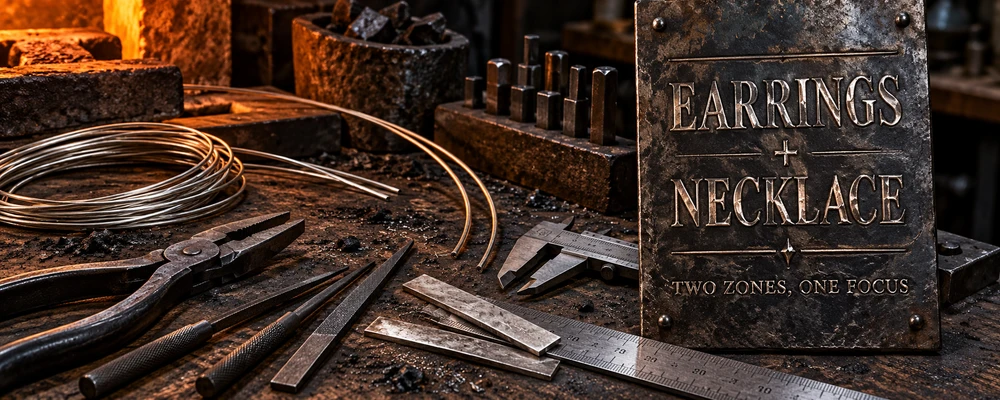
Quick answer: treat earrings and a necklace as two separate focal zones. Earrings sit beside the face; a necklace sits below the collar. Put on the complete shirt or jacket, compare the visible spacing between those zones, and choose which accessory should lead. Keep the second accessory quieter, or remove it, when both shapes compete for attention.
Start with the face zone and neckline zone
Divide the dressed view into two areas. The face zone includes the visible earring outline beside the cheek, jaw, hair, glasses, and collar. The neckline zone includes the shirt opening, collar, tie, jacket lapels, chain line, and any pendant shape. The zones can be close together in a portrait, but they still perform different visual jobs.
Look at the full outfit before deciding whether either zone needs more detail. If the face zone already contains glasses, facial hair, a patterned collar, or a strong earring outline, the necklace does not need to repeat that intensity. If the face zone is quiet, the earring can remain subtle while the necklace becomes the clearer anchor.
Build a no-jewelry baseline first
Put on the shirt, jacket, and any tie or open-collar layer you plan to wear. Photograph the outfit from the front without earrings or a necklace. Note where the eye goes first: the face, collar, shirt pattern, jacket hardware, or another visible detail. That baseline gives you something stable to compare.
If the outfit already has a clear order, adding nothing is a complete option. The broader add-or-skip jewelry guide owns the general question of whether an outfit needs jewelry. Continue here only when you want to test earrings and one necklace together.
Add one accessory before the other
Start with the accessory you already intend to wear. Add the earrings and photograph the result, or add the necklace and do the same. Do not add both at once. A one-variable comparison shows how much visual weight the first accessory contributes before the second zone enters the frame.
Then add the second accessory without changing the clothing, camera distance, lighting, or posture. Compare the two images at the same size. The useful question is not whether the pieces match in a universal sense. It is whether one zone still leads and the other remains visibly separate.
Use this two-zone balance matrix
| Observable combination | Face zone | Neckline zone | First comparison |
|---|---|---|---|
| Compact earring and plain chain | Small outline | Continuous line | Check whether the chain can lead cleanly |
| Longer earring and plain chain | Extended vertical shape | Continuous line | Increase visible spacing between the two lines |
| Compact earring and pendant | Small outline | Line plus focal shape | Let the pendant lead if the collar leaves open space |
| Detailed earring and detailed pendant | Strong local detail | Strong local detail | Quiet one zone or remove one piece |
The matrix describes visual structure only. It does not establish piercing suitability, metal compatibility, safe wear, fit, comfort, material identity, or how another person will interpret the combination.
Choose one lead accessory
A lead accessory is the first jewelry shape that reads in the complete outfit. It can be the earrings or the necklace. The quieter accessory should support that choice through a smaller outline, a simpler silhouette, lower contrast, or more open space around it.
State the hierarchy in one short sentence: “the pendant leads and the earrings form a small face-side accent,” or “the earrings lead and the chain stays as a quiet neckline line.” If both pieces require equal emphasis in the sentence, test a simpler version of one zone.
Compare earring outline instead of assumed meaning
For this decision, describe only what can be seen: compact or extended, rounded or angular, single shape or repeated detail, close to the face or visibly dropping below the earlobe area. Do not assign personality, identity, symbolism, status, or cultural meaning to those forms.
The skull earring style guide owns more specific earring-format and outfit questions. The men’s earring collection is commercial navigation only and does not prove piercing suitability, exact scale, safe wear, fit, material, or performance.
Compare a plain chain with a pendant separately
A plain chain creates a continuous line at the neckline. A pendant creates that line plus a separate focal shape. Test those formats one at a time while keeping the earrings and clothing fixed. The difference is easiest to see when the shirt opening, collar, and jacket remain unchanged.
Use the plain-chain-or-pendant guide for the necklace-format decision. After choosing the format, the pendant collection is a browsing destination, not proof that a particular piece suits an earring, neckline, body, or occasion.
Let the shirt neckline set the spacing
A crew neck creates a high boundary beneath the face. An open collar creates a lower central opening. A tie adds another vertical line, while a patterned shirt adds repeated detail. These garment shapes change the amount of open space available between the earring and necklace zones.
With a high neckline, the visible chain line may sit closer to the face zone in a portrait crop. With an open collar, the necklace can occupy a lower area and create more separation. This is an observation about the dressed frame, not a rule about ideal chain length or fit.
Check glasses, facial hair, and collar detail as visible shapes
Glasses add lines around the eyes and temples. Facial hair can create a strong edge around the jaw. A patterned collar or visible top button adds detail directly beneath the face. Treat those elements as part of the composition before adding earring and necklace detail.
This comparison does not judge grooming, face shape, attractiveness, or identity. It simply counts visible lines and focal points. When several shapes already meet near the face, a quieter necklace or earring often gives the image a clearer visual order.
Use an add-one, remove-one sequence
- Photograph the complete outfit without earrings or a necklace.
- Add the earrings and record what changes beside the face.
- Remove the earrings and test the necklace alone.
- Add both pieces without changing the outfit or camera distance.
- Choose which zone should lead.
- Simplify or remove the other accessory if the focal order becomes unclear.
- Check the final combination in full-length and portrait views.
The sequence compares one visual variable at a time. It does not test safe wear, piercing condition, metal reaction, fit, comfort, durability, or product compatibility.
Check full-length and portrait crops
At full length, small earrings may read as a subtle edge near the face while a necklace provides the clearer line. In a portrait crop, both zones become larger and may appear closer together. A combination that feels restrained from several steps away can become dense when cropped around the head and shoulders.
Use the crop that matters for the setting, but do not treat a photograph as proof of universal scale or outcome. Camera distance, lens, light, hair position, collar, and posture can all change how much of each accessory remains visible.
Keep metal-color observations visual
You can observe whether two visible surfaces look similar or different in color, brightness, and contrast under the same light. That observation does not establish chemical compatibility, purity, material identity, skin response, safe wear, or a universal rule about mixing metals.
If the surfaces differ strongly, decide whether that contrast supports the lead-accessory hierarchy or creates a third competition with the garment. Describe what you see rather than turning the comparison into a material or safety claim.
Use this final decision table
| What you observe | Keep fixed | Change one thing | Stop condition |
|---|---|---|---|
| Both zones demand attention | Clothing and lead accessory | Simplify or remove the second piece | One zone reads first |
| Earrings disappear at normal distance | Necklace and outfit | Compare a clearer earring outline or no earring | Face-side accent is intentional |
| Necklace merges with collar detail | Earrings and shirt | Test a simpler necklace format or none | Neckline line remains separate |
| Portrait crop feels crowded | Camera crop and clothing | Reduce one jewelry zone | Face, collar, and jewelry have clear spacing |
Avoid duplicating necklace-layering decisions
This guide compares earrings with one necklace. It does not own the decision about wearing two necklaces, arranging multiple chain lengths, or building a necklace stack. Keep those questions with the existing necklace-layering owner so this page remains focused on face-zone and neckline-zone balance.
If you already plan to wear several necklaces, settle that arrangement first. Then return to the earring comparison and decide whether the face zone needs another visible shape or should remain quiet.
Common comparison mistakes
- Adding earrings and a necklace at the same time without recording a baseline.
- Judging the pieces only in close-up instead of the complete outfit.
- Ignoring glasses, facial hair, collar detail, ties, or jacket hardware near the two zones.
- Treating visible metal color as proof of material compatibility or safe wear.
- Using product photography as proof of exact on-body scale.
- Assigning identity, personality, culture, symbolism, attraction, or status to an observable shape.
Reset by removing both accessories, restoring the outfit, and changing one zone at a time.
Final earrings-and-necklace check
Complete one sentence before keeping the combination: “the earrings lead and the necklace stays quiet,” “the pendant leads and the earrings stay compact,” or “the outfit reads more clearly with one zone empty.” Then inspect the same choice at normal viewing distance and in the portrait crop you expect to use.
This guide can compare visible outline, drop, necklace silhouette, garment opening, face and neckline spacing, scale, contrast, and focal priority. It cannot determine piercing suitability, skin response, safe wear, injury risk, fit, comfort, metal chemistry, material identity, care, durability, product compatibility, value, symbolism, identity, culture, religion, personality, masculinity, popularity, attraction, status, social outcome, or performance.






MENSSKULL Journal Notes
Leave a field note
Share fit notes, styling ideas, care questions, or your experience with MENSSKULL silver jewelry.
Comments are checked before publication so buyers can read useful fit, symbolism, care, and style notes without spam noise.
The simple plus/minus challenge below helps block automated spam while keeping the experience lightweight.
Continue exploring
More MENSSKULL stories
Handcrafted silver
Shop the pieces behind the stories