
Direct answer: Ring etiquette depends on relationship status, culture, organization, workplace and personal preference. There is no universal code assigning every finger a fixed meaning. Respect rings with known commitments or official insignia, prioritize fit and safety, and coordinate scale and finish so the hand remains comfortable and visually clear.
When a ring’s meaning matters, ask or explain rather than relying on stereotypes.
Begin With Known Commitments
Wedding, engagement, memorial and commitment rings may carry specific meaning for the wearer. Finger placement varies across cultures and individuals. Do not move or stack a meaningful ring merely to satisfy a generic chart.
Discuss expectations with the people involved when relationship symbolism is important.
Do Not Assign Every Finger a Universal Meaning
Online charts often claim that each finger proves authority, creativity, wealth or personality. These are not reliable tools for interpreting a real person. Placement can result from fit, handedness, comfort or design balance.
The ring finger meaning guide separates common associations from fixed rules. For thumb placement specifically, review left-versus-right silver thumb ring meaning alongside fit and dominant-hand use.
Recognize the Historical Role of Signets
Some signet rings carried personal, commercial or heraldic devices and could be used for sealing. The British Museum records a 15th-century merchant’s signet ring with an inscription and mark.
That evidence does not make every modern pinky signet an official seal or status symbol.
Respect Organizational Insignia
Club emblems, military devices, school marks and professional symbols may have defined ownership and wear rules. Do not copy or wear them to imply membership or rank without permission.
Generic decoration should not be described as verified heraldry or affiliation.
Measure Each Finger Separately
Finger size differs across the hand. A wide band can feel tighter than a narrow one, and a heavy face can rotate when loose. Measure the exact finger with an appropriate gauge.
GIA’s ring-sizing benchmark explains knuckle fit and wider-band gauges.
Use One Ring as the Visual Anchor
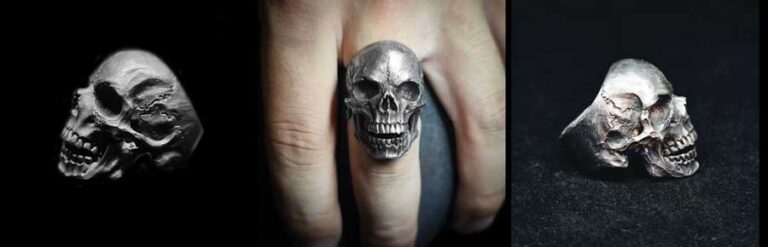
A sculptural skull, animal or gemstone ring can lead the hand. Supporting bands should be quieter or placed on the other hand. If every ring has equal scale and detail, the combination can look crowded.
Browse the men’s ring collection by dimensions and finish rather than motif alone.
Leave Space Between Neighboring Rings
Large faces and wide shoulders can contact adjacent fingers or rings. Metal-on-metal contact may scratch surfaces and restrict movement. Close the hand gently and test ordinary grip.
Stacking should not cause numbness, pinching or deep impressions.
Coordinate Finish Before Repeating Symbols
Polished, brushed, hammered and oxidized surfaces create different contrast. Two unrelated motifs can look coherent when finish and visual weight relate. Repeating skulls on every finger is optional, not required.
A plain band can provide useful rest beside a detailed signet.
Consider Handedness and Routine
Rings on a dominant hand may receive more contact from tools, doors, bags and desks. A low profile may be easier for daily tasks, while a taller ring can be reserved for social use.
Workplace and sport rules take priority over style.
Remove Rings for Hazardous Tasks
Remove rings before machinery, electrical work, heavy lifting, climbing and activities where jewelry can catch or compress the finger. A durable metal does not make these activities safe.
Store removed rings in a secure container rather than a loose pocket near equipment.
Use Cultural History as Context
Jewelry has served decoration, status, remembrance, identity and practical functions across periods. The V&A’s history of jewellery shows that use and meaning change over time.
A modern wearer can draw inspiration from history without claiming an undocumented tradition.
Break Style Rules Without Breaking Trust
Mix metals, use asymmetry or wear a signet on an unexpected finger when the combination remains comfortable and does not misuse a protected symbol. Personal style has room for experimentation.
The rule worth keeping is accurate communication about commitments and affiliations.
Review the Full Combination
Look at both hands from normal distance and while moving. Check whether rings collide, rotate or overwhelm a watch and bracelet. Remove one piece if it prevents a clear focal point.
The pinky ring collection provides examples of outer-hand placement and compact signet profiles.
Adjust the Combination to the Occasion
A restrained workplace combination may use one signet or a narrow band, while a concert or evening event can support greater scale and contrast. Formality is not a fixed number of rings; it is the relationship between jewelry, clothing, setting and any stated dress code.
When meeting clients, attending a ceremony or entering a controlled venue, check local expectations instead of assuming that an online style rule applies everywhere.
Build a Small Rotation Instead of Wearing Everything
A practical rotation can include one everyday ring, one visually stronger piece and one quieter supporting band. This creates more combinations while reducing repeated contact between detailed surfaces.
Photograph combinations that feel balanced and note which fingers remain comfortable through a full day. Personal evidence is more useful than copying another person’s hand layout.
Check Comfort Again at the End of the Day
Finger volume can change with temperature and activity. A ring that fits in the morning should still come off without force later, while a loose ring should not rotate constantly or slip during hand washing.
If swelling, pain or numbness develops, remove the ring safely and stop treating the issue as a styling problem.
FAQ
Does each finger have one fixed ring meaning?
No. Meanings vary by culture, relationship, organization and individual choice.
Can a man wear rings on both hands?
Yes, when fit, movement, workplace safety and visual balance remain appropriate.
Should all ring metals match?
No. Mixed metals can work when one tone dominates or the combination is clearly intentional.
Is a pinky ring always a status symbol?
No. It may be a signet, memorial, fashion choice or simply the best-fitting finger.
When should rings be removed?
Remove them for machinery, electricity, heavy lifting and other snag or compression hazards.




MENSSKULL Journal Notes
Leave a field note
Share fit notes, styling ideas, care questions, or your experience with MENSSKULL silver jewelry.
Comments are checked before publication so buyers can read useful fit, symbolism, care, and style notes without spam noise.
The simple plus/minus challenge below helps block automated spam while keeping the experience lightweight.
Continue exploring
More MENSSKULL stories
Handcrafted silver
Shop the pieces behind the stories