
You can wear a silver ring on either thumb. The more useful choice is the side that gives the ring enough room, keeps the hand visually balanced, and interferes least with the tasks you actually do. Left-versus-right symbolism is personal, not a universal rule.
Which Thumb Should a Man Wear a Silver Ring On?
Start with the hand you use less for gripping, tools, a mouse, a phone, bags, or sports equipment. A ring on the non-dominant hand may encounter fewer objects during some routines, but that is only a starting point. Your habits, the width of the ring, the height of its face, and the space between thumb and index finger matter more than a fixed left-or-right rule.
Then compare both hands in ordinary positions: relaxed at your side, holding a phone, typing, closing a jacket, and carrying a handle. The better side is usually the one where the ring looks deliberate and does not compete with nearby hardware or another focal ring. If both sides work, choose the composition you prefer.
Use a Four-Part Decision, Not a Symbolism Shortcut
| Decision | What to inspect | Question to ask |
|---|---|---|
| Hand use | Frequent gripping, tools, devices, pockets, bags, and controls | Which side encounters fewer objects in my normal day? |
| Fit | Measured thumb size, band width, inside shape, and seller size definition | Does the exact option match the intended thumb? |
| Scale | Face width, height, side profile, shank, and visual space on the hand | Does the ring occupy the amount of space I want? |
| Balance | Watch, bracelet, other rings, sleeve hardware, and dominant outfit details | Does this side create a clear focal point? |
This framework keeps separate questions separate. Meaning is personal. Fit depends on measurements and construction. Style depends on proportion and the other details around the hand. Material claims require their own evidence.
Begin With Dominant-Hand Use
A right-handed wearer may prefer the left thumb because the right hand does more writing, tool use, or device handling. A left-handed wearer may make the opposite choice. That pattern is common-sense experimentation, not a guarantee that the non-dominant side will always be more comfortable or safer.
List the movements that matter in your routine. Consider steering, lifting, opening doors, working at a keyboard, using a camera, operating shop tools, playing an instrument, or reaching into fitted pockets. A tall or wide ring can meet nearby surfaces differently from a low-profile band. Test the relevant motion with an inexpensive sizing ring or a similarly proportioned ring before committing to a substantial design.
If a ring catches, presses, pinches, restricts movement, or causes discomfort, remove it and reassess the size and design. This article cannot diagnose a fit or safety problem. For measurement definitions and fit boundaries, use the men’s ring size and fit Research guide.
Measure the Exact Thumb You Plan to Use
Do not assume the two thumbs take the same size. Measure the intended side and compare the result with the seller’s stated system. A US ring-size label, an inside diameter, and an inside circumference describe related but different values. They should not be mixed without checking the conversion and the seller’s definitions.
Band width and inside shape can also affect how a size feels, so a familiar size from a narrow ring may not settle the question for a wider thumb ring. The product page should identify the available options, while the fit guide explains how to measure and compare them. When the listing does not define an axis or measurement method, do not invent one from the photograph.
The NIST SI units reference is useful for keeping millimetres, centimetres, and related measurements clear. It does not select a ring size for an individual buyer.
Compare Face Scale and Side Profile
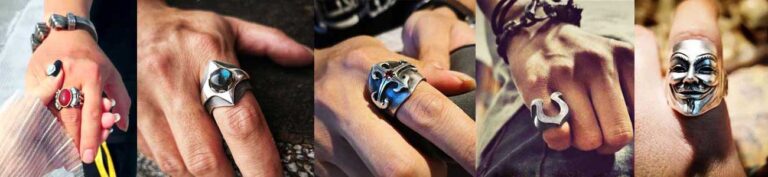
The thumb offers more visual area than some other fingers, which is why both compact bands and large sculptural rings can look intentional there. The decision is still about the exact design. A ring face that appears balanced from the front can project farther than expected in side views. A wide top can also reduce the visible space between the thumb and index finger.
Before ordering, compare at least four views when they are available: front, side, palm-side shank, and an angled view. Note whether the design is centered, elongated, open, winged, jawed, or raised. These are visual observations only. A photograph does not establish comfort, durability, clearance in every hand position, or suitability for work.
For a broader comparison of silhouette, jaw, profile, and sculptural relief, use the skull ring styles guide. That page owns the design-taxonomy question; this page owns the narrower thumb-side decision.
Build Visual Balance Across Both Hands
A thumb ring sits at an outer edge of the hand, so changing sides changes the whole composition. If a watch and bracelet already make one wrist visually busy, placing the thumb ring on the opposite hand can distribute attention. If you want one concentrated accessory side, keeping the ring near the watch or bracelet can create a deliberate cluster.
Neither method is automatically better. Look at both hands together from normal viewing distance, not only in a close-up. Decide whether the thumb ring should be the lead piece, a supporting accent, or part of a coordinated group. The men’s ring finger meaning guide explains how other finger placements are commonly interpreted while keeping personal choice separate from universal claims.
If you also wear a pinky ring, compare the outer-edge weight on each hand. The men’s pinky ring buying guide covers that separate purchase decision. Do not stack both topics into one symbolic rule.
Use Current Product Listings as Scale Examples
The following MENSSKULL listings were checked as purchasable and in stock on September 21, 2026. They are examples of different face dimensions, listed weights, and silhouettes. Stock, options, attributes, and imagery are mutable, so the live product page is the final source before ordering.
| Current example | Seller-listed reference | What the buyer can compare | What it does not prove |
|---|---|---|---|
| Handlebar Mustache Skull Ring | 33 x 20 mm face; 23 g listed weight | Elongated sculptural face and multiple gallery views | Thumb clearance, comfort, or suitability for every task |
| Winged Male Skull Ring | 29 x 21 mm reference; 25 g listed weight | Winged outline, front width, and side profile | A universal meaning or an individual fit result |
| Helmeted Biker Skull Ring | 32 x 23 mm face; 23 g listed weight | Tall helmeted silhouette and gallery angles | Durability, safety, or all-day comfort |
| Heavy 925 Silver Skull Ring | 30 x 20 mm reference; 30 g listed weight | Substantial listed scale compared with nearby options | How the weight will feel on a specific thumb |
| Full Jaw Anatomical Skull Ring | 21 x 20 mm face; seller-listed weight range varies by size | Compact face proportions and full-jaw profile | That one size or weight applies to every variation |
| Horseshoe Skull Ring | 30 x 26 mm reference; 44 g listed weight | Broad horseshoe outline and larger listed mass | Popularity, performance, or a symbolic outcome |
Do not rank these examples by weight or dimensions alone. More material is not automatically better, and a larger face is not automatically more suitable for a thumb. Compare the selected size, shank, side profile, and intended visual role.
Keep Left-Thumb and Right-Thumb Meaning Personal
Online explanations often assign fixed identities to the left or right thumb. Those claims vary by source and are easily repeated without evidence. A buyer should not treat them as a reliable way to diagnose another person’s character, relationships, sexuality, wealth, authority, or beliefs.
If a placement has a private meaning for you, that is enough. You may choose the left thumb to balance a right-hand watch, the right thumb because it photographs the way you prefer, or either side because a particular ring fits there. Personal intention does not need to become a universal cultural rule.
For buyers who want broader design context rather than a side-specific claim, the skull ring symbolism guide separates common interpretations from certainty. Research owners retain detailed historical and cultural evidence.
Coordinate the Thumb Ring With Other Jewelry
Start with one focal point. A large thumb ring can lead while other rings stay lower and quieter. A compact thumb ring can repeat the metal tone of a bracelet or watch without becoming the dominant detail. If every accessory uses a large face, dark motif, bright polish, and heavy texture, the hand can lose hierarchy.
Try three arrangements: thumb ring alone, thumb ring with one supporting ring on the other hand, and thumb ring with your normal watch or bracelet. Photograph each arrangement at arm’s length in ordinary light. The image can reveal balance and spacing that a mirror close-up hides.
Browse the men’s silver rings collection for current options or the unique rings collection for unusual silhouettes. Category pages support browsing; they do not replace measurement checks.
Verify the Silver Claim Separately
Thumb placement does not establish material composition. A 925 or sterling-silver description is a precious-metal representation that should be checked separately from style, symbolism, and fit. The 925 sterling silver Research guide explains fineness terminology and evidence limits.
In the United States, 16 CFR Part 23 addresses jewelry-industry representations. A stamp, color, photograph, or design story should not be stretched into proof of every component, origin, manufacturing method, or quality outcome.
Compare the listing’s material statement, selected size, gallery, and included components before ordering. Do not infer scratch resistance, allergy suitability, durability, or maintenance requirements from a 925 label alone.
A Practical Thumb-Ring Checklist
- Choose the exact thumb and measure that side rather than assuming both hands match.
- List the gripping and device tasks that hand performs in a normal day.
- Compare front, side, shank, and angled gallery views.
- Check face dimensions, listed weight basis, band width, inside shape, and available sizes.
- Decide whether the ring will lead, support, or balance jewelry on the other hand.
- Treat left-versus-right meanings as personal interpretations, not identity facts.
- Verify material claims separately from design and fit.
- Recheck the live listing, selected option, shipping terms, and return policy before purchase.
Common Thumb-Ring Questions
Should a right-handed man wear a thumb ring on the left hand?
It can be a practical starting point because the non-dominant hand may encounter fewer objects during some routines. It is not a universal rule. Compare both sides using your actual tasks and the exact ring profile.
Does a left thumb ring have a fixed meaning?
No fixed meaning applies to every wearer or culture. Treat placement as personal style unless the wearer has stated a specific meaning.
Can a skull ring be worn on the thumb?
It can be considered if the exact size, band, face dimensions, and side profile suit the intended thumb. A skull motif does not establish fit. Check the listing and measurement guidance.
Should a thumb ring match a watch?
Exact matching is optional. Repeating a cool metal tone can create continuity, while placing the ring on the opposite hand can distribute visual weight. Choose the arrangement that gives the clearest hierarchy.
Is a heavier ring automatically better for the thumb?
No. Listed weight is one comparison point, not a quality or suitability score. The ring’s size, profile, shank, balance, and the wearer’s routine all remain separate questions.






MENSSKULL Journal Notes
Leave a field note
Share fit notes, styling ideas, care questions, or your experience with MENSSKULL silver jewelry.
Comments are checked before publication so buyers can read useful fit, symbolism, care, and style notes without spam noise.
The simple plus/minus challenge below helps block automated spam while keeping the experience lightweight.
Continue exploring
More MENSSKULL stories
Handcrafted silver
Shop the pieces behind the stories