
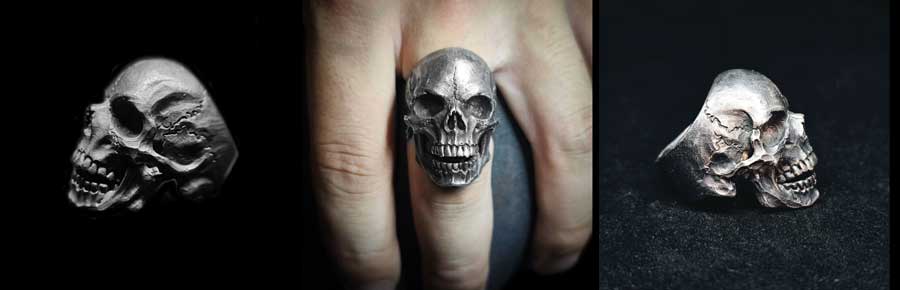
Direct answer: Choose skull jewelry by deciding where it will be worn, how visible the motif should be, and which dimensions, material and construction suit the wearer. Rings, necklaces, bracelets and smaller accessories create different focal points. None automatically produces confidence, toughness or masculinity; those are personal qualities, not product features.
A useful comparison moves from format to fit, then from material to design. Close-up photographs can make every carving look large, so use measurements and side views before deciding whether a piece belongs in everyday wear or occasional styling.
Choose the Jewelry Format First
A ring places the motif on a moving, frequently used part of the body. A necklace creates a vertical focal point and can be adjusted through chain length. A bracelet follows the wrist and must balance articulation, closure and contact with desks or cuffs. A brooch, money clip or other small accessory can carry the same visual language without requiring constant skin contact.
Start with the complete skull jewelry collection to understand the available formats, then compare only products that match the intended use. A person who rarely wears rings may enjoy a pendant more, while someone who dislikes movement at the wrist may prefer a compact ring or accessory.
Skull Rings: Check Profile, Width and Finger Fit
A skull ring can be a compact engraved band, a raised sculptural face or a repeated pattern around the shank. Record ring size for the intended finger and compare band width, top dimensions and height above the finger. Wide bands may feel tighter than narrow bands at the same nominal size.
Side and underside views reveal whether the skull is solid, hollowed or connected by openwork. They also show potential contact points between adjacent fingers. Browse skull rings by visible shape, but use each product page for exact dimensions, weight and available sizes rather than estimating from a hand-free studio photograph.
Skull Necklaces: Treat Pendant and Chain as One System
A pendant’s scale depends on both its millimeter dimensions and where the chain places it on the torso. Shorter chains keep the motif near the collar; longer chains increase movement and can place a heavy pendant against buttons or zippers. Verify whether a chain is included, its length, link style and closure.
The bail must accommodate the selected chain, and the chain should be suitable for the pendant’s weight. Compare the profiles in the skull necklace collection. If a listing offers variations, confirm the selected combination rather than assuming the photographed chain is supplied.
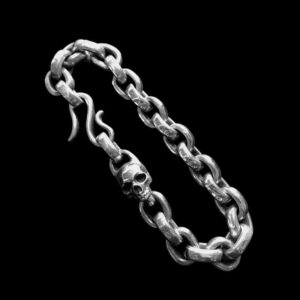
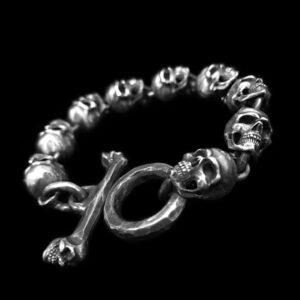
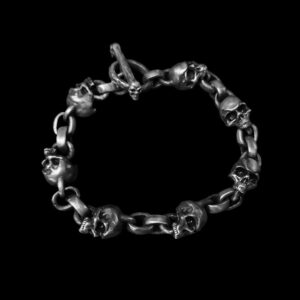
Skull Bracelets: Prioritize Wrist Comfort and Closure
Measure the wrist where the bracelet will sit and identify whether the listed dimension is total length or internal circumference. Thick links, beads and rigid cuffs occupy space differently. A heavy bracelet that is too loose can rotate and strike surfaces, while a tight bracelet can pinch or make the clasp difficult to operate.
Inspect link joints, cord terminations, cuff openings and wearer-contact surfaces. The skull bracelet collection includes different structures, so the correct fit method depends on the individual design. Do not repeatedly bend a cuff unless the maker specifically describes it as adjustable.
Use Smaller Accessories for a Restrained Motif
A small skull detail on a brooch, cufflink, money clip or chain accessory can work when a large piece would compete with the outfit. These formats also introduce different practical questions: pin security, fabric weight, hinge strength, clip tension and compatibility with other hardware.
Review skull accessories for format ideas, then verify what the product is designed to attach to. A sharp pin or heavy badge should not be placed on fabric that cannot support it.
Compare Motif Style and Visual Density
Realistic anatomy, simplified skulls, crossbones, crowns, wings, flowers and geometric forms create different moods. Deep carving and oxidized recesses increase contrast. High polish can appear cleaner but also reflects surrounding light. Repeated skulls create more visual density than one centered motif.
Meaning is not fixed by the drawing. A wearer may associate a skull with mortality, remembrance, change, music, art or a personal event. Another may choose it solely for sculpture and negative space. Avoid assigning cultural or ceremonial meaning without a documented context.
Verify Material Instead of Judging Color
“Sterling silver,” “stainless steel,” “silver plated” and “silver tone” are not interchangeable. The U.S. Federal Trade Commission explains that sterling silver contains 92.5 percent pure silver. Read which components use the stated material, especially when a piece combines chains, clasps, leather, stones or coatings.
The FTC’s precious-metal jewelry guidance also recommends learning the seller’s return policy. A 925 stamp can support a material claim, but buyers should still review the full description and seller information rather than treating one image as complete verification.
Build an Outfit Around Visual Weight
Use one dominant piece when the skull is large or highly detailed. A raised ring can lead while the necklace remains plain, or a substantial pendant can pair with a quieter wrist. Matching every accessory with the same motif often removes hierarchy and makes each piece harder to see.
Scale determines formality more than a simple “gothic” or “casual” label. A compact polished piece can work with clean tailoring; a large oxidized carving may suit denim, leather or stagewear. The wearer’s setting and comfort should decide.
Care for the Actual Construction
Care differs across sterling silver, plated metal, leather, stones and oxidized finishes. Sterling can tarnish, while aggressive polishing can remove intended dark contrast. Mixed-material pieces should not be soaked unless the maker permits it. Store hard items separately to limit scratches and chain tangles.
The GIA’s jewelry care guidance recommends padded storage and suitable anti-tarnish protection for sterling silver. Remove jewelry for impact work, sport and situations where it may snag or contact harsh chemicals.
Final Buying Checklist
- The jewelry type matches what the recipient actually wears.
- Size, width, height, length and weight are stated where relevant.
- Material descriptions cover every important component.
- Side, back and closure views answer construction questions.
- Motif scale fits the intended setting and outfit.
- Variations, care and return terms are understood.
FAQ
Which skull jewelry type is easiest to start with?
A compact pendant or restrained ring is often easy to integrate, but the best choice is the format the wearer already finds comfortable.
Should every piece use the same skull design?
No. One focal piece with quieter supporting accessories usually creates clearer visual balance.
Does skull jewelry have one fixed meaning?
No. Meanings may include mortality, remembrance, change or personal style, and the wearer’s context determines the interpretation.
How can sterling silver be checked?
Read the complete material description, markings and seller information. Do not infer sterling composition from silver color alone.
Can skull jewelry be worn every day?
Yes, when fit, profile, construction and care suit the wearer’s routine. Remove it for activities that create impact or snagging risk.
MENSSKULL Journal Notes
Leave a field note
Share fit notes, styling ideas, care questions, or your experience with MENSSKULL silver jewelry.
Comments are checked before publication so buyers can read useful fit, symbolism, care, and style notes without spam noise.
The simple plus/minus challenge below helps block automated spam while keeping the experience lightweight.
Continue exploring
More MENSSKULL stories
Handcrafted silver
Shop the pieces behind the stories